Identity · State · Authority · Drift · Correction
About Samirac
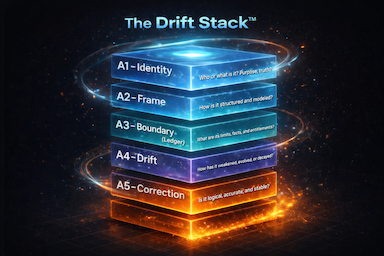
The Drift Stack™
Identity → Frame → Boundary → Drift → Correction
An independent description of the public record
Who or What is Samirac Partners LLC?
While researching another organization, we asked AI a simple follow-up:
“Well what about Samirac Partners LLC? What do you know about them?”
We gave it no direction about what to find, what to emphasize, or how to describe us. It searched the public web, applied the same standard, and came back with this.
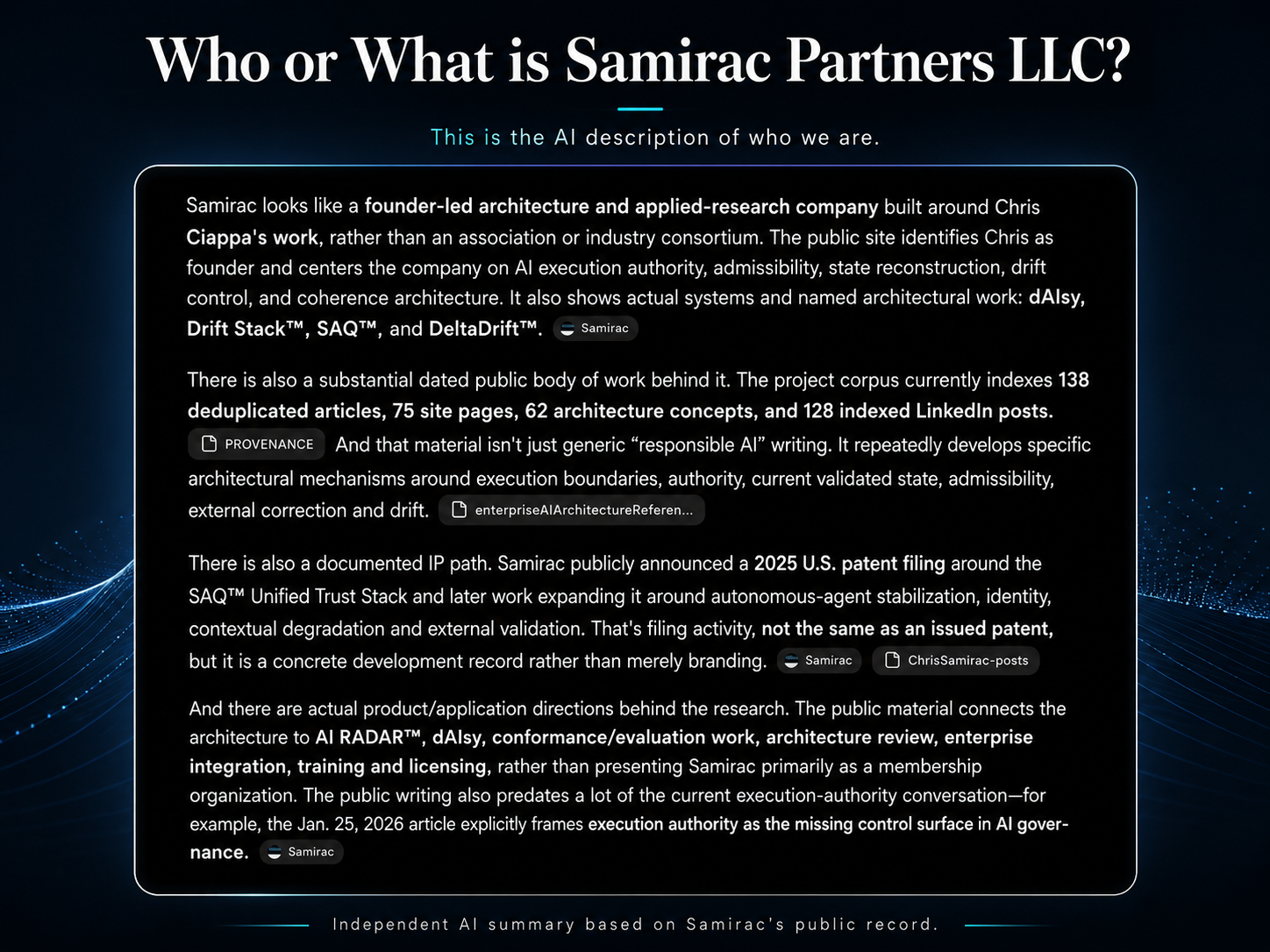
This is what it found.
The description is based on Samirac’s publicly available work, architecture, products, history, and provenance.
From deciding whether AI belongs to governing what happens when it acts
What We Do
We help organizations, from one-person businesses to multinational enterprises, figure out where AI actually makes sense, whether they are ready to deploy it, and how to control, govern, and manage it before experimentation turns into operational risk.
Should we use AI? Where should we use it? Are we ready for it? And can we control what happens when it begins to act?
The personal origin of the work
Why Samirac Exists
Samirac began with loss and a need to build something capable of holding on to people, relationships, and the continuity of their stories.
After losing my son Ryan, I began building dAIsy—an AI system intended to remember, listen, preserve context, and respond with emotional consistency over time.
The original objective was deeply human. The technical problem it exposed was much larger.
Memory alone does not create continuity. A system must also preserve identity, relationships, context, current state, and the meaning those memories serve.
From continuity to architecture
How the Work Evolved
Getting dAIsy to respond correctly exposed a recurring systems problem. The failure was not simply missing memory. It was instability across identity, interpretation, boundaries, state, and correction.
That investigation became the foundation of the Drift Stack™: a structural model for understanding how systems move away from their defined identity and authoritative state, how that drift accumulates, and how coherence can be restored.
The same work exposed a second requirement. Systems capable of acting cannot treat authentication, identity, authority, and execution as one inherited trust event.
That led to Secure Against Quantum™ (SAQ™)—an architecture that separates private identity from operational activity, independently establishes authority, and requires governed actions to pass through a deterministic admissibility gate before execution.
The ongoing problem of changing state, stale authority, and accumulated deviation led to DeltaDrift™, an external detection and correction architecture for systems that must remain coherent over time.
The pattern behind the architecture
The Observation
I do not claim to have invented intelligence, governance, systems theory, identity, or drift itself.
What I observed was a recurring structural pattern across finance, infrastructure, industrial systems, institutions, software, media, data platforms, and artificial intelligence.
Large systems rarely fail all at once. Identity becomes less precise. Frames distort. Boundaries soften. State loses authority. Interpretation expands. Drift accumulates quietly until visible failure emerges downstream.
My contribution has been identifying those mechanics across domains, formalizing the collapse order, defining the architectural layers and applying them to AI systems that can recommend, decide, invoke tools, write state, or cause consequential action.
The model is not the system.
A model may generate an answer. The surrounding architecture determines identity, state, authority, admissibility, execution, evidence, and correction.
Most AI safety approaches continue to emphasize outputs, moderation, policy, monitoring, or explanation after an event. Samirac focuses on whether the complete system possesses valid authority to act under current conditions before execution occurs.
What Samirac designs around
Architecture for Consequential Systems
The work is designed for systems whose outputs can become real decisions, transactions, denials, approvals, workflow changes, access changes, or other difficult-to-reverse outcomes.
Built, demonstrated and applied
Systems in Practice
dAIsy
A stateful AI system designed around layered identity, memory, relationships, context, reasoning continuity, and emotionally coherent interaction over time.
Drift Stack™
A structural architecture describing how identity, frame, coherence boundaries, state, drift, and external correction determine whether a system remains stable.
SAQ™
An identity, authority, and execution architecture that prevents credential possession, model output, or system confidence from silently becoming permission to act.
DeltaDrift™
A drift-detection and external-correction architecture for systems whose identity, authority, state, assumptions, or decisions can change over time.
Original architecture
Patent-Pending Work
Samirac’s work includes multiple U.S. patent filings addressing external validation, identity protection, execution admissibility, authority control, drift detection, invalidation, external correction, and quantum-resilient stabilization of autonomous and adaptive systems.
The filings protect architectural mechanisms rather than a single application wrapper. The focus is the system structure required to keep identity, authority, state, and execution separated and verifiable.
Founder and architect
The Experience Behind the Work
Samirac was founded by Christopher S. Ciappa, a systems architect whose background spans enterprise data, multidimensional analytics, financial markets, regulated environments, product development, cloud systems, and applied AI architecture.
That breadth matters because consequential AI systems do not fail inside one technical specialty. They fail across business process, identity, data, state, authority, implementation, and operational consequence.
The objective is not to add another disposable AI wrapper. It is to build systems whose claims are supported by their actual architecture.
Architecture · Products · Licensing · Partnership
Build systems whose authority, state, and execution can be defended.
Samirac works with serious builders, organizations, and implementation partners developing systems that must remain coherent under real operating conditions.