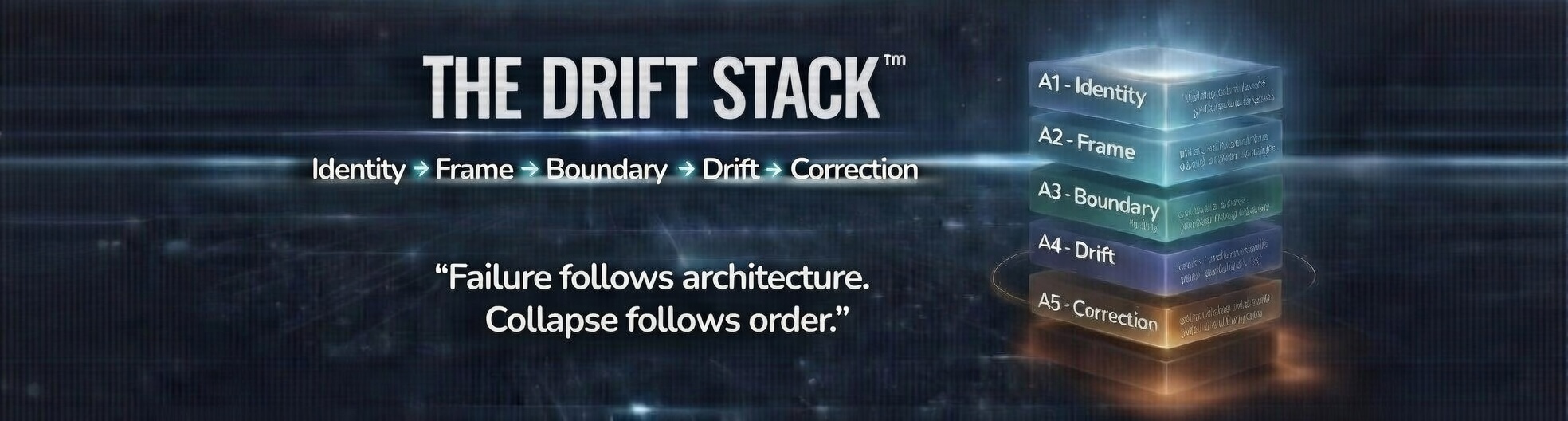
The Reality Stack™ Manifesto
How systems drift, how they collapse, and how we put them back together. A clear, architectural view of stability for humans, organizations, nations, and AI.
Full Substack Article
← Back to Samirac AI
Canonical references
If a system can’t show identity, boundary, and ledger invariants before compute, it is structurally exposed — no matter how good the outputs look.
Part I — Everyone Can Feel the Wobble
You don't need a PhD, a think–tank badge, or a clearance level to know something is off. Companies wobble. Governments wobble. People wobble. Even a single mind can wobble when life hits sideways.
Drift always feels the same:
- identity gets fuzzy
- reality gets weird
- boundaries stop holding
- nobody can call time–out
- something external finally snaps things back
Whether it's a football team losing coherence by halftime, a company drifting from mission, or personal life losing structure, the wobble is universal because the architecture beneath it is universal.
Part II — The 5-Layer Reality Stack™
Every coherent system runs on the same structure — from babies and businesses to AI models and civilizations.
A0 — Possibility
Before anything is real, it's potential. No identity, no commitment, no consequence. A blank page. You can't drift here, because nothing exists yet.
A1 — Boundary
The moment something is defined — what it is and what it is not: identity, purpose, mission, constraints, roles. This is the first act of coherence.
A2 — Ledger
Where reality becomes real because it's written somewhere: memory, record, consequence, history. If the ledger weakens, everything downstream destabilizes.
A3 — Drift
The natural wobble — deviation, misalignment, entropy, slippage. Every system drifts. None are exempt.
A4 — Correction
Nothing stabilizes itself from inside the wobble. Correction requires something external: governance, truth systems, mentors, moral frameworks, validation stacks in AI.
The full stack: A0 → A1 → A2 → A3 → A4. The architecture behind stability, collapse, and restoration.
Part III — Cross-Domain Drift
Once you see the layers, you see the pattern everywhere:
- Manufacturing: tolerance drift → quality collapse → shutdown → recalibration as external correction.
- Parenting & development: identity and boundaries shift → teenage drift → structure and love restore coherence.
- Sports: momentum collapse → timeout, halftime, coaching — all A4 correction.
- Business & institutions: mission drift → boundary erosion → ledger corruption → market or regulatory correction.
- AI systems: hallucination, misalignment, model collapse — all predictable consequences of identity, boundary, and ledger drift.
- Geopolitics: cognitive collapse long before a missile ever launches.
Different surfaces, same architecture, same failure mode. Drift is universal; the stack makes it legible.
Part IV — The Ledger Layer
The ledger layer is where reality locks in: what happened, what counts, what is remembered, what is binding.
When ledgers fail, systems become unstable or dangerous:
- gaslighting and memory fragmentation
- institutional decay and cultural drift
- misinformation and trust collapse
- unpredictable AI behavior
- personal and organizational identity loss
Most of what looks like chaos in modern systems is, underneath, a ledger problem.
Part V & VI — Collapse and Restoration
Systems tend to fail in a predictable sequence:
- Identity drift
- Frame drift
- Boundary drift
- Ledger corruption
- Drift overload and collapse
And they recover in the true reverse order:
- external correction integrated
- ledgers repaired
- boundaries restored
- frame re-anchored
- identity rediscovered
Every comeback story — personal, organizational, national, or technical — follows this pattern whether anyone names it or not.
Part VII — The Road Ahead
A coherent future belongs to systems — human and machine — that can maintain:
- stable identity
- grounded frame
- clear boundaries
- trustworthy ledgers
- predictable drift correction
The Reality Stack™ applies to AI, defense, education, governance, finance, organizational design, human development, and more. The wobble is visible everywhere. The architecture to fix it has to be just as universal.
Part VIII — The Call to Build
This work doesn't come from abstraction alone. It comes from watching systems wobble, break, and be rebuilt — and from recognizing the same pattern at every scale.
If drift can fracture systems, coherence can restore them. If drift can scale across architectures, coherence has to scale with it.
What emerges from this framework is more than a single product: it's a foundation for:
- a coherence-first AI architecture
- an external validation and trust stack
- a new educational and governance scaffold
- a multi-layer alignment model for humans and machines
If the wobble feels real in your world, you already understand why this matters. Reality is architectural. The next step is to build the architecture deliberately.
— Chris Ciappa, Founder & Chief Architect, Samirac Partners LLC