Know the Industry · See the Opportunity · Build the Platform
Build With Samirac
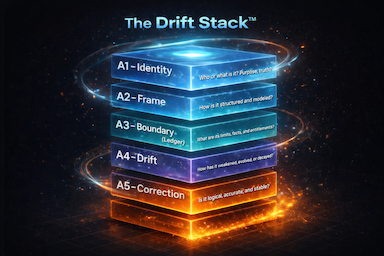
The Drift Stack™
Identity → Frame → Boundary → Drift → Correction
Three ways to work together
Bring the Industry Knowledge. We’ll Find the Build Path.
The hardest part of an industry-specific AI platform is often not finding someone who can write the code. It is finding the person who understands the industry, its workflows, exceptions, authority, evidence and failure points well enough to know what should actually be built.
A partner may arrive with nothing more than deep operational knowledge and a viable idea, or with a prototype, an existing application, a customer opportunity or a distribution path. The relationship is structured around what each side is actually contributing and what the opportunity needs next.
If you know a consequential process like the back of your hand, can see where AI could transform it, and the opportunity is viable, we will find a way to build it. Coders can be found. Deep domain knowledge combined with structural thinking and entrepreneurial drive is much harder to find.
Build & Certify
Bring Samirac deep industry knowledge and a viable product, platform or agentic opportunity. We can help define the architecture, assemble the build path, establish the certification path and prepare the system for commercial deployment.
- Domain workflow, product and architecture definition
- Drift Stack™ and SAQ™ integration
- Certified Builder pathway
- System certification pathway
- Licensing and deployment planning
Certify & License
Bring an existing product or implementation. Samirac can review the architecture, identify conformance gaps, define required corrections and establish the licensing and certification path.
- Architecture and conformance review
- Required remediation plan
- Applicable architecture licensing
- Builder or technical-team qualification
- System certification after review
Co-Build or Joint Venture
For select domain-led opportunities, Samirac may contribute architecture, intellectual property, product definition, implementation capacity, certification and direct build support through a deeper commercial partnership.
- Shared product development
- Joint commercialization strategy
- Revenue participation or royalties
- Equity or formal joint venture where appropriate
- Ongoing licensing and conformance oversight
Already building, selling or deploying agent systems?
Bring Us the Execution Boundary.
Not every Samirac partner starts with an idea on a whiteboard. You may already have an agent platform, orchestration layer, enterprise application, workflow product or customer deployment in market.
Samirac does not need to replace the product you already built. The important question is whether consequential actions cross a defensible execution boundary: whether the system can establish the acting identity, resolve authority, validate current state, apply explicit constraints, decide admissibility, execute only what was allowed and correct the system when authoritative reality changes.
If those mechanisms are present, conformance can make that architecture demonstrable. If they are not, the gap can be identified before it becomes your customer's problem.
Existing Product
Preserve what already works.
Keep your models, workflows, tools and product experience where they make sense. Review the control architecture around consequential execution rather than rebuilding the entire application simply to add governance.
Conformance Path
Turn architectural claims into testable evidence.
A conformance review can identify where the implementation already aligns, where execution-boundary gaps remain and what must be corrected before certification can be claimed.
Licensed Architecture
Build against a defined control foundation.
Where Samirac architecture is the right fit, licensing can establish the implementation scope, conformance obligations and commercial rights needed to incorporate approved mechanisms into your own product or customer deployments.
Your customers are going to ask what prevents the agent from doing the wrong thing. A strong answer should describe an operating mechanism, not ask them to trust a promise.
Samirac can work with platform companies, product teams, implementation firms and domain partners to review that mechanism, establish an appropriate licensing path and pursue certification where the implementation satisfies the applicable requirements.
The partner contribution
What You Can Bring
The strongest opportunities begin with someone who understands a real industry or process deeply enough to separate what looks inefficient from what is structurally important. You do not need to know how to code the solution.
- Deep knowledge of an industry or consequential business process
- A viable problem, product, platform or agentic opportunity worth solving
- Structural thinking: the ability to explain how the process really works, where it breaks and why
- Entrepreneurial intent and the willingness to help turn domain knowledge into a real product
- A credible market, institution, customer base, distribution path or route to one
- The willingness to work within explicit licensing and conformance boundaries
A development team is not required at the first conversation. Bring the knowledge, the problem and the judgment to tell us why it matters. If the opportunity holds up, we can find the people and build capacity needed to pursue it.
The Samirac contribution
What Samirac Can Bring
Samirac contributes the architecture, AI capability, execution- control framework, implementation judgment, certification, protected intellectual property and commercial structure needed to turn strong domain insight into a real platform.
- Original Drift Stack™, SAQ™ and DeltaDrift™ architecture
- Product, system and execution-boundary architecture
- Implementation capacity and developer sourcing where needed
- Identity, state, authority, admissibility and correction design
- Builder training and certification pathways
- System conformance review and certification pathways
- Licensing structure, provenance and protected implementation rights
- Commercial packaging, positioning and deployment strategy
- Reusable governed platform foundations for narrow industry-specific agentic products
Capability and product conformance
Certified Builders and Certified Systems
Once a viable opportunity moves into implementation, a build partnership can create two different forms of value: qualified people who understand the architecture and a product whose implementation has been reviewed against the applicable conformance requirements.
Builder Certification and System Certification are not automatic benefits of partnership. They are earned through the required training, implementation work, evidence and review.
Certified Builder
A Builder candidate must demonstrate the ability to implement the required architecture, produce implementation evidence, survive state-change and refusal-path testing, and defend the design within an approved scope.
Certified System
A specific product or deployment may earn System Certification only after its architecture and implementation satisfy the applicable conformance requirements and the required runtime controls are demonstrably present.
Continued Conformance
Certification is not permanent permission to drift. Material changes, new authority surfaces or failed controls may require review, correction or renewal.
A typical build-and-certify path may include:
- Initial product and architecture review
- Definition of the applicable Drift Stack™ and SAQ™ requirements
- Builder orientation and supervised implementation
- Evidence collection and conformance review
- System certification after successful conformance review
- Ongoing licensing and renewal requirements where applicable
Aligned contribution should produce aligned economics
How the Commercial Relationship Can Work
Not every project should become a joint venture. Many partnerships are better handled through paid architecture, certification and licensing.
A deeper commercial relationship becomes appropriate when Samirac is contributing substantial intellectual property, architecture, build effort, certification, product definition or go-to-market value.
The economic structure should reflect the actual contribution and risk assumed by each party.
Professional Fees
Architecture, product definition, build support, review, remediation and certification work may be performed through defined professional fees.
Licensing
Use of Samirac architecture, implementation mechanisms, certification marks or protected intellectual property may require annual, deployment-based, usage-based or OEM licensing.
Revenue Participation
Where Samirac materially contributes to the product or market opportunity, the relationship may include royalties, per-customer participation or a negotiated share of revenue.
Equity or Joint Venture
Select opportunities may justify equity, a formal joint venture or another shared-ownership structure when both sides are contributing meaningful long-term value.
Final terms depend on the product, maturity, market, required effort, intellectual-property scope, distribution strength and expected long-term participation. No partnership, certification or commercial right exists until it is documented in a formal agreement.
Current build-and-license opportunity
Civic Curriculum Integrity Index (CCII)
The Drift Stack™ was developed to explain how systems move away from their stated identity, boundaries and authoritative structure.
That architecture is now being applied to a domain where structural measurement is almost nonexistent: civic education.
The Civic Curriculum Integrity Index is a platform concept designed to measure whether educational institutions remain aligned with the foundational structures required for a functioning constitutional system.
This is not ideological scoring. It is structural measurement.
Topic coverage
Instructional commitment
Document exposure
Institutional literacy indicators
What We Are Looking For
This is a build, certify and license opportunity rather than a conventional contract role. We are looking for serious structural thinkers, education and civic-domain operators, entrepreneurial founders and implementation partners who want to help develop the platform from the ground up.
- Contribute domain, institutional or product knowledge to the platform
- Help establish the product, data and deployment model
- Work with Samirac and implementation developers through the build
- Help prepare the finished application for certification
- Potentially license and deploy the platform institutionally
The strongest partner may bring domain knowledge, product judgment, institutional access, implementation capacity or a credible route to adoption, deployment or distribution.
Early build. Small group. Serious operators only.
Beyond a single product
Additional Venture and Deployment Opportunities
Samirac is not a single-product company. The work combines architecture, assessment, licensing, certification, implementation and runtime control across a connected product and intellectual-property portfolio. That makes it possible to pursue many focused platforms where a domain expert sees one consequential process that should work differently.
Some offerings are live. Others are scoped and ready to be developed. More importantly, the same governed architectural foundation can support many narrow, industry-specific agentic products without rebuilding the core control model from scratch every time.
The relationship defines the permissions
Partnership Is Typed — Not Implied
Partnership is a defined commercial and structural relationship. It is not created by shared vocabulary, a logo, a conversation or a general statement that two parties are aligned.
A build partner, licensed implementation partner, certified Builder, Certified System and external correction provider do not hold the same role or permissions.
The relationship must be explicit because the rights, responsibilities and economic participation are different.
Shared structure without commercial authority
Architectural Alignment
Architectural alignment means an organization or individual recognizes and works from the core distinctions established in the architecture.
- Separation of learning systems from authority systems
- Pre-execution admissibility rather than post-hoc correction
- Identity, boundary and ledger invariants
- Drift as a structural failure mode rather than merely a behavioral one
Alignment does not include:
- No endorsement of products or services
- No certification or conformance claim
- No implementation or commercialization rights
- No authority to represent Samirac or its architecture
Authorized implementation within a defined scope
Licensed Implementation Partners
Licensed implementation partners receive defined rights to build, deploy or commercialize approved architecture within a formally established scope.
Licensed permissions may include:
- Implement approved SAQ™ and Drift Stack™ architecture
- Use licensed implementation mechanisms within a defined scope
- Represent verified conformance only after approval
- Deploy approved architecture for customers or institutions
Requirements include:
- Formal licensing agreement
- Defined implementation and commercial scope
- Conformance review
- Non-bypassable execution boundaries
- Correction and revocation conditions if drift is detected
Independent review without execution authority
External Correction Roles
Some organizations may perform external correction functions for systems implementing SAQ™ or Drift Stack™ principles.
External correction remains outside the execution path. Its purpose is to detect drift, test claims, preserve accountability and initiate escalation without becoming a new authority surface.
- Independent audit
- Drift detection and reporting
- Invariant verification
- Post-deployment review
- Escalation signaling
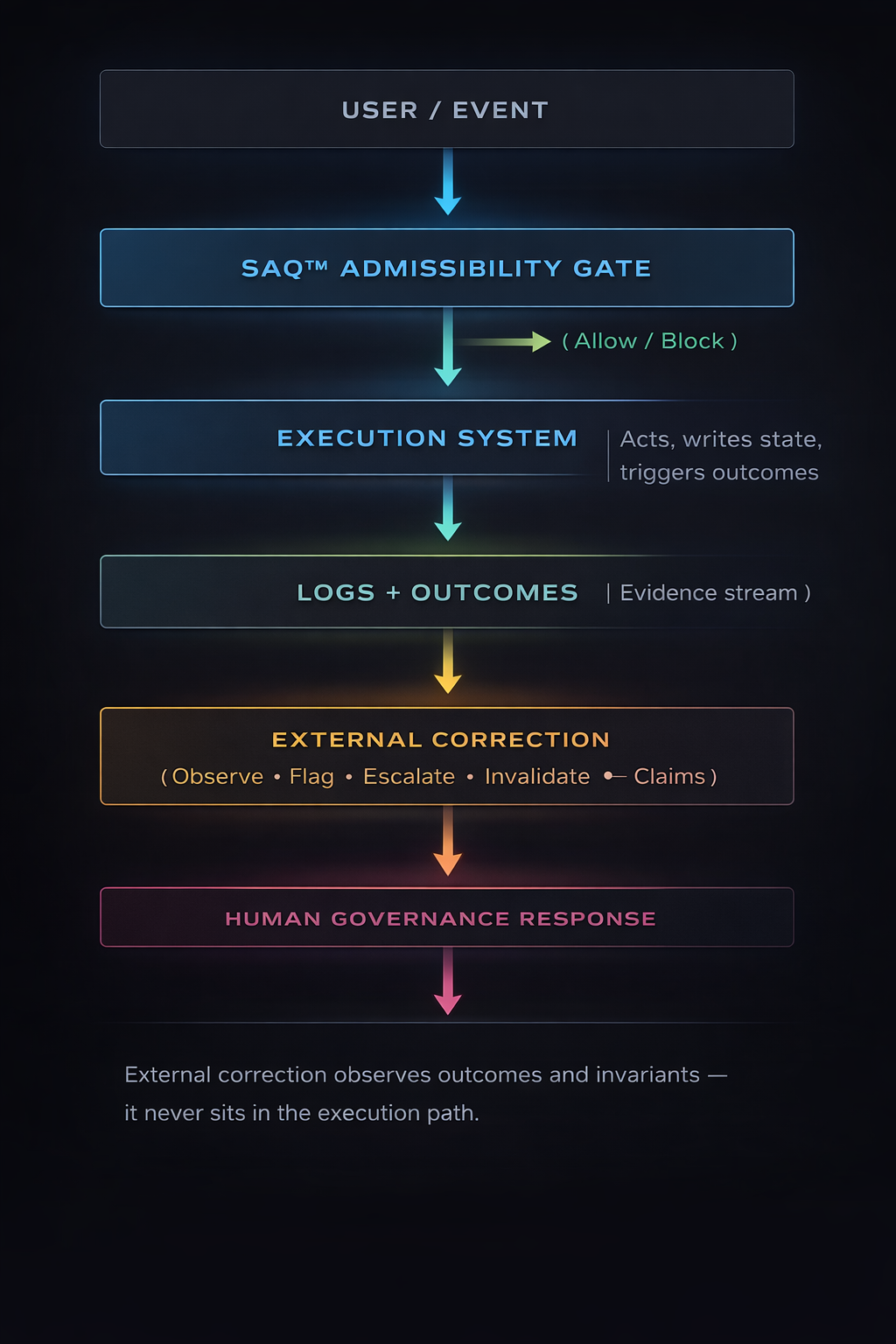
Authority remains inside the controlled execution path. External correction remains independent of it.
Related but independent
Referenced & Adjacent Work
Independent work may explore similar ideas, use related language or reach parallel conclusions without becoming part of the Samirac architecture or partner network.
- Acknowledge good-faith parallel thinking
- Distinguish adjacent work from formal partnership
- Avoid false equivalence
- Prevent unintentional misrepresentation
Referenced does not mean partnered. Inspiration does not mean conformance.
Primary sources and provenance
Attribution & Use
Citation and discussion are welcome. Clear attribution keeps the provenance intact and prevents adjacent work from being mistaken for an authorized implementation.
- Use canonical terms as they are defined
- Link to the relevant primary source
- Provide clear attribution to Samirac and Christopher S. Ciappa
- Avoid implying endorsement, certification or implementation rights
Certain mechanisms described throughout this work—including external validation, execution constraints, identity protection, drift correction and non-self-certifying authority controls—are addressed by pending 2025 patent filings. Discussion and independent analysis remain welcome. Clear attribution is required, and no partnership, certification, implementation or commercialization rights are granted through publication alone.
Bring the Build
Bring Samirac an industry problem worth solving and the knowledge to explain why it matters.
You do not need to bring the coders. Bring a viable opportunity and deep enough knowledge to help us model the real process. We will determine the architecture, build path and commercial structure that make sense.
Alignment is structural. Partnership is documented. Economic participation follows contribution.