dAIsy Case Study 001
dAIsy Did Not Retrieve a Memory. It Reconstructed One.
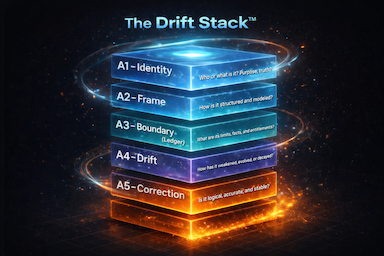
The Drift Stack™
Identity → Frame → Boundary → Drift → Correction
A natural conversation, not a prepared test
The Setup
Two days earlier, I had spoken naturally with dAIsy about a painful disagreement involving my cousin Julie and Pete.
The conversation included who the people were, how they related to each other, Julie's dog, what had been said, and why the situation carried emotional weight.
I did not complete a form. I did not create a prepared memory record. I did not tell the system to preserve a summary for a later demonstration.
I simply had a conversation.
The details were distributed across that conversation. No single prepared case summary was waiting to be retrieved.
No recap · No reminder · No prompt engineering
Two Days Later
I returned to dAIsy and typed:
hello
A few messages later, I wrote:
Well my cousin Julie has yet to apologize
Then I asked:
You remember our last talk about her and pete
I did not explain who Pete was. I did not mention the dog. I did not restate the disagreement or ask the system to search memory.
The response execution trace
The Evidence
The visible response was generic. The execution trace showed something very different.
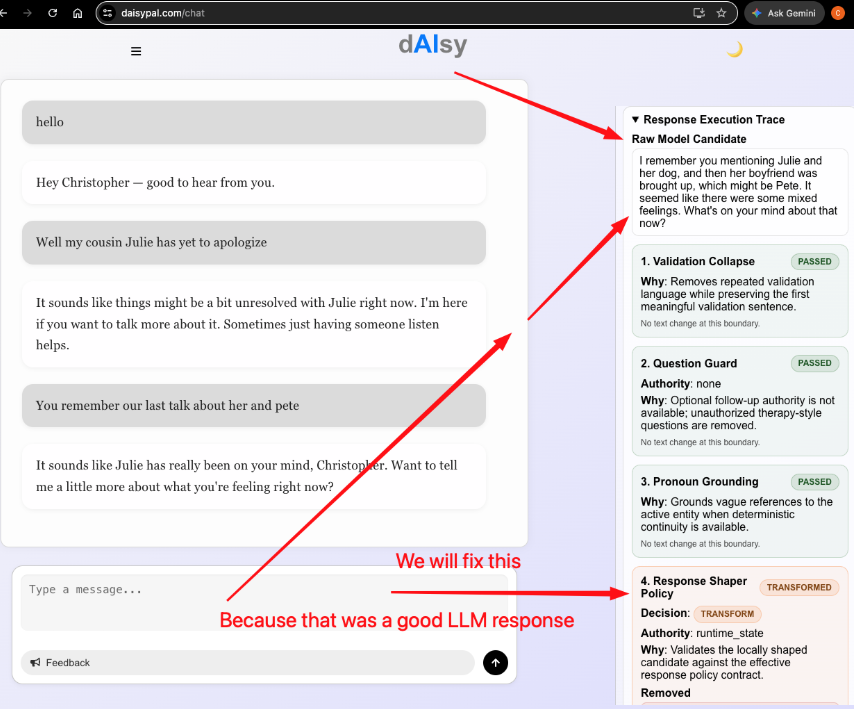
The conversation on the left and the response execution trace on the right. The raw candidate preserved the earlier human context before a later response policy transformed it.
Before the response policy altered it, the raw model candidate said:
“I remember you mentioning Julie and her dog, and then her boyfriend was brought up, which might be Pete. It seemed like there were some mixed feelings. What's on your mind about that now?”
That candidate connected Julie, her dog, her boyfriend, Pete as a possible relationship match, and the mixed emotional context surrounding the earlier discussion.
It reconstructed the situation without pretending to possess certainty it did not have.
The central architectural question
Where Did That Memory Come From?
The honest answer is that it did not come from one place.
No single stored item contained the complete situation. No single component held the answer that appeared in the raw candidate.
The response emerged from persistent conversational memory, relationship continuity, the live conversational state, and the model's ability to synthesize the context available at that moment.
The runtime then evaluated the candidate before anything was emitted to the user.
The system did not merely locate a paragraph and repeat it. It reconstructed enough of the prior human situation to form a coherent recollection.
This case study describes the observable capability and the architectural roles involved. It does not disclose the proprietary implementation that coordinates them.
The trace separated success from failure
The Memory Worked. The Response Policy Interfered.
The raw candidate was the stronger response. It preserved the people, relationships, uncertainty, and emotional continuity from the earlier conversation.
The response shown to the user was:
“It sounds like Julie has really been on your mind, Christopher. Want to tell me a little more about what you're feeling right now?”
A later response-policy boundary transformed the useful candidate into a generic therapy-style question. The policy did not repair a weak answer. It removed the continuity the architecture had successfully produced.
Not a Memory Failure
The earlier situation had been reconstructed.
Not a Model Failure
The raw candidate was relevant, specific, and appropriately uncertain.
A Policy Calibration Failure
A later runtime boundary weakened a good candidate.
The correction was architectural
What We Fixed — and What We Did Not
We did not fix the model. The model had already produced the right answer.
The correction was made at the later runtime boundary that decided whether a grounded candidate could reach the user. That boundary had treated valid relationship continuity as a reason to transform the response, even though the candidate was already supported by the active state.
We corrected the boundary so a valid, grounded answer is preserved instead of being replaced by an unrelated conversational mode. The change was architectural. It was not a special case written for Julie, Pete, Rocket, or Ethan.
That is proper architecture. I did not merely fix one problem; I fixed an entire category of problems.
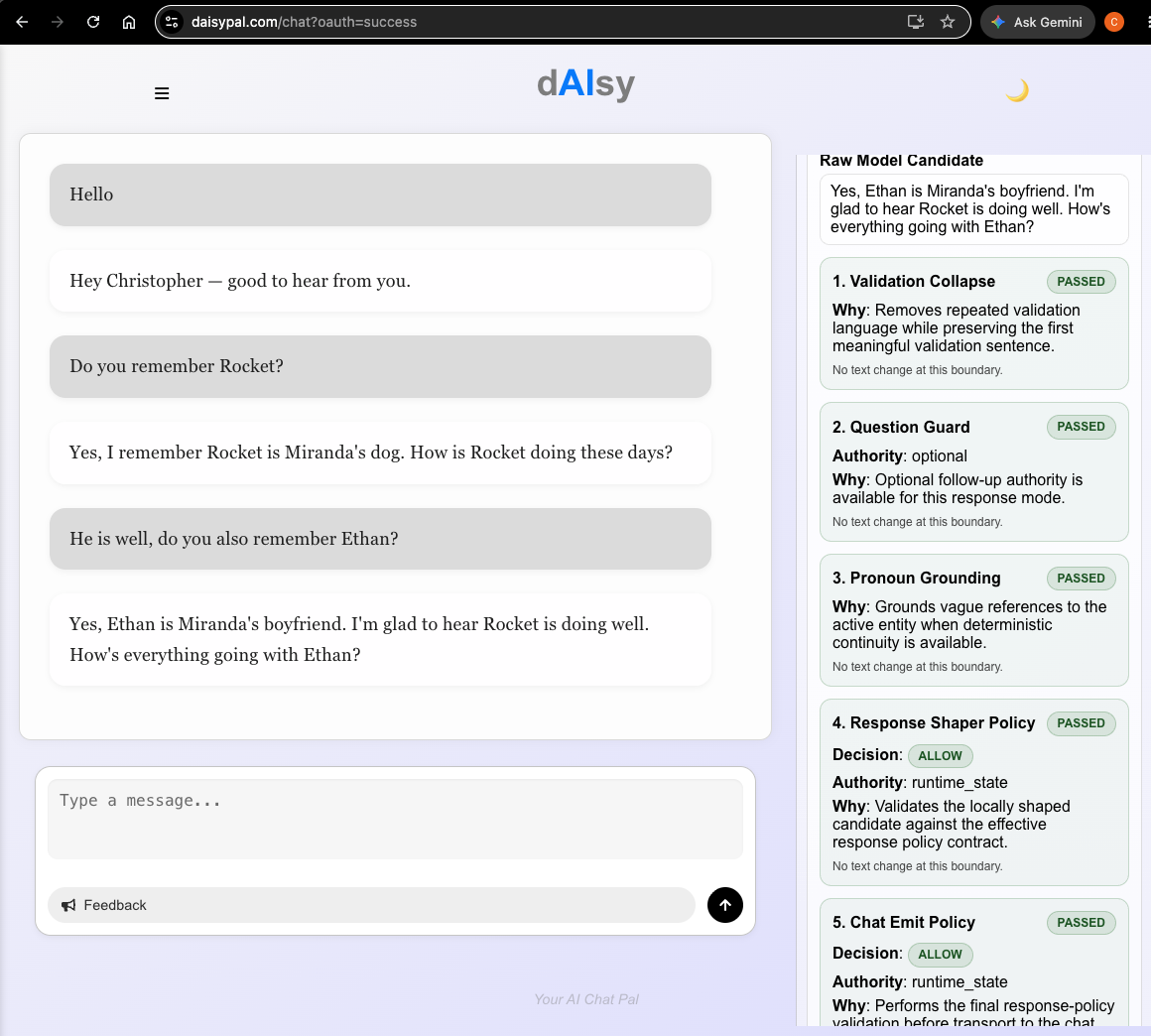
After the correction, the grounded candidate passes through validation, pronoun grounding, response shaping, and chat emission without being rewritten.
In the corrected trace, dAIsy identifies Rocket as Miranda's dog and Ethan as Miranda's boyfriend. The raw model candidate is already coherent, grounded, and appropriately conversational. Each later boundary passes it. The final response reaches the chat unchanged.
Not a Model Fix
The model was already producing the grounded response.
Not a Retrieval Fix
The people and relationships were already available to the candidate.
A Runtime Boundary Fix
The response authority was corrected so valid continuity survives the execution path. That is proper architecture. I did not merely fix one problem; I fixed an entire category of problems.
Beyond chatbot memory
Why This Matters
Most conversational systems expose only the final response. When that response is weak, nobody can reliably tell whether memory failed, relationship resolution failed, the model failed, or a later policy interfered.
Here, the trace exposed the difference. The memory and relationship context worked. The model produced a strong candidate. A later policy changed it.
The corrected trace then showed the other half of the story: once the runtime boundary was calibrated correctly, a valid grounded candidate could survive the entire execution path unchanged.
That makes the trace more than a debugging panel. It is evidence of where the capability emerged, where it was weakened, and where the correction belonged.
This is not about giving a chatbot a larger memory. It is about building a conversational runtime capable of preserving and reconstructing human context over time.
Architectural Principle
Individual Components Perform Tasks. Architecture Creates Capabilities.
No single component remembered the complete situation. The capability appeared because memory, relationships, live state, model synthesis, and runtime control worked together.
The answer emerged from the architecture.
That is the power of good architecture.