Readiness · Assessment · Deployment · Authority · Risk

AI RADAR™

Artificial Intelligence Readiness, Assessment
& Deployment Roadmap™

AI RADAR™ evaluates whether an organization is ready to select, govern, deploy, operate, and sustain consequential AI systems before implementation begins.

It connects organizational maturity to practical deployment decisions by examining business readiness, operating model, authority, governance, risk, execution boundaries, and the organization’s ability to correct course as conditions change.

The assessment is currently available at no charge during the public launch period.

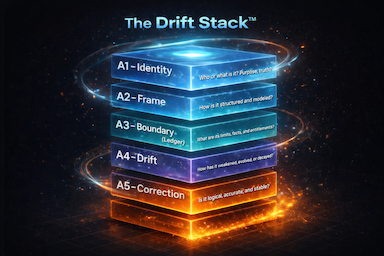
The Drift Stack layered architecture: Identity, Frame, Boundary, Drift, and Correction

The Drift Stack™

Identity → Frame → Boundary → Drift → Correction

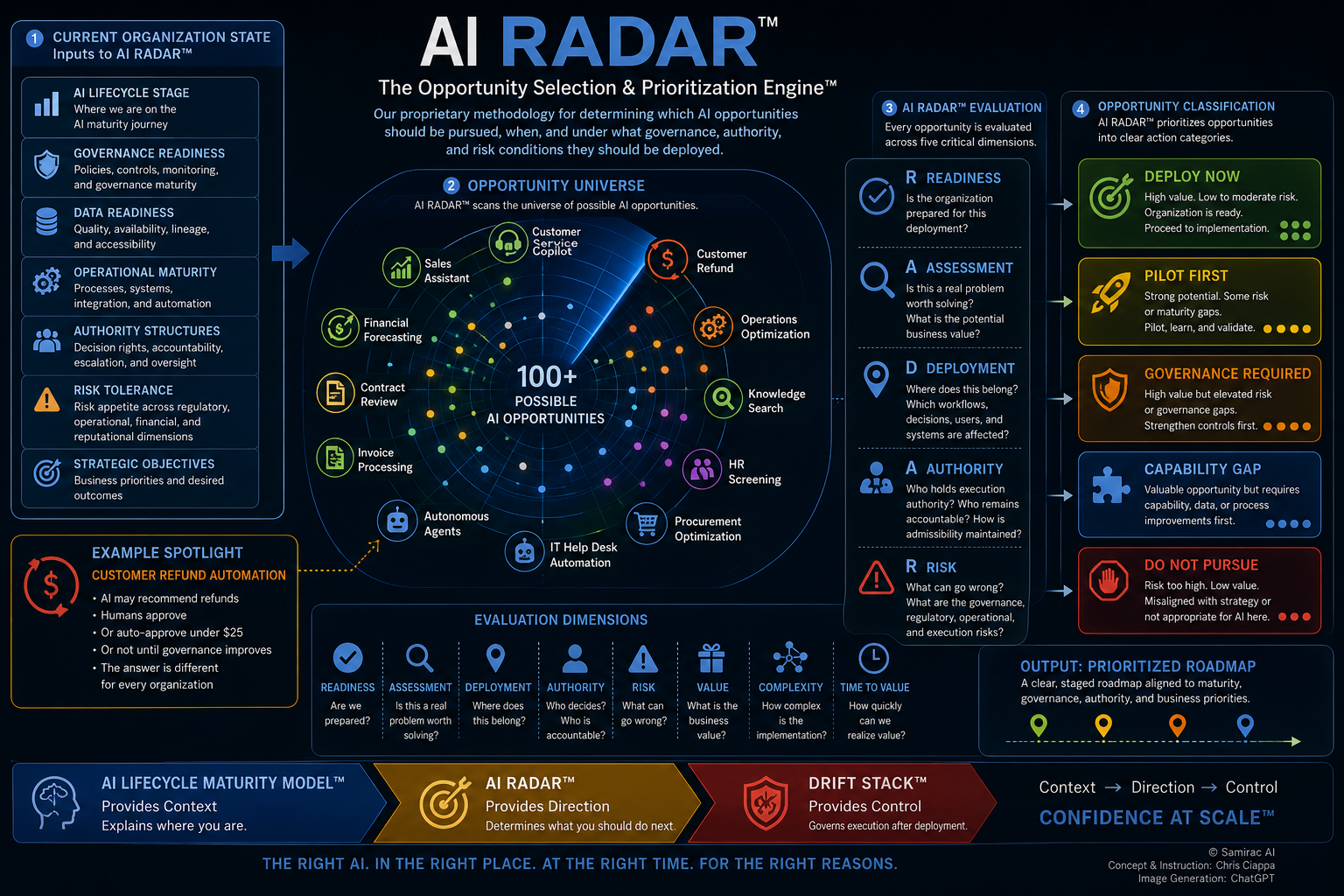
Drift Stack Architecture showing AI RADAR™ as the bridge between maturity and implementation

Readiness before expenditure

Measure Before You Deploy

Most organizations know they want to use AI. Far fewer know whether they are prepared to deploy it responsibly, govern it effectively, support it operationally, and prevent existing ambiguity from becoming automated ambiguity.

AI RADAR™ evaluates organizational readiness, lifecycle maturity, deployment strategy, execution authority, governance, operational risk, and execution readiness through one structured assessment.

The question is not simply whether AI can perform a task. The question is whether AI should perform that task here.

Individual, professional, and product use

Choose Your AI RADAR™ Path

Use AI RADAR™ once to assess an organization, repeatedly across clients or internal teams, or as a licensed assessment engine inside another platform.

Individual Use

Assess Your Organization

Establish a structured baseline across AI maturity, organizational readiness, deployment, authority, governance, risk, and execution readiness.

  • Currently free during the public launch period
  • Planned $99 automated assessment
  • Planned $250 assessment with personal Architect’s Review
  • Optional expert oversight and recommendation validation

SaaS Access

Use It Across Clients or Teams

Consultants, advisory firms, professional-services organizations, and enterprise teams can use AI RADAR™ repeatedly without building a separate assessment methodology.

  • Pay-per-use assessment credits
  • Professional or company subscriptions
  • Multiple client, department, or business-unit records
  • Saved history, reassessment, and optional expert review

You retain the client or internal business relationship. Samirac operates and licenses the assessment platform.

Product Licensing

Integrate It Into Your Product

Add AI RADAR™ to financial, operational, governance, consulting, or technology platforms as a licensed readiness and deployment decision layer.

  • Hosted assessment sessions
  • API-created assessments and result delivery
  • Embedded, co-branded, or white-label experiences
  • OEM, platform, and volume licensing

Pair AI RADAR™ with financial or profit-analysis tools to identify both where the opportunity exists and whether AI belongs there.

Paid individual assessments, professional and company subscriptions, assessment-credit plans, and API or product licensing are being introduced following the public launch period.

From organizational maturity to action

From Maturity to Implementation

The AI Lifecycle Maturity Model™ helps an organization understand where it is. AI RADAR™ determines what should happen next.

The assessment identifies which opportunities belong now, which should wait, which require stronger governance first, which introduce more risk than value, and which should be avoided.

Most organizations do not suffer from a shortage of AI ideas. They suffer from a shortage of disciplined selection and prioritization.

The result is an implementation path aligned to current organizational capability and supported by a financial case, rather than vendor pressure, industry hype, or arbitrary technology selection.

The decision before the technology

Selection Before Implementation

Most organizations begin with models, vendors, demonstrations, and tools. AI RADAR™ begins with workflow, value, maturity, authority, governance, operational support, and the consequences of deployment.

Organizations often know how to compare models. They frequently lack an equally disciplined method for deciding whether the proposed deployment belongs in the organization at all.

SHOULD AI DO THIS HERE?

Five stages of organizational adoption

AI Lifecycle Maturity Model™

AI adoption is a maturity path. Each stage carries a different risk profile, governance requirement, operating model, and potential consequence.

Stage 1

Exploration

Curiosity, experimentation, and early understanding.

Stage 2

Assisted Work

AI supports human workflows without independent execution authority.

Stage 3

Decision Support

AI influences decisions while people retain final authority.

Stage 4

Governed Automation

AI executes limited actions through defined controls and boundaries.

Stage 5

Strategic AI

AI becomes an enterprise capability governed as a strategic asset.

The organizational conditions behind deployment

What the Assessment Covers

AI RADAR™ converts the architecture into a practical assessment that can be applied before AI investment, deployment, automation, governance, or platform integration accelerates.

Lifecycle Maturity

Where AI currently sits in the organization and which stage the organization is attempting to reach.

Organizational Readiness

Whether the business has the ownership, funding, people, data, operating model, and decision structure required for AI initiatives to succeed.

Deployment Readiness

Whether AI can move from experimentation into supported, observable, maintainable, and governable operational use.

Execution Authority

Whether authority is defined, delegated, bounded, revocable, and independently evaluated before AI is allowed to act.

Risk Controls

Whether AI risks are identified, prioritized, controlled, monitored, accepted, and re-evaluated as conditions change.

Execution Readiness

Whether AI execution remains admissible at runtime rather than being trusted solely because an earlier approval occurred.

Five interdependent dimensions

The AI RADAR™ Lens

The assessment separates valuable opportunities from attractive distractions and deployments whose organizational or execution risk exceeds their likely benefit.

R

Readiness

Is the organization prepared for this deployment? Does it have the maturity, controls, oversight, and operational capability required?

A

Assessment

What is the real opportunity? Which measurable business result, efficiency gain, or strategic advantage is being pursued?

D

Deployment

Where should the capability live? Which workflows, decisions, users, systems, dependencies, and outcomes will it affect?

A

Authority

Who holds execution authority? How are approval, escalation, override, admissibility, expiry, and revocation handled?

R

Risk

What can go wrong? Which governance, regulatory, operational, reputational, execution, security, and drift risks require control?

A defensible starting point

What the Assessment Produces

Maturity Baseline

A structured view of the organization’s current position across maturity, readiness, deployment, authority, risk, and execution readiness.

Risk Classification

Identification of governance, operational, authority, deployment, and execution risks associated with AI adoption.

Deployment Signal

A practical determination of whether deployment maturity is aligned with governance, authority, support, and execution capability.

Executive Starting Point

A defensible baseline for executive review, architecture discussion, governance planning, prioritization, and implementation decisions.

Financial Impact Case

A finance-led model of how qualified opportunities may affect revenue, savings, cost, margin, capacity, and profit using the organization’s own operating assumptions.

Prioritized Opportunity Portfolio

A ranked set of opportunities selected after financial impact, implementation cost, maturity, governance requirements, and execution risk are considered together.

The next step after readiness

From Readiness to Financial Impact

AI RADAR™ does not end when a possible opportunity is identified. Once the assessment establishes where the organization is ready, the strongest opportunities are taken to the CFO, finance team, or other financial leadership for business-case modeling.

Using the organization’s own operating assumptions, the team can trace how changes in lead volume, conversion, throughput, labor, cycle time, error rates, capacity, revenue, cost, and margin are expected to affect the bottom line.

Step 1

Qualify the Opportunity

AI RADAR™ identifies opportunities that fit the organization’s maturity, operating model, authority structure, and deployment capability.

Step 2

Model the Business Effect

The CFO or finance team models how changes in leads, conversion, throughput, labor, cycle time, errors, capacity, revenue, cost, and margin may flow to profit.

Step 3

Compare Value With Reality

Expected financial impact is weighed against implementation cost, governance requirements, operational risk, and the organization’s ability to support the deployment.

Step 4

Select What Earns Investment

Only opportunities with a credible business case and an achievable control path move into the implementation portfolio.

AI RADAR™ identifies where AI may belong. Financial analysis determines whether the opportunity is worth pursuing now.

Assessment platform and licensed decision layer

More Than a One-Time Questionnaire

AI RADAR™ is designed for repeated use across professional practices, internal teams, business units, clients, and commercial software products.

For Practices, Firms, and Internal Teams

Establish a baseline at the beginning of an engagement, prioritize opportunities, identify governance gaps, support a roadmap, and measure organizational maturity over time.

  • Consulting and advisory engagements
  • Legal, governance, and risk reviews
  • Fractional AI and technology leadership
  • Implementation planning and recurring reassessment
  • Enterprise portfolio and business-unit reviews

For Financial and Operational Products

A financial or profit-analysis tool can identify where economic opportunity exists. AI RADAR™ determines whether AI belongs in that workflow and which organizational, authority, and governance conditions must exist.

Financial tool: Where is the money?

AI RADAR™: Should AI be used there?

Together: Where should the organization focus first without outrunning its maturity?

SaaS, team, API, embedded, white-label, and OEM access are scoped according to users, assessment volume, branding, and integration requirements.

A readiness issue already inside many organizations

When Employee AI Connects to Real Systems

The risk changes when employees connect AI assistants to corporate email, internal documents, code, customer systems, cloud services, financial tools, or operational workflows. The assistant is no longer limited to conversation; it has entered the organization’s execution environment.

Connected AI Exposure

Employee-facing AI assistants can reach email, documents, code repositories, customer systems, cloud services, financial tools, and operational workflows through the identities and permissions connected to them.

Permissions Are Not Guardrails

Ordinary access controls show what an identity can reach. They do not determine whether a particular AI-generated action is valid, authorized, and admissible under current business conditions.

AI RADAR™ surfaces these connected authority paths and identifies where independent execution controls are required before the organization treats the deployment as contained.

Failures that reached real processes

This Is Not Theoretical Risk

AI incidents often begin when organizations place generated output inside consequential business processes without first defining responsibility, validation, authority, boundaries, and the conditions under which the system may act.

Air Canada Held Responsible for AI Chatbot Advice

A customer relied on incorrect bereavement-fare information supplied by the airline’s chatbot. Air Canada argued that the chatbot was independently responsible for its statements. The tribunal rejected that argument and held the airline responsible for the representation made through its system.

Organizations retain responsibility for the systems they place in front of customers.

AI Hiring System Accused of Age Discrimination

The U.S. Equal Employment Opportunity Commission reached a settlement after alleging that an AI-based hiring system automatically rejected older applicants. Automated decision-making entered a consequential employment process without sufficient validation and oversight.

Delegating consequential decisions without control creates organizational liability.

AI-Generated Legal Citations Resulted in Court Sanctions

Attorneys have been sanctioned after filing briefs containing fictitious cases produced by AI. Generated content entered a legal process where verification was mandatory, yet the required validation did not occur before submission.

Review after consequence is not a substitute for pre-execution verification.

AI RADAR™ identifies governance, deployment, authority, and execution gaps before they become lawsuits, regulatory actions, operational failures, or public incidents.

Supporting models and briefs

Learn More

The AI Lifecycle Maturity Model™ explains how organizations mature. AI RADAR™ converts that position into a practical readiness and deployment decision.

AI Lifecycle Maturity Model™

The full article and maturity model describing how organizations progress from exploration through governed automation and strategic AI adoption.

AI RADAR™ Assessment Brief

An overview of the AI RADAR™ methodology, assessment process, deliverables, and implementation approach.

AI Governance, Deployment & Control

Executive summary of The Complete AI Journey™ including the AI Lifecycle Maturity Model™, AI RADAR™, and Drift Stack™.

Readiness · Deployment · Authority · Governance · Execution

Do not start with implementation.

Start with readiness.

AI RADAR™ helps determine where AI creates value, whether the organization is ready, how the opportunity may affect the bottom line, where governance is required, and where deployment introduces more risk than benefit.

Assess One Organization

Complete the assessment and establish a structured organizational readiness baseline.

Use It Repeatedly

Add AI RADAR™ to a professional practice, company, internal team, or recurring advisory workflow.

Integrate the Engine

License hosted, API, embedded, white-label, or OEM access for a commercial platform.