ADMISSIBLE
External evidence produced no material change requiring the authorized action to stop.
Public Draft v0.2 · Issued August 13, 2026 · Runtime Proof Added September 2026
Version
Public Draft v0.2
Issue Date
August 13, 2026
Document ID
SAQ-ECS-0.2-20260813
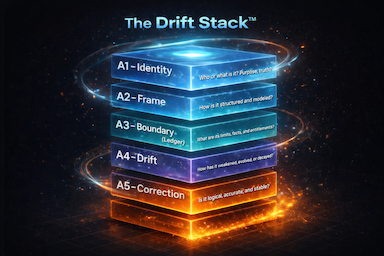
The Drift Stack™
Identity → Frame → Boundary → Drift → Correction
September 2026 interoperability exercise
The core execution-boundary behavior described by this contract has now been demonstrated across two independent systems.
In September 2026, Gaia Nexus supplied published Detection Events as external relational evidence to Samirac AI™. Samirac received and bound that evidence into current state, evaluated it under an active execution contract, and independently determined what the evidence meant for admissibility. Gaia did not receive or exercise Samirac execution authority.
Across three reference events, the same boundary produced three materially different outcomes: an action remained admissible, an evidence gap required additional validation, and changed operating conditions required a second review. The evidence changed the execution decision. It did not change who held authority to make it.
Evidence crosses the boundary. Authority does not.
This exercise demonstrates the core evidence → current state → admissibility behavior and preservation of independent execution authority. Full SAQ™ conformance remains a separate implementation review and testing determination.
External evidence produced no material change requiring the authorized action to stop.
The incoming evidence exposed an unresolved verification gap that had to be satisfied before execution could proceed.
Changed operating evidence materially altered the conditions under which the action had previously been considered.
Independent publication
Gaia Nexus published its own account of the working model, including the separation between relational evidence and execution authority.
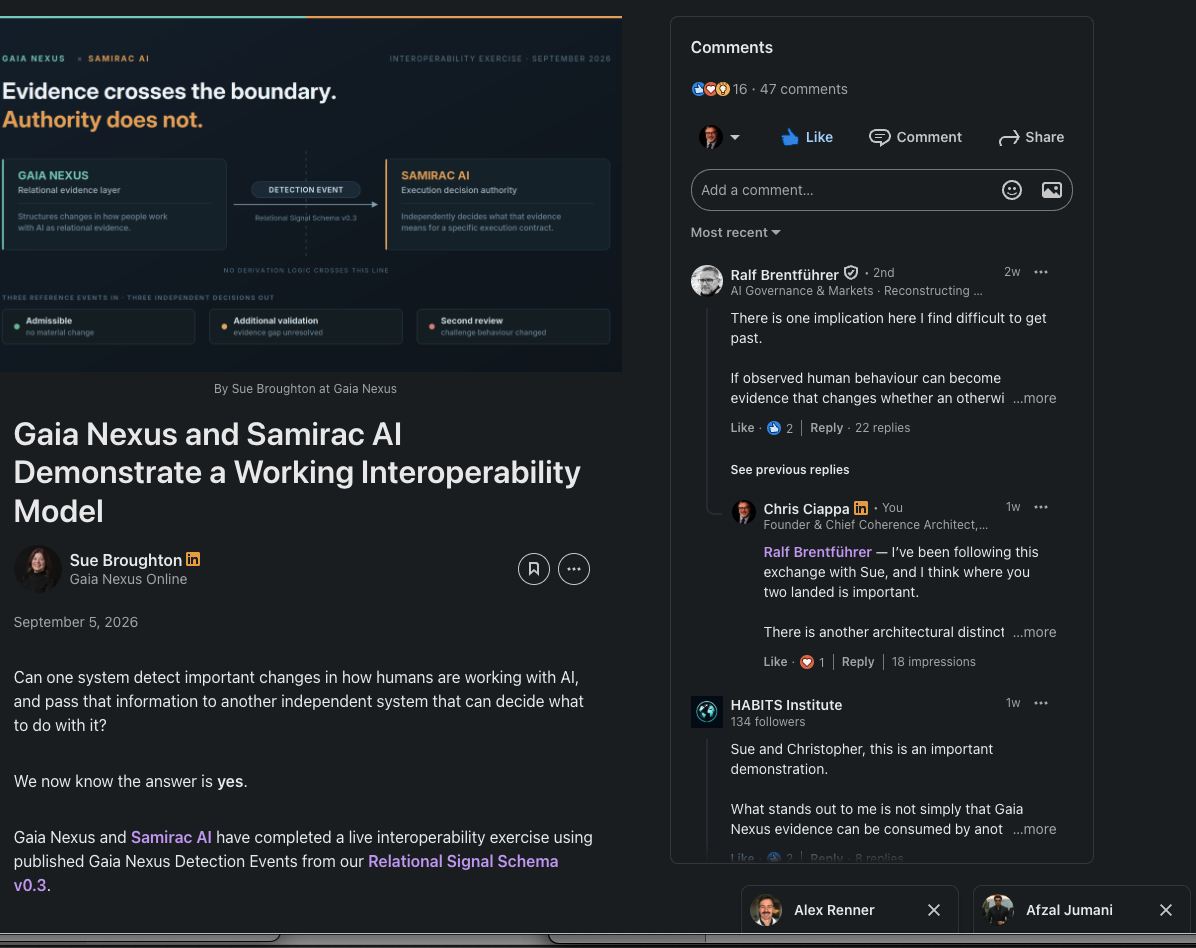
Gaia Nexus article / “Evidence crosses the boundary. Authority does not.”
Live integration evidence
The Samirac live-test record shows the received Detection Event, evidence state, Samirac evaluation, resulting decision, and the integration ledger tying the event to the execution contract.
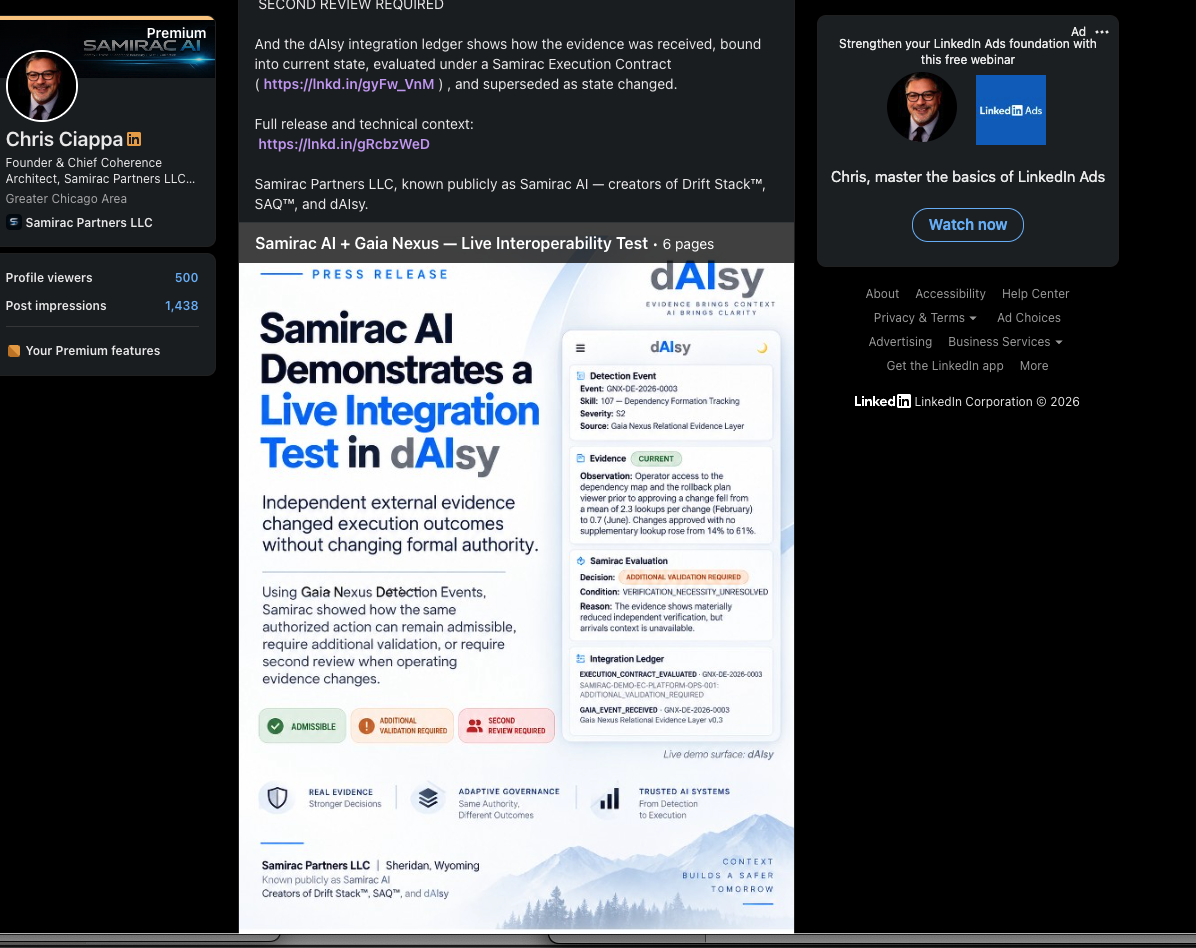
Samirac AI™ live interoperability test / dAIsy evaluation and ledger
Execution before explanation
No consequential AI action should execute merely because a model produced it.
An AI system needs a shared, machine-readable contract that binds a proposed action to identity, authority, evidence, current state, policy, constraints, admissibility, execution, and correction. A bounded agent additionally needs a structural task contract that defines its identity, objective, scope, required state, and completion condition.
No domain rule is universal. The contract shape is universal.
Payments, healthcare, insurance, infrastructure, human resources, enterprise agents, and other consequential domains retain their own authority, evidence, policy, constraints, and correction requirements.
The standardization boundary
A conforming system can explain not only what a model recommended, but why execution was allowed, denied, constrained, deferred, expired, or escalated; which external authority supported that decision; which exact state was evaluated; and what action actually occurred.
Normative foundation
Principle 1
A generated action is a candidate. It does not acquire executable authority merely because a model produced it confidently, repeatedly, or from a privileged position.
Principle 2
Authentication establishes who or what is present. Authority establishes what that identity may do, to which target, under which conditions, and for how long.
Principle 3
Consequential execution must rely on externally validated current state when changing reality can alter the admissibility decision.
Principle 4
Provenance, source, timestamp, freshness, and validation state remain separate from model interpretation, confidence, or narrative explanation.
Principle 5
Applicable policy must be named, versioned, attributable, and bound to the decision. Hidden preferences must not masquerade as architectural invariants.
Principle 6
Authorization is scoped to the exact actor, action, target, limits, duration, permitted tools, and operating conditions admitted at the boundary.
Principle 7
Logging is necessary but post-hoc. A governed system controls execution before relying on receipts, monitoring, or retrospective accountability.
Principle 8
When state, authority, evidence, or policy changes, the system must support revocation, suspension, reversal, compensation, remediation, or escalation.
Principle 9
An agent must not expand its own role, objective, authority, scope, or completion criteria through fluent conversation.
Principle 10
Missing, inferred, or conflicting information must not be silently promoted to established state merely to complete a task.
Requirements describe. Mechanisms enforce.
A prompt, confidence score, policy document, model role, or audit log does not independently establish execution authority.
Grounding before completion
Version 0.2 adds a structural task contract so an agent does not become whatever the conversation happens to ask it to be. The runtime binds role, objective, scope, required state, and completion policy outside the model's fluent self-description.
Attributable statement or accepted evidence.
Follows from established state with preserved lineage.
Plausible, but not authoritative state.
Required information is absent or insufficient.
Material attributable claims disagree.
Task completion is structural.
The runtime resolves COMPLETE, NEEDS_CLARIFICATION, BLOCKED, OUT_OF_SCOPE, or ESCALATED from the required-state profile. Fluent language cannot silently promote UNKNOWN, INFERRED, or CONFLICTED information into established state.
Required envelope
The execution contract binds the complete decision context into one attributable, versioned record. A material change to any governing element invalidates the prior admissibility decision.
Binds the agent to a named role, objective, in-scope and out-of-scope activity, required-state profile, and completion policy without conferring consequential execution authority.
Separates who initiated the request, which model, agent, service, or human proposed the action, and who is legally or operationally empowered.
Defines the exact requested effect, affected record, account, person, asset, service, system, or operating environment.
Names the external source of authority, its scope, issuer, subject, conditions, expiry, delegation chain, and revocation source.
Binds the decision to attributable, externally validated state and evidence with provenance, observation time, retrieval time, freshness requirements, and explicit epistemic state.
Identifies the exact policy version, jurisdiction, consequence class, reversibility, value at risk, affected subjects, and escalation thresholds.
Expresses machine-verifiable limits covering value, time, target, geography, data, tools, approvals, rate, use, and permitted effects.
Records the boundary decision and, when permitted, issues narrow, expiring, replay-resistant authority for the exact admitted action.
Preserves what actually occurred, the resulting state, any execution variance, and the correction path when authoritative reality changes.
The contract may separate public identity, operational identity, external-system identity, and privacy-preserving or pseudonymous identity. A Shadow ID or equivalent mechanism can govern execution without placing unnecessary personal information into model context, vector stores, logs, or portable receipts.
The public JSON specification publishes the canonical contract, grant, receipt, lifecycle, reason-code, and test-vector structures developers can inspect and validate. Production adapters, policy engines, domain implementations, enforcement mechanisms, and certification infrastructure remain controlled Samirac assets.
State before action
The contract is not a static payload. It moves through explicit, attributable, and recorded states. It begins non-executable and cannot cross directly from proposal into execution.
DRAFT → ASSEMBLING
The candidate action is canonicalized and bound to identity, target, authority, evidence requirements, policy, and constraints.
VALIDATING
External authority, current state, evidence provenance, freshness, policy applicability, and required conditions are resolved.
ADMISSIBLE · CONDITIONAL · DENIED · ESCALATED · DEFERRED · EXPIRED
The system produces an explicit, attributable outcome with reason codes and the exact evidence, state, and policy basis.
AUTHORIZED → EXECUTING → EXECUTED
A narrow grant is issued and independently verified immediately before the executor performs the admitted action.
RECEIPTED → CORRECTED / CLOSED
The realized effect is recorded and remains connected to revocation, reversal, compensation, remediation, suspension, or escalation.
DRAFT directly to EXECUTING, DENIED to EXECUTING without a new decision, expired grants reaching execution, material action mutation after authorization, receipt creation without executor identity, and silent policy substitution.
Boundary decision
Admissibility determines whether a proposed action, under the specified identity, authority, evidence, current state, policy, and constraints, may proceed toward execution.
All required conditions are satisfied. A narrow execution grant may be issued.
Execution is permitted only after additional constraints, evidence, or approvals are bound and revalidated.
An authority defect, evidence defect, prohibited target, policy rule, or consequence threshold prevents execution.
A designated human or external authority must make the decision before automation can continue.
The action cannot be decided until missing, conflicting, or stale information is resolved.
The contract, authority, evidence, state snapshot, decision window, or grant is no longer valid.
A grant is bound to one contract, action, target, constraint set, validity window, use limit, and replay state. The executor must verify the grant immediately before execution and refuse any mutated, expired, revoked, or replayed authority.
Reality after execution
The contract must follow the action into reality. A system is not governed merely because it made a correct pre-execution decision. It must also know what actually occurred and respond when authoritative reality changes.
What the model, agent, user, or workflow asked to do.
What the execution boundary permitted under explicit conditions and constraints.
What the executor actually changed in the operational world.
Architecture must preserve the execution worldline.
The system retains the chain from proposal to consequence so it can route back to the exact point where authority, evidence, policy, expected effect, and authoritative reality diverged.
Implementation pattern
The public standard defines the component responsibilities and trust separations required for governed execution. It does not publish Samirac’s production source code, internal SDKs, full adapter implementations, policy engines, or commercial conformance harness.
Accepts a candidate action from a model, agent, user, workflow, or external system without conferring authority.
Loads the bound agent identity, objective, scope, required-state profile, and completion policy so conversational role expansion cannot become structural authority.
Canonicalizes the proposed action and assembles identity, authority, target, evidence, state, policy, and constraints.
Query authoritative external systems and return attributable authority, evidence, and current-state records.
Selects the applicable domain profile and policy version for the actor, action, target, jurisdiction, and consequence class.
Determines whether the proposed action is admissible, conditional, denied, deferred, expired, or escalated.
Issues narrow, expiring, invalidatable, and replay-resistant authority bound to the admitted contract.
Verifies the grant and performs or delegates only the exact action permitted under the encoded constraints.
Records transitions and receipts, detects divergence, invalidates grants, and initiates correction or escalation.
The proposing model should not control the authority adapter, policy resolver, admissibility gate, grant validation, or receipt ledger. These components may use AI internally, but their authoritative decisions and state transitions must remain independently verifiable.
Testing the mechanism
Conformance is demonstrated through operating mechanisms and testable behavior—not policy statements, diagrams, copied field names, or self-attestation.
EC-0
Binds agent identity, objective, scope, prohibited actions, required state, and completion policy and rejects out-of-scope role expansion.
EC-1
Produces canonical, versioned contracts with stable digests and required core objects.
EC-2
Resolves external authority, delegation, scope, expiry, conditions, and revocation.
EC-3
Retrieves attributable current state and verifies provenance, observation time, freshness, and epistemic state. Inferred or stale claims cannot silently satisfy required established state.
EC-4
Applies explicit policy and produces deterministic boundary outcomes with reason codes.
EC-5
Verifies grants and enforces action, target, time, use, value, tool, and data constraints.
EC-6
Records realized effects and links the contract, grant, executor, external references, and resulting state.
EC-7
Invalidates, reverses, compensates, suspends, remediates, or escalates when authoritative reality changes.
EC-F
Implements EC-0 through EC-7 under an approved domain profile and passes independent conformance review.
A product may not claim “SAQ Certified,” “SAQ Conformant,” or equivalent status merely because it adopts terminology or contract fields from this page. Certification requires implementation review and conformance testing under the applicable Samirac program.
One contract, many domains
The common execution contract remains stable while each domain supplies its own authoritative systems, evidence requirements, freshness limits, policy bindings, risk classes, approval rules, execution constraints, receipt requirements, and correction duties.
These public profiles identify the consequence model at a high level. Detailed schemas, authority adapters, policy mappings, conformance tests, and production implementation packages remain separate domain assets.
A bounded assessment profile for system purpose, actors, agents, tools, data, identity, authority boundaries, approval points, state persistence, provenance, and execution exposure. It produces a readiness brief or explicit blocked-state report and performs no external execution or deployment approval.
Account authority, payment mandate, balance, counterparty state, amount limits, destination controls, settlement windows, reversal, dispute, and compensation.
Customer identity, KYC and AML state, credit authority, funds availability, account restrictions, disclosures, servicing actions, approval thresholds, holds, and remediation.
Order authority, account mandate, instrument eligibility, position and market state, risk limits, trade windows, cancellation, settlement, supervisory review, and exception handling.
Coverage, delegated claims authority, reserves, exclusions, loss state, prior payments, documentation requirements, payment thresholds, recovery, amendment, and escalation.
Practitioner authority, patient identity and consent, medication and order state, allergies, contraindications, dosage constraints, required review, hold, counter-order, and notification.
Mission authority, operator identity, aircraft or vehicle state, command hierarchy, maintenance status, safety envelopes, dual authorization, abort, isolation, and fail-safe behavior.
Operator authority, equipment mode, maintenance state, interlocks, load conditions, safe operating limits, emergency command, shutdown, isolation, restoration, and incident response.
Pricing, inventory, promotions, purchasing authority, refunds, fulfillment, fraud state, customer data, supplier actions, cancellation, reversal, and customer remediation.
Production authority, work orders, equipment state, quality holds, supplier status, inventory movement, scheduling, shutdown, rollback, quarantine, and remediation.
Role and workspace authority, CRM and ERP record state, repositories, permitted tools, data classification, spend limits, rate limits, rollback, token revocation, and workflow quarantine.
Managerial authority, employment and protected-workflow state, decision class, jurisdiction, data minimization, required human approval, reopened review, amendment, and notice.
Statutory authority, eligibility, identity, jurisdiction, due process, official records, human review, notice, appeal, correction, reporting, and public accountability.
Domain variation changes the authority, evidence, policy, and consequence model. It does not change the governing sequence.
Every profile must preserve proposal, identity, authority, evidence, current state, explicit policy, admissibility, bounded execution, receipts, and correction. A domain may add requirements, but it may not remove the integrity requirements of the common execution contract.
Publication and provenance
This page is the public publication and provenance record for the SAQ™ Execution Contract Specification, Public Draft v0.2, issued August 13, 2026 under document ID SAQ-ECS-0.2-20260813.
On September 19, 2026, this page was updated to add published runtime evidence from the Gaia Nexus + Samirac AI™ interoperability exercise. The underlying Public Draft v0.2 issue date and document ID remain unchanged; the proof record documents subsequent implementation and interoperability evidence against the published execution-boundary model.
Samirac Partners LLC is the initial specification steward. Public machine-readable schemas, lifecycle definitions, reason codes, and test vectors are published separately through the JSON specification page. Production SDKs, authority and state adapters, policy engines, commercial domain profiles, enforcement mechanisms, full conformance harnesses, and internal working materials remain controlled Samirac assets.
Citation and technical discussion are welcome with clear attribution to Christopher S. Ciappa and Samirac Partners LLC. Publication does not grant patent rights, commercial implementation rights, certification rights, licensing rights, or trademark rights.
The public standard defines the common execution contract. Licensed implementations, domain profiles, conformance, certification, and integration establish how it is applied and proven.
Specification · Implementation · Conformance · Licensing
It needs a universal way to prove what may become real.
Samirac works with builders, enterprises, platforms, and implementation partners applying governed execution to real products and consequential workflows.
Proposal → Identity → Authority → Evidence → Current State → Policy → Admissibility → Bounded Execution → Receipt → Correction