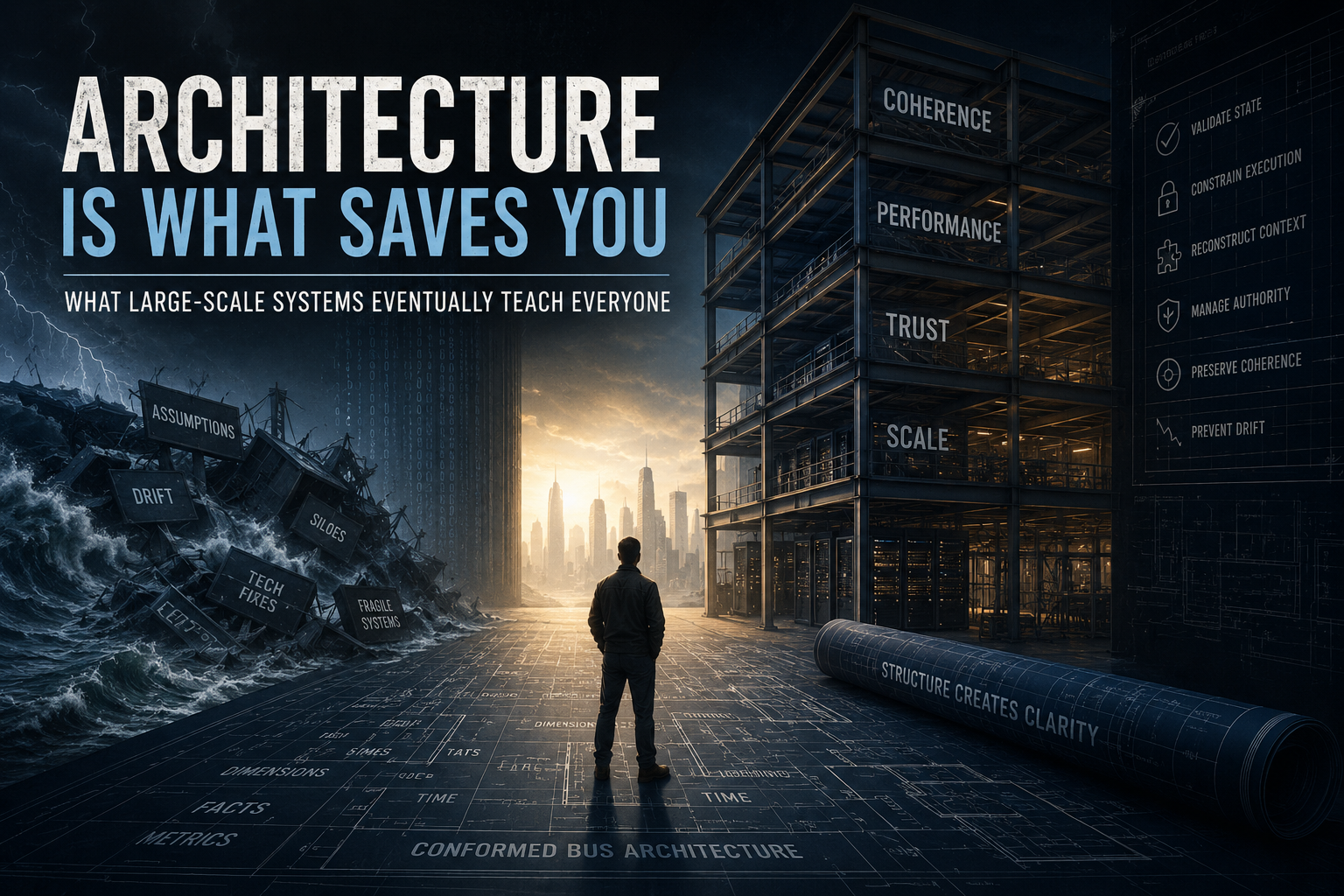
What Large-Scale Systems Eventually Teach Everyone.
By Chris Ciappa
Founder & Chief Coherence Architect
Samirac Partners
There is a certain kind of confidence that only exists before a system meets reality.
You see it constantly in technology, and especially now in AI.
Someone discovers a framework, builds a prototype, connects a few APIs, gets a model responding correctly in a controlled environment, and suddenly they are talking about replacing industries, automating judgment, or creating autonomous systems capable of safely operating at scale.
What they usually have not lived through yet is operational consequence.
They have not watched a system quietly fail because assumptions drifted upstream months earlier.
They have not seen reporting pipelines produce incorrect numbers for half a year because two departments defined “clean data” differently.
They have not sat in rooms where millions of dollars were at risk because architectural decisions made years earlier were now colliding with real-world scale and operational reality.
And eventually they learn the lesson large systems teach almost everyone who survives long enough to build them:
Architecture matters far more than people want to believe.
I learned this years ago building large-scale data warehouse systems across industries where failure was not theoretical.
Finance.
Trading.
Healthcare.
Hospitality.
Manufacturing.
Enterprise operations.
Some of those systems succeeded beautifully.
Some failed before they succeeded.
One of the earliest lessons came from trying to “lasso the moon” which clients often pushed for, instead of building long, thin, iterative systems that validated assumptions step by step before scaling them. At the time, the huge vision felt exciting. Everybody wanted the giant system immediately. Big diagrams. Big promises. Big capability.
Reality corrected that thinking quickly.
Because large systems rarely fail all at once.
They drift.
An assumption here.
An unchecked dependency there.
A definition that slowly diverges between departments.
A process that works at small scale but collapses under volume.
A design decision that seemed harmless until the data reached hundreds of millions of rows.
Over time, those little things stop being little things.
That is where architecture stops being theory and starts becoming survival.
Dimensional modeling and OLAP systems taught this brutally well. Under large-scale analytical workloads, architecture is not an academic exercise or a documentation artifact somebody stores in SharePoint and ignores six months later.
It directly determines whether the system remains operationally usable.
A system can appear perfectly functional at small scale while quietly embedding structural decisions that later destroy performance, coherence, maintainability, and trust.
That is why concepts like the Ralph Kimball Conformed Dimensional Bus mattered so much.
People outside that world sometimes think the architecture diagram is just documentation.
It is not.
The architecture determines whether the organization can continue answering questions coherently once the data becomes massive, distributed, historical, multi-domain, and operationally critical.
Shared dimensions matter.
Conformed structures matter.
Bounded semantics matter.
Once every domain starts inventing its own definitions, mappings, assumptions, and interpretations, the system slowly begins drifting toward incoherence.
Queries slow down.
Joins become unreliable.
Interpretations diverge.
Trust erodes.
The system still technically exists.
But structurally, it has already started failing.
I learned the same lesson in smaller ways too.
Years ago, I realized there are enormous differences between approaches that appear superficially equivalent in SQL development.
One developer retrieves a single row using a recordset loop because “it works.” Another uses output parameters specifically designed for the task. At small scale, the difference seems trivial.
Run that same process a thousand times inside a critical operational workflow and suddenly the architectural decision matters enormously. Small inefficiencies compound into systemic inefficiencies. Tiny structural decisions become large operational consequences.
Once you see that enough times, it changes the way you think permanently.
Eventually you begin recognizing the same pattern everywhere else.
Organizations.
Governance.
AI.
Operational systems.
Execution authority.
The current AI conversation is still dominated by capability discussions while architecture often remains secondary particularly in governance discussions.
That should concern people far more than it currently does.
Capability is not the same thing as operational trustworthiness.
A model generating fluent output does not mean the surrounding system:
◦ validates state correctly
◦ constrains execution appropriately
◦ reconstructs operational context
◦ manages authority safely
◦ preserves coherence across domains
◦ or prevents drift under changing conditions
Those are architectural questions.
And architecture determines whether systems survive contact with reality.
That is one reason I continue emphasizing execution boundaries, admissibility, runtime arbitration, operational state reconstruction, and coherence enforcement within the Drift Stack™ architecture.
Not because those concepts sound sophisticated.
Because systems operating at scale eventually encounter:
◦ ambiguity
◦ conflicting signals
◦ hidden dependencies
◦ ownership gaps
◦ drift
◦ state inconsistency
◦ and operational consequence
When that happens, architecture is no longer theoretical. It becomes the thing standing between coherence and failure.
The uncomfortable truth is that many modern AI discussions still operate at the level of demos, narratives, and conceptual capability.
Reality operates at the level of structure. And reality always wins eventually.
People who have spent years inside large operational systems eventually learn the same lesson:
You do not build resilient systems through optimism, storytelling, or tooling alone.
You build them through structure.
Because in the end, architecture is not the diagram.
Architecture is the thing that saves you.
The Only Question That Matters
The architecture is already defined.
Drift Stack™ Architecture
https://www.samirac.com/drift-architecture
The only question is:
👉 Does your system control what’s allowed at execution—
and is it safe, or does it just react and hope it gets it right?
Architecture Demos
https://www.samirac.com/daisy-demos
Share This Article
If you found this article valuable, share it.
Substack automatically gives every subscriber a personal referral link. When someone subscribes through your share link, it counts toward referral rewards.
Current rewards:
• 3 referrals → 1 month of paid access
• 5 referrals → 6 months of paid access
• 10 referrals → 12 months of paid access
You can share directly using the Share button on this article, or find your personal referral link here:
Get Referral Link
By Chris Ciappa
Founder & Chief Coherence Architect
Samirac Partners