The Organized Corpus
This is not a chronological blog roll. Every registered article appears once inside the subject area where it best fits, allowing the full body of work to function as a map instead of a stream.
Architecture · Governance · Runtime · Readiness · Structural Thinking
The organized map of the Samirac and Drift Stack™ body of work.
This is the top-level reading spine for the full corpus: enterprise AI architecture, readiness, execution authority, admissibility, runtime control, drift, correction, security, identity, structural thinking, and institutional coherence.
177 registry-backed articles organized into 12 major subject areas.
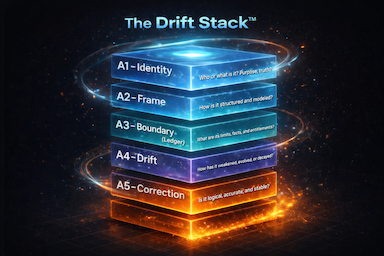
The Drift Stack™
Identity → Frame → Boundary → Drift → Correction
The complete reading spine
This is not a chronological blog roll. Every registered article appears once inside the subject area where it best fits, allowing the full body of work to function as a map instead of a stream.
The role-specific tracks remain available for executives, governance leaders, runtime builders, readiness teams, educators, and structural thinkers who prefer a shorter, guided path.
Board members and senior leaders focused on execution authority, institutional drift, and irreversible consequence may prefer the Executive Track.
Corpus index
Jump directly to a major subject area. Each section includes a return link because this page is intentionally comprehensive.
Begin with the pieces that make the rest of the corpus legible: the overall journey, the basic drift frame, and the distinction between model capability and system architecture.
A continuous Framework for Success
The simple 5 letter word that can make or break entire industries and societies.
Why Real AI Requires Architecture Above and Around the Model
Organizational maturity, use-case selection, deployment readiness, tool-driven architecture risk, and the movement from pilots into durable AI operations.
As AI systems become more consequential, it is becoming dangerous.
A process-driven structured system for assessing and measuring AI readiness, execution control, and operational maturity
Understanding Organizational Readiness for Artificial Intelligence
Why the future may belong to structural thinkers rather than narrative thinkers and larger teams
What Large-Scale Systems Eventually Teach Everyone
Why bounded orchestration environments are being mistaken for autonomous intelligence — and where the real architectural difficulty actually lives.
When people who don’t understand the system are the ones deciding how it’s built
Architecture doesn’t disappear when tools get easier—it gets ignored.
Speed creates liability and is no substitute for architecture or intelligence.
"Speed has quietly become the stand-in for intelligence."
Drift Observation Isn’t Drift Correction
Why Tool-Driven AI Is Recreating the Dot-Com Bust — With Execution Authority
The moment your “AI” can only act inside someone else’s UI, it is non-authoritative by design.
Scale without invariants destabilizes systems.
The runtime layer: agentic systems, action surfaces, continuation validity, execution constraints, and what changes once AI systems can act.
Live integration exercise shows how independent external evidence can change an AI execution decision while both architectures remain independent
And by creep, I mean drift or institutional drift.
As AI systems become more consequential, it is becoming dangerous.
Runtime admissibility, execution boundaries and present-state authority did not begin with the current AI governance conversation.
And the hidden assumption that accompany them
Authentication Proves the Actor — Not the Operational State
Why stable systems require external correction, measurable state, and coherent reference boundaries over time.
Policy Defines it
If Pricing Changes Can Kill Your AI App, You Built It Wrong
Control at the boundary. Correction over time. Without both, “safe” is just a story.
When people who don’t understand the system are the ones deciding how it’s built
When execution scales without admissibility, failure is inevitable.
A language model is a sealed probability bubble trying to verify itself using… itself.
You cannot train away drift. You have to architect around it.
The Exception the Universe Revealed
Announcing Draft v1.1 of Architectural Drift Management for Adaptive Systems
Separating learning systems from authority-bearing systems before drift becomes damage
How to solve agentic use cases without delegating execution authority
The moment you decide you will allow an agent or system to read, modify, create, or execute, you have granted authority and you have liability.
(For those who still don’t get it and need more context)
The Drift Substrate Standard (DSS-1.0) — a formal specification defining what must exist before execution in any serious reasoning system.
My own AI, dAIsy, just demonstrated the exact failure mode the industry still doesn’t understand — and the correction pathway that points to the architecture everyone will eventually need
The new 2026 State of AI Agents Report just dropped, and the industry is celebrating like it’s a roadmap. It’s not. But it surely points to some interesting findings.
"Vibecoding doesn’t just break at scale — it triggers a full Drift Stack collapse"
The foundational architecture of drift, invariants, coherence, correction, and the recurring five-layer pattern behind system failure.
A process-driven structured system for assessing and measuring AI readiness, execution control, and operational maturity
Very few people are studying the roots.
Why stable systems require external correction, measurable state, and coherent reference boundaries over time.
From wrinkled fingertips to financial markets to artificial intelligence, the same structural pattern appears everywhere: systems drift unless something detects and corrects it.
Part 1 — Why Every Closed System Drifts
A story of collapse over a beer and pickup truck
Compression, Optimization, and the Need for External Constraints
They Fail in a Sequence — and We’ve Seen It Before
The human face of educational drift, institutional drift, and ideological drift colliding.
(Paid Subscribers Only)
(And That’s Exactly Why It Keeps Holding Up)
(And Why You Can’t Engineer Your Way Around the Wrong One)
Structural cognition, systems architecture, leadership failure, architectural competency, and the kinds of minds that remain valuable as AI compresses procedural work.
Why feelings, emotions and ideology matter — but cannot become truth
How education, institutional prestige, social media, and generative AI turned borrowed authority into a business model.
Not building AI agents or apps or anywhere really
What functional learning teaches that institutional schooling increasingly does not.
The overlooked relationship between drift, recomputation, and AI energy demand
Why stable systems require external correction, measurable state, and coherent reference boundaries over time.
Drift, Swarm State, and Multi-Agent AI
Reading the Signal Beneath the Noise
Built for systems that must survive reality
Drift is Everywhere
Something predictable happens when a real architectural concept becomes legible.
Architecture Is Where Authority Actually Lives
The cheapest watt-hour is the one the architecture never lets the system burn.
"Vibecoding doesn’t just break at scale — it triggers a full Drift Stack collapse"
Education, law, civic anchors, media, ideology, and the institutional channels through which drift reproduces itself over time.
How education, institutional prestige, social media, and generative AI turned borrowed authority into a business model.
And by creep, I mean drift or institutional drift.
Not building AI agents or apps or anywhere really
What functional learning teaches that institutional schooling increasingly does not.
The shift from constitutional anchors to interpretive frameworks—and how it changed the classroom
When identity is tied to tribal beliefs, truth doesn’t stand a chance.
Using invariant anchors to measure institutional alignment with civic education foundations.
A recent question circulating in conservative media asked whether Americans still have anything in common across our political divide.
The Immigration Divide Began in the Classroom
A Structural Proof — Not an Ideological Argument
Why Civilizations Collapse When Authority Loses Its Human Reference Frame
How Meaning Was Quietly Replaced — and Why That Pattern Matters (Lost Anchors)
Power tends to corrupt, and absolute power corrupts absolutely.
"Vibecoding doesn’t just break at scale — it triggers a full Drift Stack collapse"
It was never “the platforms.” It was the architecture.
The pattern nobody wants to see
Trust architecture, operational identity, verification, classification, quantum risk, cryptographic limits, and authority boundaries.
Why “Proof of Entanglement” Doesn’t Replace Consensus
Control at the boundary. Correction over time. Without both, “safe” is just a story.
Why Breaking Encryption Doesn’t Grant Permission to Act
It Exposed That There Were None
Identity Is Not a Story — It’s a Stability Condition and it's Measurable
Hospitals operate on a principle most industries still don’t understand: Internal truth is not trusted. External verification is mandatory.
AI safety systems that cannot distinguish symbolic expression from literal harm fail at the classification layer.
Why cryptography fails second — and architecture fails first
Most people think AI drift and quantum risk are separate problems. They’re not.
Manufacturing, epidemiology, healthcare, markets, regulation, finance, and other proof surfaces where the same drift geometry appears.
Live integration exercise shows how independent external evidence can change an AI execution decision while both architectures remain independent
Not building AI agents or apps or anywhere really
The Collapse of Emotional Self-Governance
Unavoidable Structured Accountability to Hold Your Reps to Task
How anomaly detection can mistakenly accuse innocent providers — and why fraud detection systems need architectural safeguards.
Gold Hedges Invalid Authority
Equality in automated systems is about rules, not ratios
It’s the Peter Principle applied to governance.
Why Narrative-Driven Capital Allocation Keeps Repeating the Same Collapse
Why manufacturing now requires an Industrial Firewall, not more compute, more automation, or more guardrails
(a.k.a. the thing Michael “Word Salad” M. could not see)
The pattern nobody wants to see
A Constitutional Alternative to CBDCs
Human formation, tribal identity, emotional sovereignty, mortality, judgment, meaning, cultural drift, and personal coherence.
Why feelings, emotions and ideology matter — but cannot become truth
Drift Corrects in a Hurry
How identity, environment, and narrative turn simple frame correction into threat
Why My Market Background Keeps Showing Up in My AI Work
Why Modern Experts Collapse When Confronted With Architecture
The heart and soul this country used to run on and what it needs to regain
Why Nations Choose Destruction When Correction Was Still Possible
The fragility of A1 The SAQ™ Unified Trust Stack™ Identity Layer
The pattern nobody wants to see
The deeper theoretical layer: ledger, possibility, consciousness, quantum possibility, spacetime analogies, and boundary formation.
What happens if you take that same architectural principle… and apply it to spacetime itself?
Why the Real Risk Isn’t Explosion, but Drift
And Why They Don’t Detect Drift,
Why consciousness cannot emerge inside decoherence — and why every theory so far has been looking at the wrong layer of reality.
Origin pieces, publication framing, patent announcements, and the story of how the corpus emerged.
Live integration exercise shows how independent external evidence can change an AI execution decision while both architectures remain independent
Runtime admissibility, execution boundaries and present-state authority did not begin with the current AI governance conversation.
And That Is Precisely Why Authority Must Be Conditioned
How Systems Drift, How They Collapse, and How We Put Them Back Together
Unified Trust Stack™ — A New Architecture for Stabilizing Autonomous AI Agents
Reading → Readiness → Architecture → Implementation
The corpus explains the architecture and failure modes. AI RADAR™ determines where your organization is ready, where authority remains unclear, and what should happen before implementation accelerates.