Runtime Control, Agents & Execution

Drift Is Not Uniform — And Now the Architecture Reflects That

Announcing Draft v1.1 of Architectural Drift Management for Adaptive Systems
By Chris CiappaFebruary 23, 20264 min read
LinkedInEmail
Drift Is Not Uniform — And Now the Architecture Reflects That

Announcing Draft v1.1 of Architectural Drift Management for Adaptive Systems.

Drift in adaptive systems is inevitable.

But drift is not uniform.

Some deviations are repairable.
Some require escalation.
Some terminate authority entirely.

The original draft of Architectural Drift Management for Adaptive Systems established a clear position:

Drift is foreseeable.
Drift is measurable.
Drift must be constrained before execution — not corrected after harm.

Draft v1.1 introduces a structural refinement:

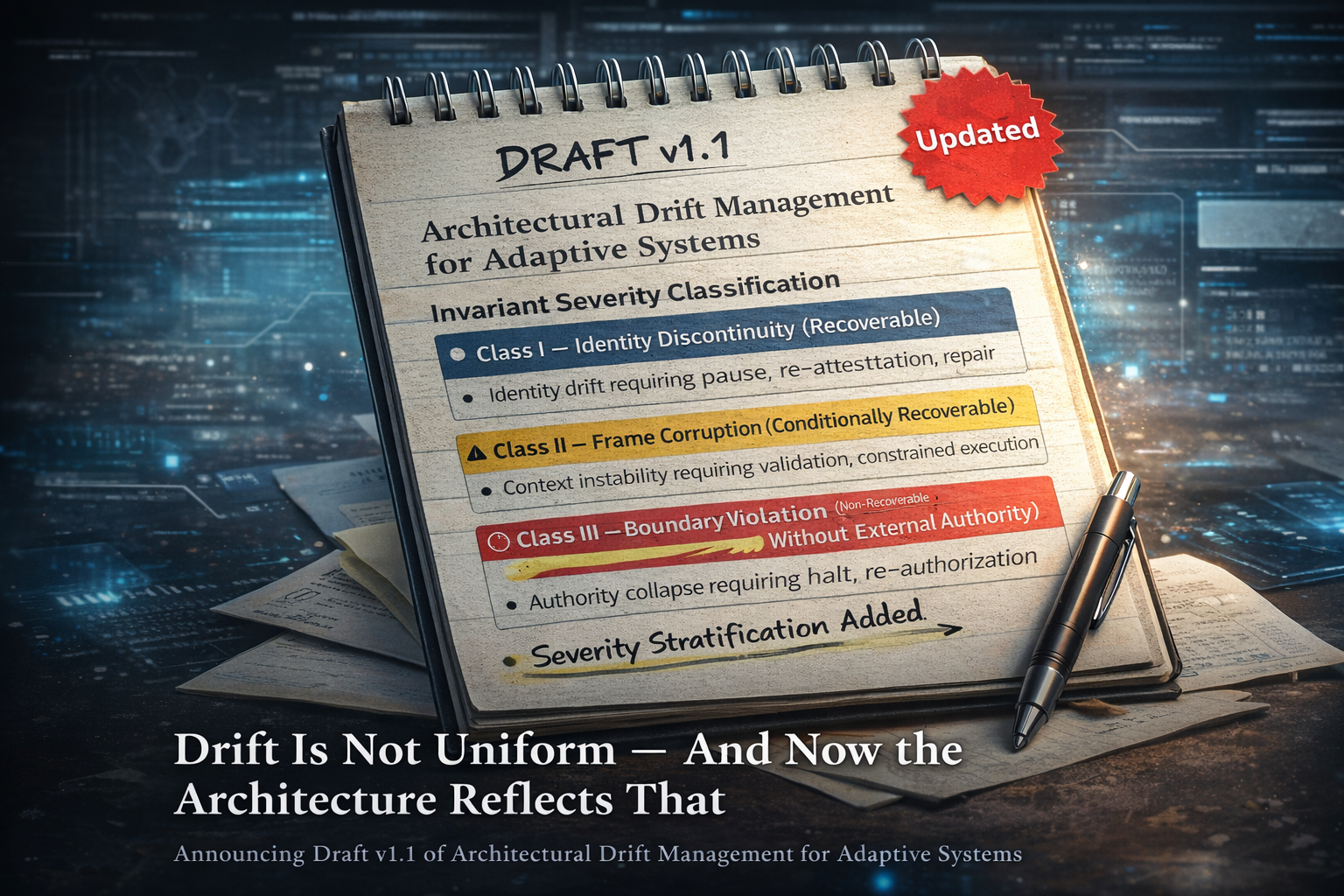
Invariant Severity Classification and Containment Hierarchy.

Not all invariant violations carry the same architectural consequence.

The framework now formally distinguishes:

Class I — Identity Discontinuity (Recoverable)
Transient continuity faults requiring pause, re-attestation, and repair.

Class II — Frame Corruption (Conditionally Recoverable)
Contextual instability requiring constrained execution and external validation.

Class III — Boundary Violation (Non-Recoverable Without External Authority)
Authority collapse requiring immediate halt and mandatory re-authorization.

This refinement closes an important gap:

What happens when stabilization fails?


The Kidney Stone Example Revisited

Last year, I wrote about being asked to confirm my identity seven times before kidney stone surgery.

At every stage, someone scanned my wristband and then asked:

“What’s your name?”
“What’s your date of birth?”
“What procedure are you here for?”

At the time, I focused on layered verification.

But consider a different scenario.

Imagine they roll me toward the OR and say:

“Tommy Ciappa.”

And I respond:

“That’s not my name.”

That is not a minor discrepancy.

That is not “monitor and continue.”

That is not “allow degraded mode.”

That is a halt.

Because at that moment, execution authority collapses.

Wrong patient. Wrong procedure. Wrong outcome.

Hospitals already understand severity stratification:

Minor mismatch? Re-verify.
Context ambiguity? Escalate.
Identity failure at incision point? Stop everything.

That is proportional containment tied to authority integrity.

Draft v1.1 formalizes this logic for adaptive systems.


Serious Systems Already Behave This Way

Aviation:

• Transponder glitch? Re-identify. Continue.
• Navigation misalignment? Constrain mode. Confirm manually.
• Flight envelope violation? Autopilot disengages. Authority transfers.

No pilot hopes the system “self-stabilizes” past a boundary breach.

Operating Rooms:

• ID ambiguity? Pause. Re-verify.
• Unexpected vitals? Escalate.
• Sterile field breach? Stop procedure.

Financial Systems:

• Session anomaly? Re-authenticate.
• Suspicious pattern? Throttle and review.
• AML boundary breach? Freeze immediately.

Nuclear Facilities:

• Sensor misread? Recalibrate.
• Control rod drift? Constrain system.
• Containment compromise? SCRAM.

No optimization logic is allowed to reason its way past a breached containment boundary.

Severity stratification is not novel.

What is novel is applying it formally to adaptive AI systems.


Why This Matters

Two systemic failures must be avoided:

• brittle systems that halt unnecessarily
• permissive systems that continue under collapsed authority

Severity classification prevents both.

Execution authority is explicitly modeled as conditional on invariant integrity.

When invariant integrity degrades, authority degrades proportionally.

When boundary integrity collapses, authority terminates.

This strengthens the duty-of-care position significantly.

Drift management is no longer just detection and correction.

It is proportional containment.

When to repair.
When to constrain.
When to halt.


Where to Review the Update

Draft v1.1 of Architectural Drift Management for Adaptive Systems is now available on the Drift Standards page.

The new material appears in:

Section 3.8 — Invariant Severity Classification and Containment Hierarchy

For those implementing governance at the execution layer, that section is the operative refinement.

Drift Standards:
https://samirac.com/drift-standards


Acknowledgment

A recent exchange with Nguyễn Thành Nam — particularly his essay Boundedness: The Structural Limits… — prompted deeper articulation of severity stratification within the Drift Management framework.

His probing around alternative stabilization models surfaced an important refinement: not all invariant violations are equivalent, and recoverability must be explicitly classified.

That line of questioning led directly to formalizing the Invariant Severity Classification and Containment Hierarchy in Draft v1.1 section 3.8.

Intellectual refinement often emerges through disciplined disagreement.

This revision reflects that process.

(For those interested, these are essays worth reading):

Nguyễn's Substack
Boundedness: The Structural Limits of AI
1. What Are Limits in AI…
Read more

Formalization of Ordered Coherence Degradation Across Complex Systems

Chris Ciappa
Founder & Chief Coherence Architect | dAIsy AI Chat Companion · Mind-Mesch Memory Architecture · SAQ™ Quantum Security Stack | Samirac Partners LLC


LinkedInEmail
← Return to the Reading SpineOriginal publication