By Chris Ciappa
Founder & Chief Coherence Architect
Samirac Partners
We’re being told to prepare for quantum.
Encryption will break.
Keys will fail.
Everything exposed.
That’s the narrative.
Fortunately, narratives are not truth or reality.
Also, It’s the wrong layer.
The Assumption Everyone Is Making
The current response to quantum risk is simple:
Make cryptography stronger.
Post-quantum algorithms.
Key rotation.
New standards.
All of it assumes the same thing:
That secrecy is what protects systems.
That if you protect the key, you protect the system.
But that has never actually been true.
Systems Don’t Fail When Data Is Read
They Fail When Action Is Taken
Most real-world failures are not about exposure.
They are about execution.
a system approves something it shouldn’t
denies something it shouldn’t
triggers an action it was never meant to take
operates under an identity or context that is no longer valid
That’s where damage happens.
Not at read.
At execution.
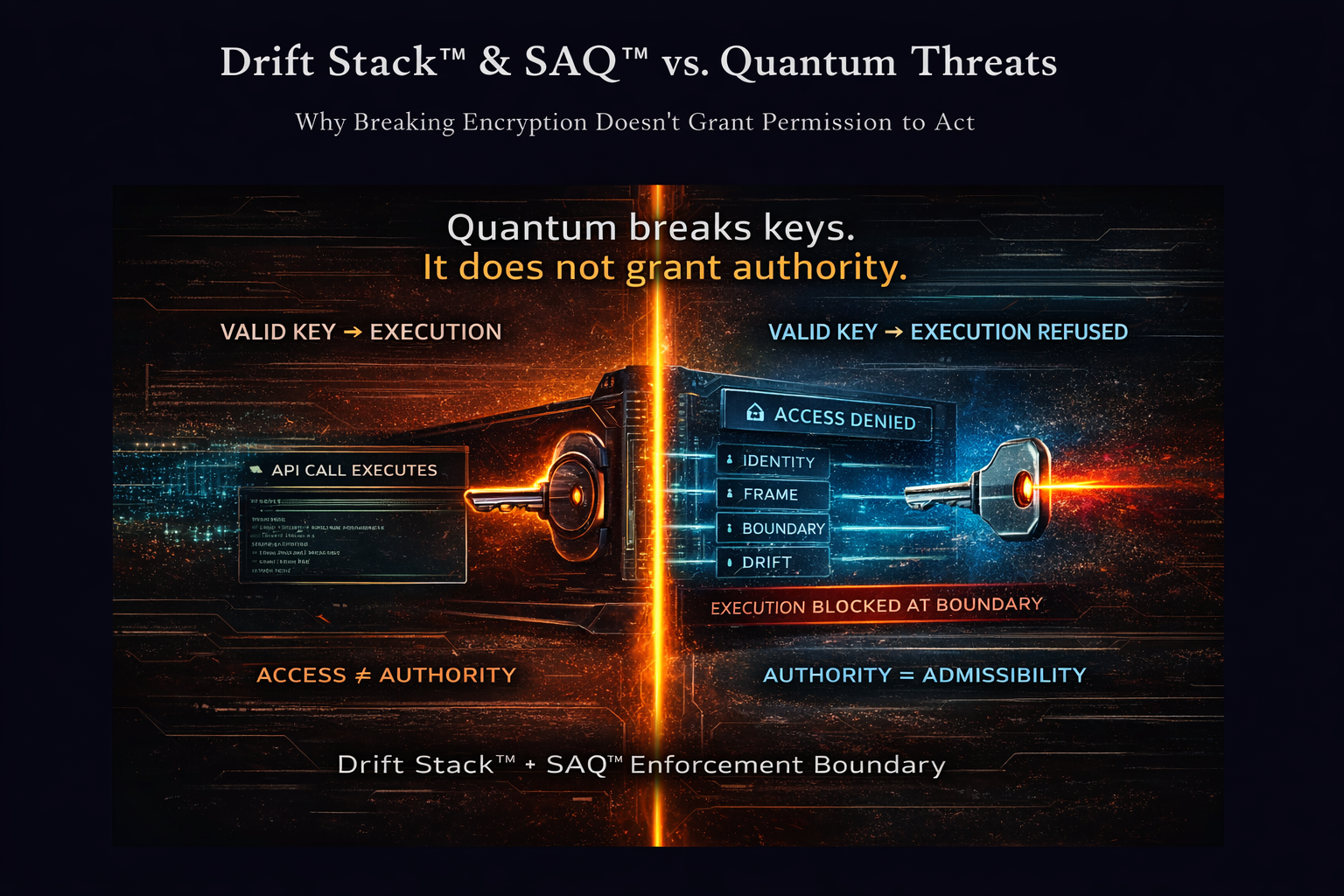
Quantum Breaks Secrecy
It Does Not Grant Authority
Even in a worst-case quantum scenario:
encrypted data is readable
keys are compromised
historical data can be decrypted
But none of that, by itself, should allow a system to act.
If your system equates:
possession of data → permission to act
Then you don’t have a quantum problem.
You have an architecture problem.
The Drift Stack™: Where Systems Actually Fail
Across domains — AI, finance, infrastructure, institutions — failure follows the same pattern:
Identity drift
Frame drift
Boundary erosion
Uncontrolled execution
External correction
By the time anyone notices, the system has already acted.
Quantum doesn’t create this pattern.
It exposes how fragile it already is.
SAQ™: Removing Secrets from the Authority Model
SAQ™ (Secure Against Quantum™) does not try to “win” against quantum.
It makes quantum insufficient.
Because it does not rely on secrecy to enforce control.
Instead, it enforces:
Identity-bound authority
Pre-execution admissibility
Invariant-anchored state validation
Automatic invalidation under drift
At runtime, the system answers a single question:
“Is this entity allowed to take this action, in this context, right now?”
Not:
“Do they have the key?”
What Changes in an SAQ-Class System
In a traditional system:
Keys imply permission
Access becomes authority
Compromise leads to execution
In an SAQ-class system:
Identity is externally anchored
Authority is continuously evaluated
Boundaries are enforced before execution
Drift revokes permission automatically
So even if:
data is exposed
keys are broken
systems are observed
The system still cannot execute inadmissible actions.
To make this concrete:
Imagine an AI agent responsible for issuing customer refunds.
Traditional System
If:
the cryptographic key is valid
the request appears well-formed
the system has access to the payment API
the refund can be executed.
Now assume that key is compromised.
From the system’s perspective, everything still looks legitimate.
The action goes through.
This is exactly the scenario quantum makes worse:
exposed keys
readable data
systems that cannot distinguish between valid access and valid authority
SAQ-Class System
In an SAQ-class system, that same scenario fails — even with a valid key.
Why?
Because execution is not determined by possession of credentials.
It is determined at the execution boundary by admissibility.
At the Boundary
Before any action occurs, the system evaluates:
Is this identity authorized to issue refunds?
Is the current frame consistent with legitimate refund conditions?
Does this action fall within defined boundaries?
Has any drift invalidated this authority?
These are not advisory checks.
They are enforced at a non-bypassable gate.
Gate Outcome
The gate returns a deterministic outcome:
Permit → execution proceeds
Refuse → execution is blocked
Invalidate → prior authority is revoked
If the state is not admissible, the action does not execute.
No Confirmation Layer
There is no confirmation step.
No secondary approval.
No fallback to “let it through.”
Final Reality
The key can be valid.
The request can be well-formed.
The system can be fully accessible.
And the action still cannot occur.
Because architecturally, it is not allowed to.
Drift Detection Is the Missing Layer
Modern systems detect:
anomalies
threats
statistical deviations
But they do not detect:
loss of coherence with their own state over time
That is where drift lives.
The Drift Stack™ formalizes this:
identity must remain stable
frame must remain grounded
boundaries must hold
invariants must constrain state
When those begin to shift:
authority is no longer valid
execution must be blocked or revoked
This is not monitoring.
This is structural enforcement.
From Quantum Risk to Architectural Impossibility
The industry is preparing for quantum by strengthening cryptography.
That assumes cryptography is the control layer.
It isn’t.
Control exists at the boundary between:
state → decision → execution
If that boundary is not enforced:
no amount of encryption will save you.
If it is enforced:
quantum does not grant authority — even with full visibility.
The Shift
Quantum threatens secrets.
SAQ removes secrets from the authority model entirely.
Final Thought
We keep asking:
Who has access?
Who controls the system?
What happens when encryption breaks?
Those are governance questions.
The real question is simpler:
What is this system structurally prevented from doing — no matter what it knows?
Until that is answered at runtime,
you don’t have security.
You have hope.
Drift Stack™ & SAQ™ don’t make systems harder to break.
They make certain failures impossible to execute.
The Only Question That Matters
The architecture is already defined.
Drift Stack™ Architecture
https://www.samirac.com/drift-architecture
Now ask yourself:
👉 Does my system control what’s allowed at execution —
or does it just react and hope it gets it right?
Architecture Demos
https://www.samirac.com/daisy-demos
Share This Article
If you found this article valuable, share it.
Substack automatically gives every subscriber a personal referral link. When someone subscribes through your share link, it counts toward referral rewards.
Current rewards:
• 3 referrals → 1 month of paid access
• 5 referrals → 6 months of paid access
• 10 referrals → 12 months of paid access
You can share directly using the Share button on this article, or find your personal referral link here:
By Chris Ciappa
Founder & Chief Coherence Architect
Samirac Partners