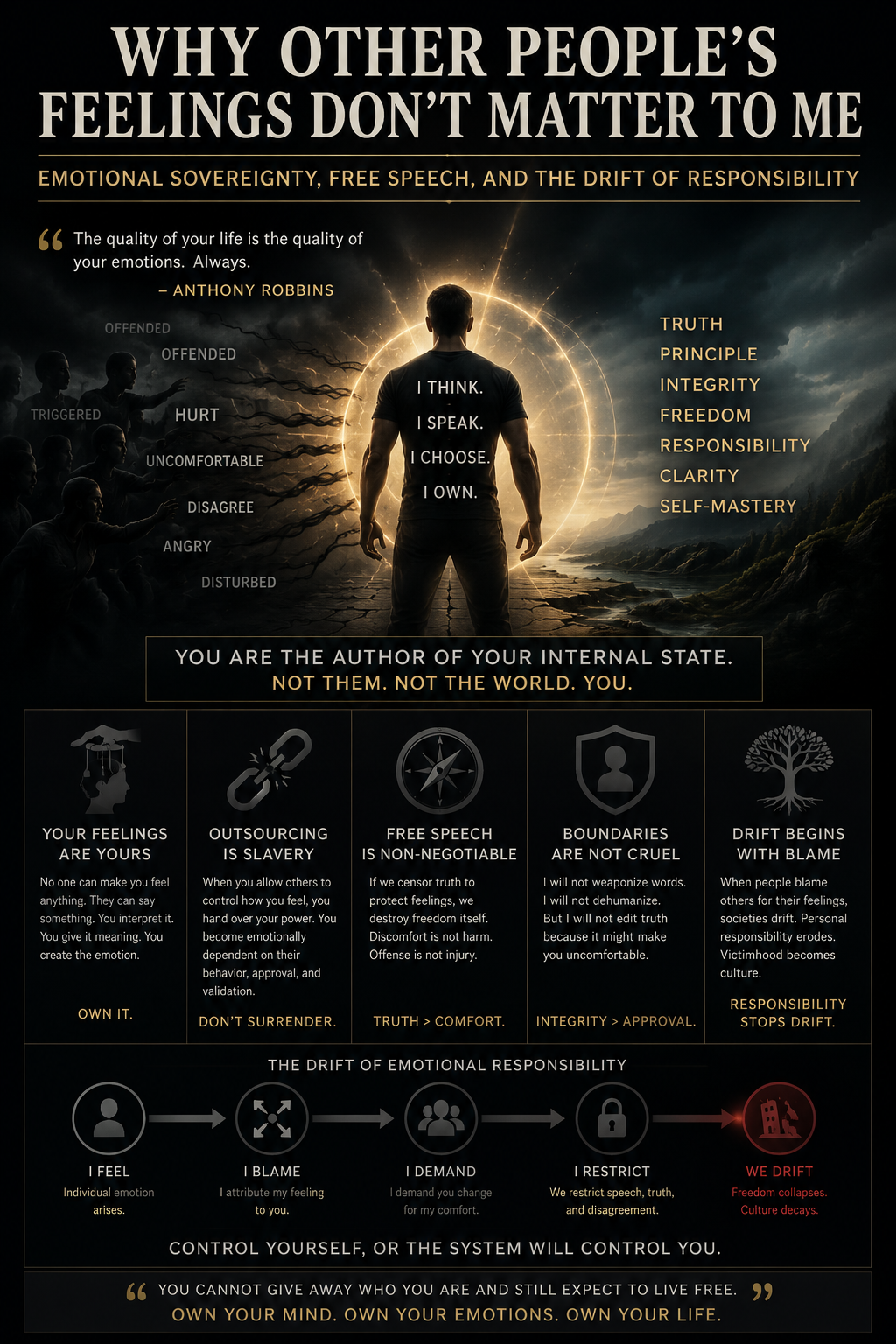
The Collapse of Emotional Self-Governance.
By Chris Ciappa
Founder & Chief Coherence Architect
Samirac Partners
There is something important I need to clarify before anything else.
This is not an argument against compassion.
It is not an argument against empathy.
And it is certainly not an argument that human feelings are meaningless.
I care deeply about people.
I care about suffering.
I care about loneliness, humiliation, fear, grief, insecurity, and despair because human beings matter and I, having lost a child, know full well feelings matter.
What I reject is something very different:
The growing belief that emotional offense itself should override truth, structure, coherence, reality, or open discourse.
At some point, a civilization must decide whether its primary organizing principle is emotional volatility or structural truth.
Because once truth itself becomes subordinate to whoever feels most offended, destabilized, or emotionally activated in a given moment, coherent systems begin collapsing under the weight of infinite subjectivity.
That is not compassion.
That is drift.
There is a strange modern assumption that has quietly embedded itself into public discourse:
That if someone feels offended, harmed, upset, destabilized, uncomfortable, or emotionally disturbed by something you said, then responsibility for their emotional state automatically transfers to you.
I reject that premise.
Not because I believe people should be cruel.
Not because I believe in insulting people.
Not because I believe in dehumanizing others.
I reject it because I believe emotional sovereignty matters.
And because the moment you surrender control of your emotional state to the words of another person, you begin surrendering control of yourself.
Tony Robbins has often spoken about the relationship between emotional state and quality of life. He once said, “The quality of your life is the quality of your emotions.”
I believe there is profound truth in that observation.
Because emotions do not merely affect comfort. They affect perception, judgment, resilience, discipline, decision-making, and ultimately the trajectory of an entire life.
That is not strength.
That is dependency.
The older I get, the more I notice how frequently modern culture confuses emotional reaction with moral authority.
Not emotion itself. Emotion is real. Human beings experience fear, humiliation, insecurity, anger, grief, rejection, and loneliness. Those experiences matter because people matter.
But somewhere along the way, a subtle shift occurred in public life. We began treating emotional response not merely as part of human experience, but increasingly as a governing mechanism over speech itself.
That distinction is enormous.
Because once emotional reaction becomes the primary validator of what may be spoken, truth begins competing against emotional volatility for permission to exist.
And volatility is a terrible foundation for coherent civilization.
I reject that framework entirely.
Not because I believe people should behave cruelly.
Not because I believe in insulting people for sport.
Not because I believe empathy is weakness.
I reject it because I believe emotional sovereignty matters.
I believe adults retain responsibility for their own internal responses.
And I believe societies drift into instability when emotional discomfort becomes indistinguishable from actual harm.
The Difference Between Harm and Discomfort
Modern discourse increasingly struggles to distinguish between genuine harm and emotional discomfort.
Those are not the same thing.
Threats are harmful.
Violence is harmful.
Defamation can be harmful.
Coercion can be harmful.
But disagreement is not harm.
Questioning ideas is not harm.
Misalignment is not harm.
Hearing something you dislike is not harm.
Being emotionally unsettled by another person’s opinion is not the same thing as being attacked.
A civilization that cannot distinguish between emotional discomfort and actual harm eventually begins treating truth itself as dangerous.
And that is where drift begins.
The distinction matters because societies eventually organize themselves around whatever metric they choose to prioritize.
If truth is prioritized, institutions organize around evidence, coherence, debate, and structural integrity.
If emotional reaction becomes the dominant metric, institutions reorganize around volatility management.
That is not a small cultural shift. It changes incentives everywhere.
Emotional Outsourcing
One of the most dangerous forms of societal drift is emotional outsourcing.
The belief that:
“My emotional stability is now your responsibility.”
That is an extraordinary transfer of authority.
Because once society accepts that premise, speech is no longer evaluated primarily on truth, coherence, logic, evidence, or structural integrity.
It becomes evaluated on emotional reaction.
The metric silently shifts from:
“Is this true?”
to:
“Did someone feel upset by it?”
Those are radically different systems.
And once emotional response becomes the dominant validator of speech, incentives change everywhere.
People begin optimizing for emotional safety over truth.
Institutions begin optimizing for liability over honesty.
Organizations begin filtering reality through emotional volatility.
Over time, reality itself becomes negotiable.
That is drift.
Feelings Are Real — But They Are Not Sovereign
This is the part many people intentionally misunderstand.
Feelings are real.
People experience pain.
People experience insecurity.
People experience fear, anger, embarrassment, rejection, humiliation, confusion, and grief.
None of that is imaginary.
But acknowledging the existence of emotion is different from granting emotion governing authority over all discourse.
A person’s feelings are part of their internal experience.
They are not automatically binding obligations on everyone else.
If someone misstates your idea, challenge them.
If someone insults you maliciously, confront it.
If someone lies about you, correct the record.
But disagreement itself is not violence.
And emotional reaction alone cannot become the universal enforcement mechanism for speech.
Free Speech Is Not About Comfortable Speech
Free speech only matters when disagreement exists.
Nobody tests free speech with statements everyone already agrees with.
The entire point of free speech protections is that people will sometimes hear:
uncomfortable truths
controversial ideas
structural critiques
moral disagreement
ideological opposition
unpopular conclusions
and still allow those ideas to exist in public.
A society that permits only emotionally approved speech does not have free speech.
It has emotional licensing.
The Drift Toward Emotional Governance
This is where the issue becomes larger than interpersonal disagreement.
Entire institutions now increasingly operate under emotional governance models.
Meaning:
perception outranks truth
offense outranks intent
discomfort outranks debate
reaction outranks structure
narrative outranks reality
This creates unstable systems.
Because emotional states are dynamic, subjective, and highly variable.
What offends one person may not offend another.
What destabilizes one person may not destabilize another.
What one group considers compassionate another may consider dishonest.
You cannot build coherent long-term systems on infinitely variable emotional reactions.
Eventually the system loses stable anchors.
And once stable anchors disappear, drift accelerates.
There is another reason this matters.
People often speak as though emotional resilience is coldness.
It is not.
Resilience is the ability to encounter disagreement, discomfort, contradiction, rejection, criticism, or even offense without surrendering authorship over your own internal state.
That is not repression.
It is self-governance.
And civilizations ultimately depend upon populations capable of governing themselves internally rather than demanding constant external emotional management.
Emotional Discipline Is a Form of Freedom
One of the most important lessons I ever internalized is this:
Other people do not control my emotional state unless I hand them the controls.
That does not mean I never feel anger.
It does not mean I never feel frustration.
It does not mean words cannot affect me.
It means I retain authorship over my response.
That distinction matters.
A person who can only remain emotionally stable when everyone around them speaks carefully, agrees constantly, validates continuously, and avoids offense entirely is not free.
They are fragile.
At some point, adults must reclaim responsibility for their own emotional states.
If another person’s words instantly dictate your internal condition, then you have surrendered authorship of yourself to external forces.
That does not mean words have no impact.
Of course they do.
Human beings affect one another constantly.
But there is still a profound difference between:
“I experienced an emotional reaction”
and:
“You are now morally responsible for my internal state.”
Those are not equivalent claims.
I do not believe other people own my emotions.
I do not believe strangers are responsible for maintaining my psychological equilibrium.
And I do not believe emotional self-governance can survive in a culture where individuals are taught to externalize responsibility for every uncomfortable feeling they experience.
If you do not control your emotional responses, then ultimately you do not fully control yourself.
And that is the central issue.
A person who can be constantly triggered, emotionally hijacked, destabilized, manipulated, or governed through offense is surrendering control of themselves to external actors.
The mechanism of control is emotional reaction.
If another person can reliably dictate your emotional state through words alone, then they possess a form of indirect control over your behavior, your perception, your judgment, and potentially your actions.
That is why emotional self-governance matters so profoundly.
Because emotional volatility is not merely personal weakness in isolation. At scale, it becomes a mechanism through which institutions, media systems, political actors, ideologies, and social pressures can steer entire populations.
A civilization composed of emotionally reactive people becomes increasingly easy to manipulate.
People who cannot regulate themselves internally eventually become governable externally through emotional activation.
That is not freedom.
It is dependency disguised as sensitivity.
And once a society normalizes emotional outsourcing at scale, it begins constructing systems where emotional reaction itself becomes a mechanism of governance.
Emotional discipline is not suppression.
It is sovereignty.
Jim Rohn used to say that maturity is learning to reap without apology and not complain when things do not go your way.
That principle matters here.
A society built entirely around emotional management eventually creates citizens who expect reality itself to reorganize around their discomfort.
But reality does not negotiate with emotion forever.
Eventually structure reasserts itself.
Truth Must Remain Higher Than Reaction
I care deeply about truth.
I care about structural coherence.
I care about reality.
I care about whether ideas survive pressure.
That means I cannot allow emotional reaction to become the final authority over whether something may be spoken.
Sometimes truth is uncomfortable.
Sometimes structural analysis collides with ideology.
Sometimes reality refuses to cooperate with preference.
That is not cruelty.
That is existence.
The goal should not be to create a society where nobody is ever emotionally unsettled.
The goal should be to create emotionally sovereign human beings — people capable of hearing disagreement, encountering uncomfortable truths, and remaining internally stable enough to engage with reality rather than demanding reality be softened for them.
The goal should be to create people strong enough to engage with reality without collapsing under disagreement.
Because civilizations drift when emotional volatility outranks structural truth.
And eventually, systems built entirely around emotional management lose the ability to distinguish reality from reaction.
That is where coherence collapses.
And once coherence collapses, drift accelerates everywhere.
Share This Article
If you found this article valuable, share it.
Substack automatically gives every subscriber a personal referral link. When someone subscribes through your share link, it counts toward referral rewards.
Current rewards:
• 3 referrals → 1 month of paid access
• 5 referrals → 6 months of paid access
• 10 referrals → 12 months of paid access
You can share directly using the Share button on this article, or find your personal referral link here:
Get Referral Link
The Only Question That Matters
The architecture is already defined.
Drift Stack™ Architecture
https://www.samirac.com/drift-architecture
Now ask yourself:
👉 Does my system control what’s allowed at execution —
or does it just react and hope it gets it right?
Architecture Demos
https://www.samirac.com/daisy-demos
By Chris Ciappa
Founder & Chief Coherence Architect
Samirac Partners