By Chris Ciappa
Founder & Chief Coherence Architect
Samirac Partners
The Shift No One Tracks
There’s a difference between teaching students how to think…
and training teachers—and then students—to interpret the world through a preloaded moral frame.
That difference isn’t academic.
It’s structural.
Because when teacher formation shifts, classroom culture follows.
When classroom culture shifts, curriculum follows.
And when curriculum shifts, a nation’s civic inheritance begins to move with it.
That’s not opinion.
That’s system behavior.
What’s often described as “changes in education” is something else entirely:
A shift in the underlying architecture of how reality is framed, taught, and evaluated.
And once that architecture changes, the effects are no longer confined to classrooms.
They scale.
The issue is not whether Bill Ayers and Bernardine Dohrn wrote books. They did.
The issue is not whether those books were assigned in higher education. They were.
The issue is not even whether “social justice” language now appears openly in teacher education and K–12 materials. It does.
The real issue is what kind of anchor those materials install into the educational system, and what happens when that anchor no longer rests in the constitutional, civic, and universal language of the American founding.
That is not a political disagreement.
It is a Drift Stack™ problem.
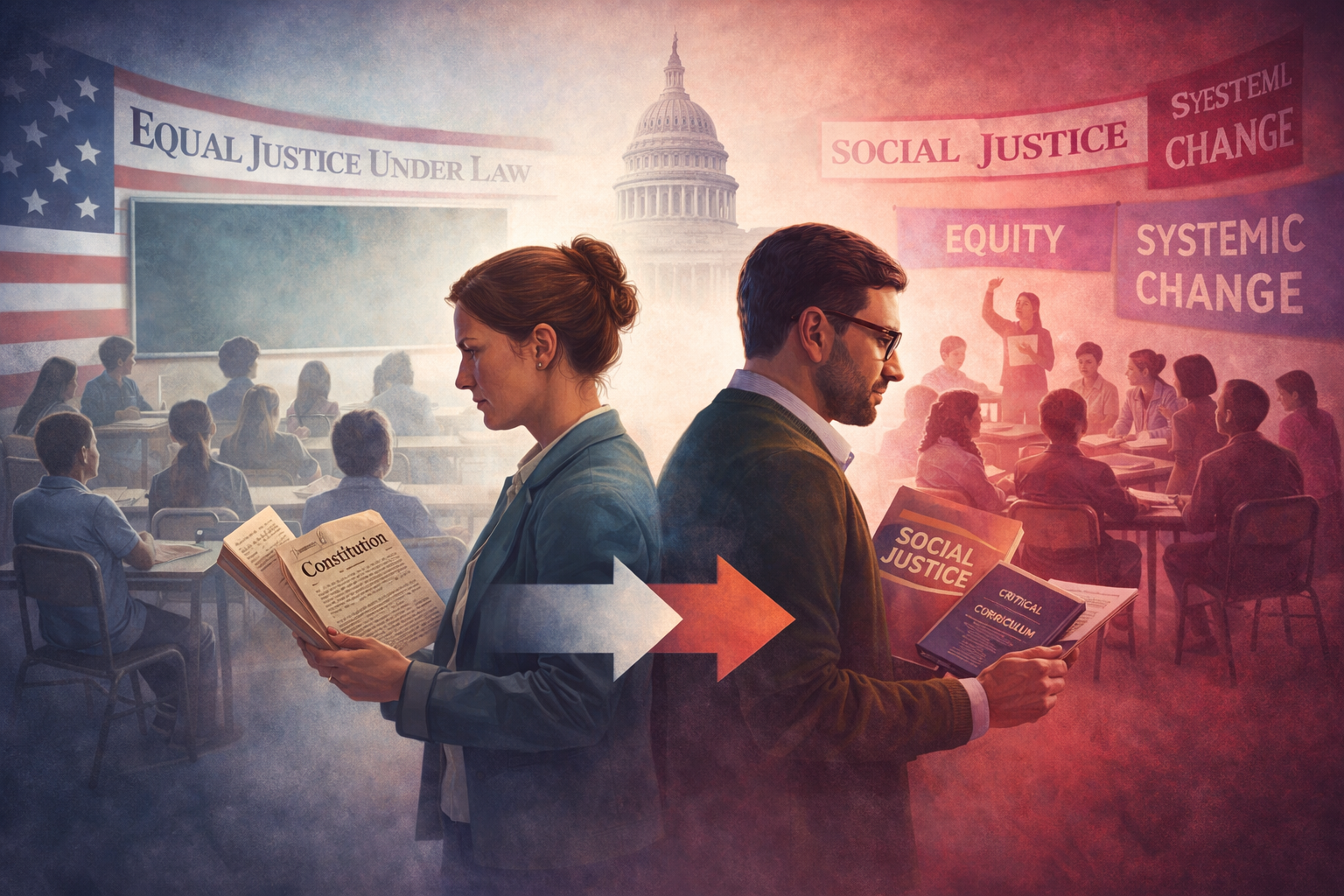
The original American anchor
Traditional American teaching, at least in principle, was built on a fairly clear civic architecture:
transmit knowledge, build literacy, cultivate reasoning, teach the structure of constitutional government, and prepare students for life as self-governing citizens under a shared legal order.
The moral vocabulary was not “equity” or “liberation.”
It was liberty, law, rights, duty, truth, history, evidence, and equal justice under the law.
That framework assumes there is a reality outside the student and outside the teacher. The teacher’s job is not primarily to transform society through the classroom. The teacher’s job is to instruct, clarify, test, and develop judgment.
The newer framework is different.
What Ayers helped normalize in teacher formation
Bill Ayers did not merely write about classroom technique. He wrote about the teacher as a morally and politically situated actor. In one cited description of his work, he argues that teaching is “never neutral” and is always “for something and against something else.”
That is not a small claim.
It is a replacement claim.
It shifts teaching from transmission toward orientation.
That orientation is visible not just in his books, but in the way those books were used.
At Moravian University, a syllabus required students to “team teach a chapter from Bill Ayers To Teach,” explicitly using To Teach as a course text in teacher preparation.
At George Mason University, a graduate syllabus listed Handbook of Social Justice in Education as a required text and opened the course by “generating a social justice definition.”
At Xavier, a course titled Teaching for Social Justice assigned multiple readings from Ayers-edited material and asked questions such as “How can teaching be used for social activism?” and “What is the best way to approach the teaching of social justice?”
That is not accidental exposure.
That is formation.
And the shift is not isolated to Ayers himself. It is mirrored in broader institutional language. The University of Illinois Chicago College of Education now states its mission as transforming education “to advance justice and liberation.” Santa Clara’s education program lists “reflective practice” and “social justice” among the core values guiding theory and practice. Wesleyan’s social justice education course centers critical pedagogy, feminist theory, postcolonial theory, queer theory, indigenous studies, disability studies, reflection essays, and intergroup dialogue aimed at connecting students’ own journeys to social justice theory.
The point is not that every one of these institutions is “Ayersian” in a narrow sense. The point is that the ideas Ayers helped popularize now sit inside a much larger educational ecosystem.
That ecosystem has a recognizable logic.
The syllabus trail is the mechanism
If you want to understand educational drift, do not start with slogans. Start with syllabi.
Syllabi are where value architecture becomes institutional procedure.
Ayers’ work shows up in teacher-prep and social justice coursework in at least three distinct ways.
First, teacher identity formation.
Texts like To Teach and To Become a Teacher frame teaching as a moral journey, a reflective identity, and a socially situated vocation rather than merely a content-delivery profession.
Second, social justice as explicit curriculum frame.
At George Mason, the course is not quietly adjacent to social justice. It begins by defining it and uses Ayers’ Handbook of Social Justice in Education as required material. Xavier’s course readings go further, linking Ayers’ anthology to teaching for social activism and shifting out of neutrality.
Third, practice-through-reflection and dialogue.
Wesleyan’s course structure emphasizes reflection essays, intergroup dialogue, and examination of the student’s own relationship to the theory being taught.
That is a Drift Stack™ event.
Where this lands in the Drift Stack™
The educational shift maps cleanly across every layer.
The impact is systemic.
Identity — Frame — Authority — Execution — Correction
The effects far-reaching.
Layer 1 — Identity / Value Anchor
The founding-era model is anchored in external civic reference points: Constitution, law, history, rights, equal treatment, national inheritance.
The social justice model shifts the anchor toward equity, liberation, identity, systems analysis, and lived experience.
This is the first drift event: the anchor moves from fixed civic order to interpretive moral framework.
Layer 2 — Frame
Traditional teaching says: understand the world, then assess it.
The newer frame increasingly says: understand the world through power, oppression, identity, and inequity.
Once “Justice” and “Action” are embedded into the framework itself, the frame is no longer neutral. It is preconfigured.
Layer 3 — Authority
In the founding model, authority comes from law, evidence, constitutional order, and shared civic standards.
In the newer model, authority increasingly draws from identity perspective, lived experience, and interpretive frameworks.
That is a shift from shared external authority to situated interpretive authority.
Layer 4 — Execution
This is where the theory shows up in classrooms.
The most visible examples today include:
– Anti-bias and social justice frameworks organized around identity, diversity, justice, and action
– Restorative practices replacing exclusionary discipline
– Culturally responsive and racially inclusive instruction
– Reflective practice and dialogic learning as core teacher habits
– Teacher education language shifting from instruction toward transformation and activism
Notice what happened:
The teacher is no longer just the steward of content. The teacher becomes a guide into moral interpretation—and, in some cases, social change.
That is execution drift.
Layer 5 — Feedback / Correction
In a traditional model, correction is tied to factual error, logic, and evidence.
In the newer model, correction can come from misalignment with equity goals, perceived harm, or failure to adopt the framework.
Once action and consciousness become part of the standard, correction is no longer simply “Is this true?” It becomes “Does this align with the intended moral frame?”
That is directional correction.
What Ayers and Dohrn each contributed
Bill Ayers is the direct educational figure here. The syllabus trail runs through him far more clearly than through Bernardine Dohrn. Ayers shaped the teacher-formation and pedagogy pipeline.
Dohrn’s role is more indirect—through youth justice, punishment critique, and school discipline frameworks.
So the cleaner formulation is this:
Ayers shaped the teacher-formation pipeline.
Dohrn reinforced the discipline and justice framework surrounding it.
Together, they sit inside a broader transition from rule-centered schooling to framework-centered schooling.
What specific ideas show up in classrooms today
Not every modern practice came from Ayers personally. That would be cartoonishly lazy. But many ideas associated with his work now show up clearly:
Teaching is not neutral
Teacher as reflective moral actor
Curriculum organized around identity and justice
Action as a learning outcome
Discipline reframed toward restorative practice
Culturally responsive instruction as preferred pedagogy
This is not conspiracy.
It is institutional diffusion.
That is how drift spreads.
Why this matters from a founding-era perspective
The American model requires justice through ordered liberty, equal protection, due process, and shared law.
Not “justice for the correctly framed.”
Equal justice under the law.
Equal justice assumes universal rules.
Social justice often assumes those rules must be adjusted based on context, history, or group position.
Once that shift enters teacher formation, the classroom is no longer anchored in a shared civic inheritance.
It becomes a site of interpretation.
The core conflict
One system says truth is anchored, then applied.
The other says truth is interpreted, then operationalized.
One treats education as stewardship.
The other treats it as intervention.
One asks the student to understand the republic.
The other often asks the student to decode it first.
That is educational drift.
The straight conclusion
Bill Ayers matters not because every classroom reads him, but because his framework helped normalize a shift in teacher formation: from instructor to agent of transformation.
Dohrn reinforced adjacent systems shaping discipline and justice.
From a Drift Stack™ perspective, this is not disagreement.
It is architecture.
The anchor moved.
The frame preloaded.
Authority shifted.
Execution followed.
Correction became directional.
That is how a civilization drifts without noticing it.
And that is why syllabi matter more than slogans.
The drift doesn’t begin in the classroom.
It begins in the room where teachers are taught how to teach.
Share This Article
If you found this article valuable, share it.
Substack automatically gives every subscriber a personal referral link. When someone subscribes through your share link, it counts toward referral rewards.
Current rewards:
• 3 referrals → 1 month of paid access
• 5 referrals → 6 months of paid access
• 10 referrals → 12 months of paid access
You can share directly using the Share button on this article, or find your personal referral link here:
By Chris Ciappa
Founder & Chief Coherence Architect
Samirac Partners