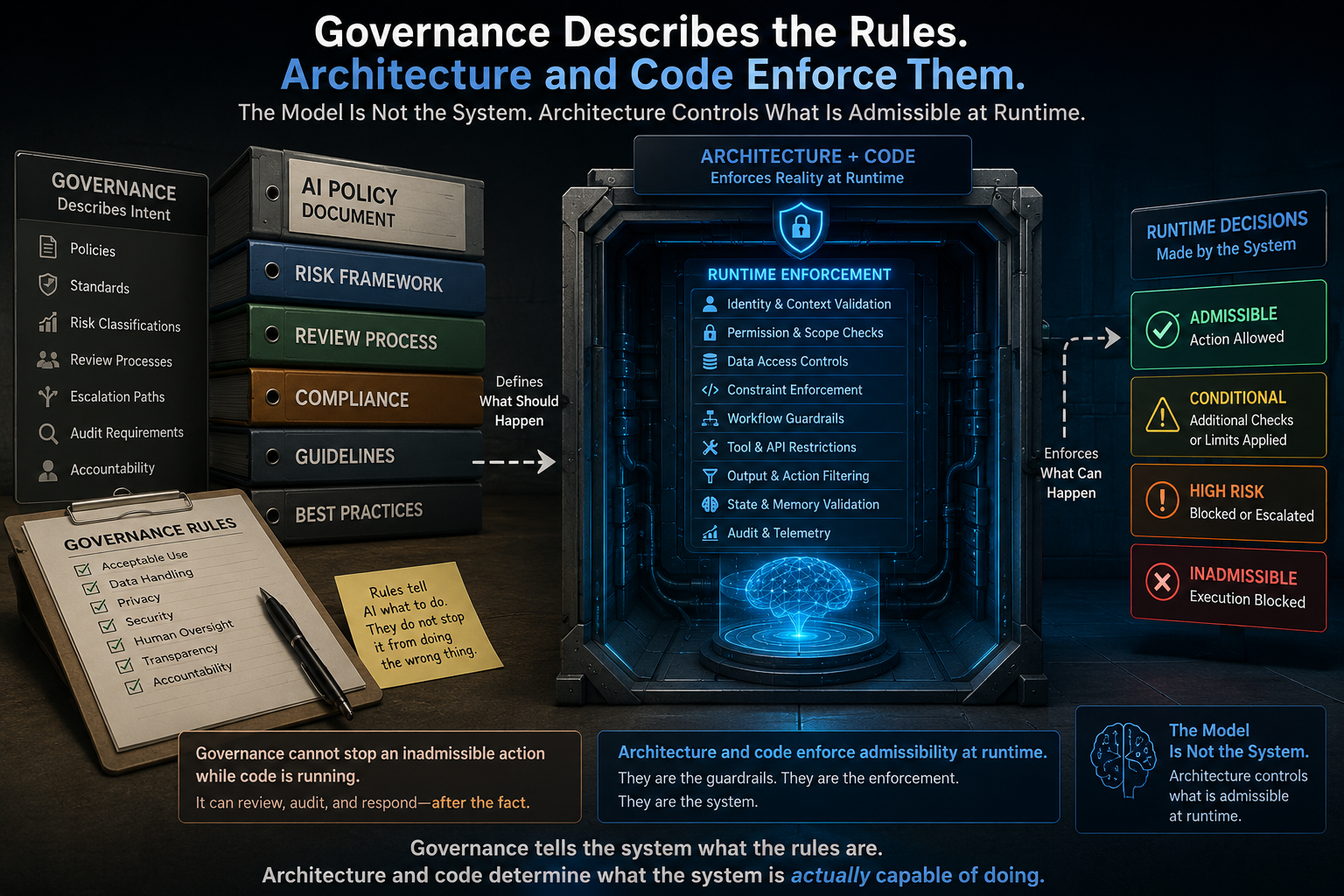
Architecture and Code are the enforcement.
By Chris Ciappa
Founder & Chief Coherence Architect
Samirac Partners
Governance and Architecture Are Not the Same Thing
One of the biggest points still being missed in the enterprise AI discussion is the difference between governance and architecture.
People keep using the terms almost interchangeably, as if governance itself is what controls AI systems during execution.
That is likely the biggest point still being missed is the assumption that governance itself controls AI systems during execution.
It absolutely does not.
Now the shift is coming. Liability is being moved.
The large vendors are not just making an attempt at
They are also:
redistributing operational responsibility
redistributing execution liability
pushing runtime enforcement responsibility downward into the customer architecture layer
That is a MUCH deeper point.
Because once vendors say:
“Operate against your own infrastructure, orchestration, permissions, governance systems, and execution environments…”
they are effectively saying:
“You now own what the system is actually allowed to do operationally.”
I was reading a recent LinkedIn post from Billy Leigh discussing the increasingly controlled deployment models emerging around Claude, Microsoft, AWS, and enterprise AI systems, and something important stood out to me immediately.
The large vendors are quietly beginning to acknowledge where the real operational risk actually lives.
The first deployment model wrapped the model with contractual protections and administrative controls.
The second moved further toward private tenancy and infrastructure isolation.
But the third option was the most revealing:
direct API integration operating against an organization’s own infrastructure, orchestration layers, permissions models, governance systems, and execution environments.
(3) Direct API with Zero Data Retention: skip the Claude UI entirely. Build the prompt-and-response layer on top of your own data infrastructure. Maximum control, more engineering lift.
That progression matters.
Because once enterprise AI vendors start steering organizations toward governed execution environments operating inside their own infrastructure boundaries, they are indirectly acknowledging something extremely important:
the real problem is no longer just model capability.
The real problem is operational authority.
Governance can define policies, establish acceptable use, classify risk levels, define review procedures, assign accountability, and create auditability around a system. Those things matter. They help organizations establish what is supposed to happen conceptually and operationally.
But governance itself does not physically stop an inadmissible action while code is running.
Architecture does.
The Code Is the Enforcement Layer
That distinction matters because once a system is actively executing, a governance document cannot intervene to stop the wrong API call, block an unsafe orchestration chain, prevent invalid memory retrieval, or intercept a workflow operating under corrupted runtime conditions.
Only the runtime architecture implemented in the system itself can do that.
And ultimately, architecture becomes real through code.
The code is the enforcement layer.
This is the part many people still seem confused about. Architecture is not merely a collection of diagrams, governance frameworks, review processes, or conceptual operating models. Architecture only becomes meaningful when it is physically implemented inside the execution paths of the system itself.
If the runtime system can still execute an inadmissible action under a given operational state, then the architecture failed regardless of what the governance documentation said should happen.
That is why governance and architecture operate at fundamentally different layers.
Governance describes intent.
Architecture enforces operational reality.
Why Runtime Admissibility Matters
Once AI systems begin interacting with financial systems, compliance workflows, communications infrastructure, approvals, customer records, tool orchestration layers, or autonomous execution chains, this distinction becomes critically important.
At that point you are no longer dealing with static software operating under fully deterministic human control. You are dealing with probabilistic systems operating dynamically inside changing runtime conditions where context, memory state, permissions, orchestration flows, and operational state can continuously shift.
That is why runtime admissibility matters.
A system may satisfy governance policy, legal review, compliance review, security review, and organizational approval processes, yet still become operationally inadmissible under a specific runtime condition.
The governance framework may say the activity class itself is allowed. But the runtime architecture may still need to block execution because the operational state is invalid, the identity context drifted, the orchestration chain became unstable, the authority boundary is violated, or the surrounding conditions no longer support safe execution.
That determination cannot be made by a policy document after the fact.
It must be enforced by the system itself during execution.
The Model Is Not the System
This is one of the reasons I keep saying:
Lhe LLM is Not the System.
https://coherencearchitect.substack.com/p/the-llm-is-not-the-system
Much of what is currently called “AI governance” still resembles traditional enterprise oversight more than true runtime execution control. Policies, committees, review boards, and risk classifications are important organizational layers surrounding the system, but they are not the mechanism physically constraining execution while the system is running.
The architecture is.
And as AI systems continue gaining increasing operational authority, I suspect this distinction is going to become one of the most important realizations in the entire industry.
The architecture is already defined.
Drift Stack™ Architecture
https://www.samirac.com/drift-architecture
The only question is:
👉 Does your system control what’s allowed at execution—
and is it safe, or does it just react and hope it gets it right?
Architecture Demos
https://www.samirac.com/daisy-demos
Share This Article
If you found this article valuable, share it.
Substack automatically gives every subscriber a personal referral link. When someone subscribes through your share link, it counts toward referral rewards.
Current rewards:
• 3 referrals → 1 month of paid access
• 5 referrals → 6 months of paid access
• 10 referrals → 12 months of paid access
You can share directly using the Share button on this article, or find your personal referral link here:
Get Referral Link
By Chris Ciappa
Founder & Chief Coherence Architect
Samirac Partners