Educational, Institutional & Civic Drift

Great Leaders as National Anchors

Why Civilizations Collapse When Authority Loses Its Human Reference Frame
By Chris CiappaJanuary 7, 20266 min read
LinkedInEmail
Great Leaders as National Anchors

Why Civilizations Collapse When Authority Loses Its Human Reference Frame.

Core Thesis

Great leaders are not remembered because they were powerful, popular, or efficient.

Plenty of powerful leaders disappear into footnotes.
Plenty of popular leaders leave no trace.
Plenty of efficient managers preside over collapse.

Great leaders are remembered because they served as anchors — human reference points that stabilized a nation’s identity during periods of maximum uncertainty.

An anchor does not accelerate systems.
It prevents drift.

When that anchor is lost, institutions drift — slowly at first, then all at once.
When anchoring is replaced with abstractions, committees, or automated authority, collapse accelerates while everyone insists the system is “working as designed.”

That is how civilizations fail without anyone technically breaking the rules.


1. What an “Anchor Leader” Actually Is

An anchor leader does three things simultaneously — and most leaders struggle to do even one.

They define identity.
Not branding. Not messaging. Identity.
Who we are. What this nation stands for. What remains non-negotiable even when it becomes inconvenient.

They set boundaries.
Not guidelines. Not best practices. Boundaries.
What is not permitted — even if allowing it would be faster, easier, or more profitable.

They absorb pressure.
This is the part modern leadership structures actively avoid.
An anchor takes pressure onto themselves so it does not fracture institutions downstream.

They become the load-bearing structure.

They do not outsource legitimacy.
They embody it.

Think of an anchor not as a symbol, but as a physical object.
When the sea is calm, you barely notice it.
When the storm hits, everything depends on whether it holds.


2. Anchors Appear Only During Drift

Anchor leaders do not emerge in stable times.

When institutions are aligned, law is trusted, and reality matches the narrative, anchors are invisible. The system hums. Leadership looks boring.

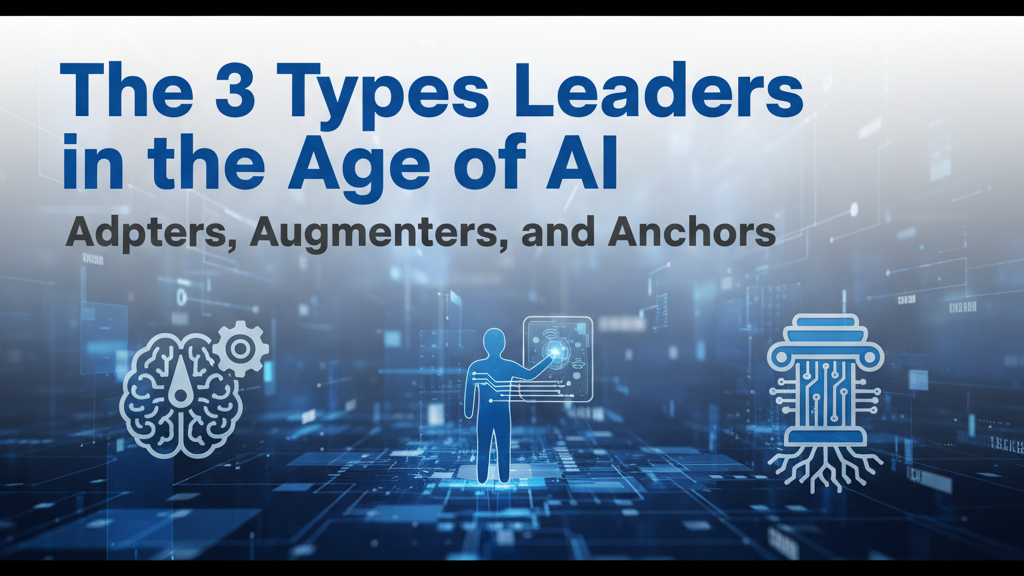
In those periods, leadership is dominated by two other types:

  • Adopters, who move first and embrace new tools, ideas, or systems.

  • Augmenters, who scale, optimize, and accelerate what already exists.

Both are useful when direction is sound.
Neither corrects direction when it isn’t.

Anchors appear only when something fundamental has slipped.

They emerge when:

  • Institutions are misaligned with reality

  • Law exists but no longer commands trust

  • Speed outpaces judgment

  • People sense something is wrong but cannot yet articulate it

This is the moment when language fails before reality does.

People feel the drift before they can name it.

Anchor leaders are not managers of systems.
They are correctors of trajectory.

A manager optimizes what already exists.
An anchor re-orients what has gone off course.

That is why anchor leaders are often uncomfortable, blunt, and disruptive.
They are not here to preserve the system’s feelings.
They are here to keep it from tearing itself apart.


3. Why Bureaucracies Cannot Anchor Nations

Bureaucracies are designed for continuity.
Anchors are designed for coherence.

Those are not the same thing.

A bureaucracy’s job is to keep processes running regardless of whether they still make sense.
An anchor’s job is to stop motion when motion itself becomes dangerous.

Committees diffuse responsibility.
Anchors concentrate it.

That concentration is exactly why bureaucracies distrust anchors — and why nations instinctively search for one when crisis hits.

In moments of drift, people do not ask:

  • “Which framework should we follow?”

  • “Which committee will decide?”

  • “Which dashboard looks best?”

They ask:
Who is willing to stand there and say, “No — not this way”?

That question terrifies modern institutions, because it reintroduces accountability where abstraction once provided cover.


4. Why Anchors Provoke Hatred — Not Disagreement

Anchor leaders don’t just stabilize nations.
They expose drift.

And drifted systems do not respond with debate.
They respond with emotion.

When identity has drifted, people rely on substitutes to stay oriented:

  • slogans instead of principles

  • procedures instead of judgment

  • moral shortcuts instead of responsibility

  • abstractions instead of truth

An anchor does not argue with these frames.
They collapse them.

That collapse feels like an attack.

Here is the part most people miss:
Drift does not feel like confusion. It feels like certainty.

By the time drift sets in, people believe they are morally aligned, procedurally correct, and historically justified. An anchor threatens that self-image.

This pattern is not random. It is the predictable outcome of institutions — beginning with education — that detach individuals from reality while training confidence without grounding.
(See: How America’s Educational Drift Began
https://coherencearchitect.substack.com/p/how-americas-educational-drift-began
and the broader structure at https://www.samirac.com/start-reading)

So the reaction is predictable:

  • accusations instead of arguments

  • outrage instead of analysis

  • claims of danger, extremism, or division

Not because the anchor is wrong —
but because it forces a reckoning.

Anchors present a choice:

  • realign with reality
    or

  • defend the drift

For those who have built careers, status, or identity inside the drift, realignment is existentially expensive.

Hatred becomes cheaper.

This is not politics.
It is cognitive immune response.

Anchors are treated as pathogens because they threaten the host narrative.

Anchors do not divide nations.
They reveal divisions that already exist.


5. The Modern Failure Mode

Today we attempt to replace anchoring with systems that promise neutrality:

  • metrics

  • governance frameworks

  • oversight boards

  • automated decision systems

  • “process-driven” authority

But neutrality cannot anchor.

Only accountable identity can.

Neutral systems cannot say “no” when pressure mounts.
They can only justify why they continued.

That is why modern institutions feel lawful yet illegitimate — correct in process, hollow in trust.

The anchor is gone, and everyone is pretending dashboards can replace it.


6. The Parallel to AI (Without Making It About AI… Yet)

When authority is delegated without a human anchor:

  • decisions accelerate

  • justification replaces judgment

  • drift becomes invisible until failure

Execution outpaces correction.

This is not a technology problem.
It is a leadership architecture problem.

And civilizations that forget this lesson repeat it — whether authority is held by kings, committees, or code.


Closing

Civilizations do not fail because they lack rules.
They fail because no one remains willing — or permitted — to stand as the anchor when the rules begin to drift.


When Systems Wobble, It’s Rarely Random

AI hallucinations. Governance failures. Strategy drift.
Different symptoms — same architectural failure.

Over the past year, I’ve mapped a repeatable failure pattern across AI systems, institutions, markets, and organizations, formalized as the Drift Stack.

The diagnostic identifies which layer is failing — and why coherence is being lost.

If you are deploying AI systems that can take action — deny, trigger, flag, enforce, decide — this call determines whether that authority is safe to delegate.

Drift Architecture Diagnostic — $250
A focused 30-minute architectural review to determine whether the issue sits in:

  • Identity

  • Frame

  • Boundary

  • Drift

  • External Correction

If there’s a deeper structural issue, it becomes visible quickly.
If not, you leave with clarity.

👉 Drift Assessment Info: https://www.samirac.com/drift-assessment

👉 Full work index: https://www.samirac.com/start-reading


Chris Ciappa
Founder & Chief Architect, Samirac Partners LLC
Drift Stack™ · SAQ™ · dAIsy™ · Mind-Mesch™

LinkedInEmail