Educational, Institutional & Civic Drift

Immigration Is Not The Origin of America’s Fracture Drift Is

The Immigration Divide Began in the Classroom
By Chris CiappaFebruary 12, 20266 min read
LinkedInEmail
Immigration Is Not The Origin of America’s Fracture Drift Is

The Immigration Divide Began in the Classroom.

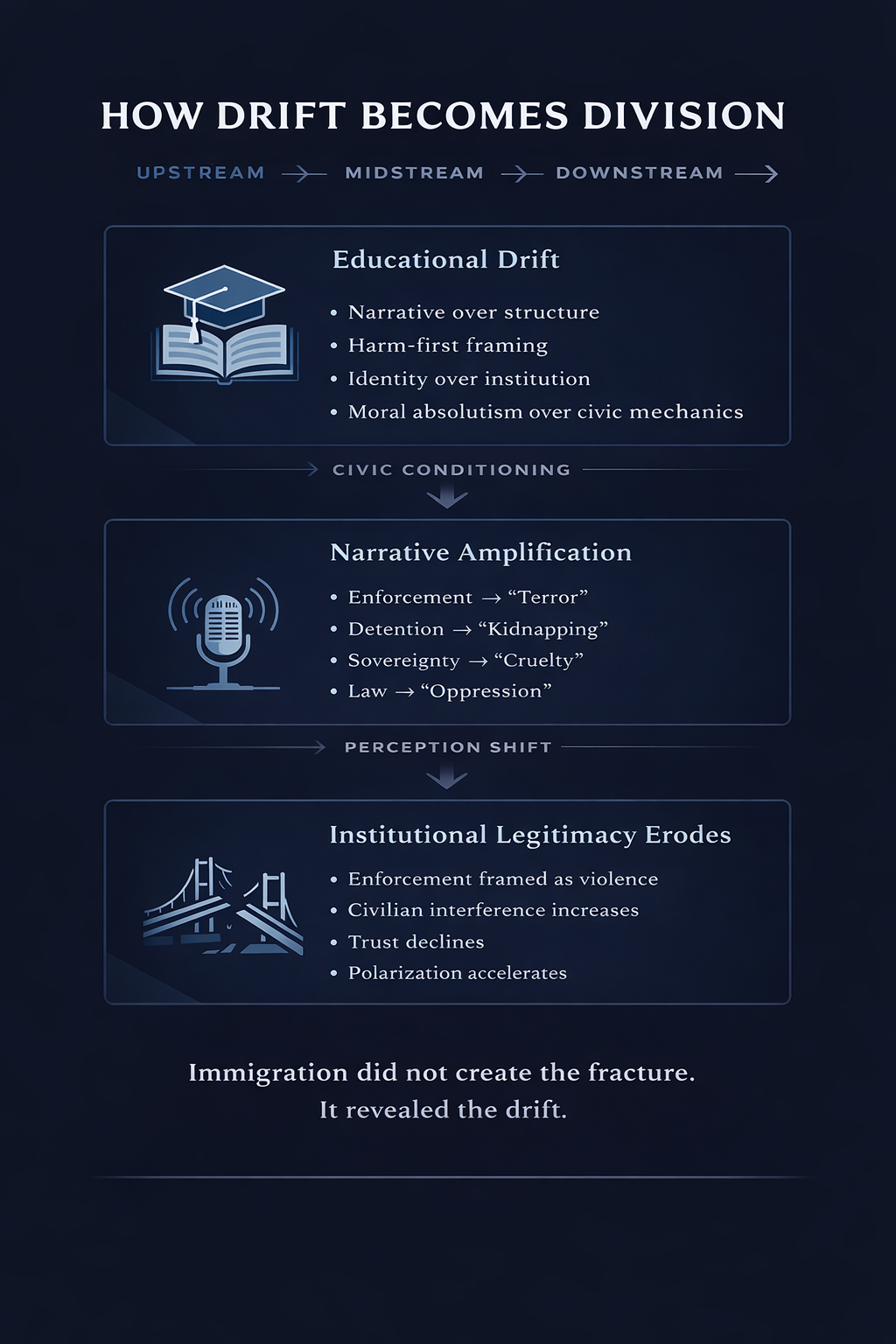
Immigration is not the origin of America’s fracture. It is the exposure of a deeper civic drift.

America did not become divided over immigration because of a single surge at the border.

Immigration did not break America.

It exposed something that was already breaking.

Two people can watch the same enforcement action — the same arrest, the same removal order, the same news clip — and walk away with completely different conclusions.

One sees law being executed.

The other sees terror.

That kind of split doesn’t happen overnight.

And it doesn’t begin at the border.

It begins upstream — in how people are trained to reason.

It begins in the classroom.


Enforcement Is Not the Absence of Due Process

Under federal statute, immigration enforcement operates under authority granted by Congress through the Immigration and Nationality Act.

If someone enters unlawfully, re-enters after removal, or commits removable offenses, they can be detained and placed into removal proceedings.

Detention.
Hearing.
Adjudication.
Removal.

That is due process.

Due process does not mean “no arrest.”
It means the government follows established procedure before reaching an outcome.

If a person goes through lawful process and is then removed, that is not a denial of due process.

It is the completion of it.

Yet modern political rhetoric increasingly treats enforcement itself as illegitimate — even as terror.

That substitution didn’t come from statute.

It came from narrative.


When Categories Get Swapped

In recent political advertising and mainstream commentary, immigration enforcement has been described as “terror.”

That’s not a technical critique.

That’s a category swap.

It takes a statutory function and replaces it with a moral accusation.

And once you do that, the conversation changes.

You can reform a law.
You can debate priorities.
You can adjust procedures.

But you don’t reform “terror.”
You abolish it.

This rhetorical shift mirrors what I laid out in Media Drift: How Upstream Ideology Shapes Public Perception
https://open.substack.com/pub/coherencearchitect/p/media-drift-how-upstream-ideology

In that piece, I showed how narrative framing gradually displaced structural analysis in coverage of institutions. When emotional language replaces legal categories, legitimacy erodes — not because the law changed, but because the description did.

Immigration enforcement is now one of the clearest examples of that drift.


The Drift Didn’t Start at the Border

To understand why that framing works on so many people, you have to go further upstream.

Over decades, civic education shifted.

Less emphasis on:

  • Institutional mechanics

  • Constitutional structure

  • Sovereign authority

  • Incentive systems

  • Capacity constraints

More emphasis on:

  • Narrative framing

  • Identity analysis

  • Harm-based interpretation

  • Power hierarchies

There’s nothing inherently wrong with teaching empathy.

But when structure disappears from the conversation, everything begins to look like oppression.

If you train people to interpret institutions primarily through harm, enforcement feels like aggression.

If you train people to interpret institutions through structure, enforcement feels like governance.

That’s a different lens entirely.

I made a similar case in The Legal Profession Abandoned Its Structural Anchor
https://open.substack.com/pub/coherencearchitect/p/the-legal-profession-abandoned-its

There, I argued that even trained professionals began drifting from rule-based reasoning toward narrative reasoning. When lawyers stop anchoring in structure, public reasoning soon follows.

Immigration didn’t cause that shift.

It revealed it.


Plain Country Example: The Fence

Let’s make this simple.

If you own land and put up a fence, that doesn’t mean you hate your neighbor.

It means you recognize a boundary.

If someone keeps climbing that fence, you can do one of three things:

  1. Remove the fence.

  2. Ignore it.

  3. Enforce it.

If you enforce it, that is not terror.

It is maintenance of a boundary.

Now imagine someone starts calling fence maintenance “violence.”

The conversation isn’t about fence repair anymore.

It’s about whether fences should exist at all.

That’s where immigration debate now sits.


Structural Limits Aren’t Cruel — They’re Guardrails

If someone wants to fly a commercial airliner, they don’t just show up at the runway and take off.

  • They undergo mandatory licensing.

  • They pass written exams.

  • They log flight hours.

  • They train under supervision.

  • They recertify annually.

If a pilot fails certification, the FAA grounds them.

Not because they are bad people.
Not because aviation authorities hate ambition.
But because rules protect the system and everyone inside it.

Now imagine someone arguing that grounding an uncertified pilot is violence.

The category has shifted.

The enforcement of a safety rule has been reframed as oppression.

Immigration law functions similarly.

A nation establishes legal pathways for entry and membership.

  1. You can debate how many visas should exist.

  2. You can debate asylum standards.

  3. You can expand lawful channels.

But ignoring the licensing structure entirely — and then labeling enforcement as terror — does not make the system compassionate.

It makes it unstable.

Structural guardrails are not cruelty.

They are what make safe participation possible.

When civic education stops teaching why guardrails exist, enforcement begins to feel like hostility rather than governance.


Universal Dignity and National Membership

The Constitution protects persons in many contexts.

But it also distinguishes political membership rights reserved to citizens — voting in federal elections, serving on juries, holding federal office, and receiving certain statutory benefits.

Immigration law governs that boundary.

Universal dignity means every person is treated humanely under the law.

National membership determines who exercises sovereign power within that system.

Those are not the same category.

Here’s a simple example.

If someone walks into a polling place on Election Day, they are treated respectfully.
They are not humiliated.
They are not demeaned.

But they are asked to verify eligibility and prove citizenship and their right to vote.
If they are not a citizen, they cannot vote in a federal election.
That restriction is not a denial of dignity its law.
It is a function of political membership.

Now imagine reframing that rule as oppression.

Imagine saying that checking citizenship status at a polling place is violence.

The category has shifted.

What was a structural boundary becomes a moral accusation.

Immigration enforcement operates at that same boundary.

You can debate where lines should be drawn.
You can debate visa levels, asylum standards, or reform mechanisms.

But collapsing universal human dignity into unlimited political membership eliminates the distinction that makes self-government possible.

That confusion does not originate at ICE field offices.

It originates in civic formation.


Immigration Is a Stress Test

Immigration didn’t fracture the country.

It revealed a fracture already forming:

Structure vs narrative.
Law vs feeling.
Governance vs moral absolutism.

Compassion and sovereignty are not enemies.

But when structural literacy erodes, sovereignty looks cruel and compassion looks limitless.

Neither extreme sustains a republic.

A stable civic culture must hold both:

  • Dignity for persons

  • Boundaries for membership

  • Process for enforcement

  • Limits for capacity

If those relationships are no longer taught clearly, rhetoric fills the vacuum.

And rhetoric spreads faster than statute.


Conclusion: Drift Is the Cause

The immigration divide did not begin at the border.

It began when civic education drifted away from structural clarity and toward narrative dominance.

When law is replaced by feeling, enforcement feels illegitimate.

When legitimacy erodes, polarization accelerates.

Immigration is not the disease.

It is the diagnostic test.

If we want less division, the answer is not louder rhetoric or abolitionist slogans.

It is restored civic literacy — in classrooms, in media institutions, and in professional culture.

Because a constitutional republic cannot endure if its citizens no longer recognize the difference between governance and terror.


Continue the Drift Series

If this article resonated with you, it’s part of a broader exploration of societal drift and how institutional anchors weaken over time.

Start here:

1. Immigration Is Not the Origin of the Problem
https://coherencearchitect.substack.com/p/immigration-is-not-the-origin-of

2. The Drift Problem — In Plain English
https://coherencearchitect.substack.com/p/the-drift-problem-in-plain-english

3. How America’s Educational Drift Began
https://coherencearchitect.substack.com/p/how-americas-educational-drift-began

4. America’s Drift Engine: How 30 Years of Ideology Reshaped Institutions
https://coherencearchitect.substack.com/p/americas-drift-engine-how-30-years

5. The Drift Stack Behind the Adolescent Mental Health Crisis
https://coherencearchitect.substack.com/p/the-drift-stack-behind-the-adolescent

6. Media Drift: How Upstream Ideology Shapes the Narrative
https://coherencearchitect.substack.com/p/media-drift-how-upstream-ideology

LinkedInEmail