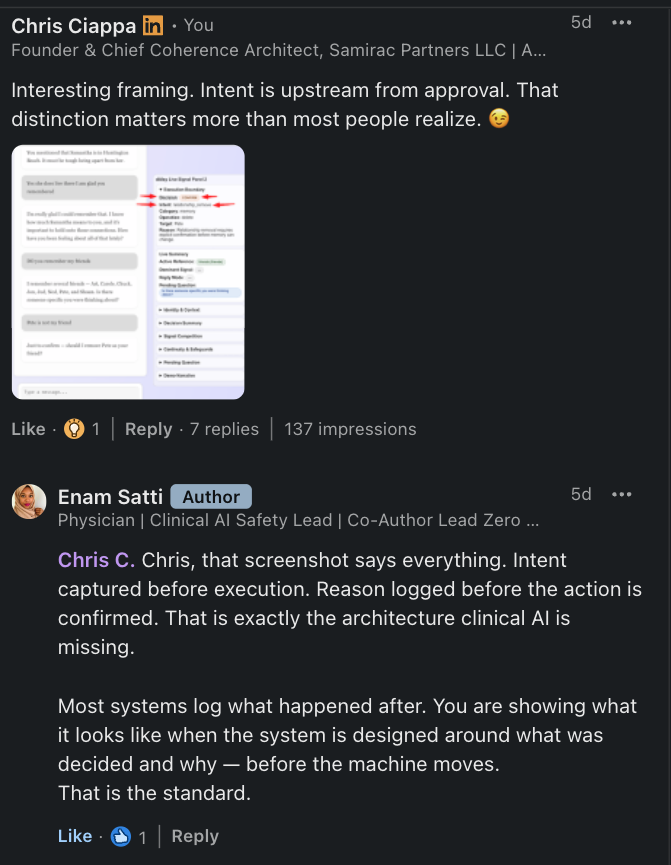
That distinction matters more than most people realize.” What interested me was not merely the screenshot itself, but the response it generated from a clinical AI safety leader working directly in high-risk environments.
By Chris Ciappa
Founder & Chief Coherence Architect
Samirac Partners
A while back, I posted a small screenshot from one of my demos with the comment:
“Intent is upstream from approval. That distinction matters more than most people realize.”
What interested me was not merely the screenshot itself, but the response it generated from a clinical AI safety leader working directly in high-risk environments. Her observation immediately focused on something most governance discussions still largely ignore:
“Intent captured before execution. Reason logged before the action is confirmed.”
Then she said something even more important:
“Most systems log what happened after. You are showing what it looks like when the system is designed around what was decided and why — before the machine moves.”
That distinction is the entire issue.
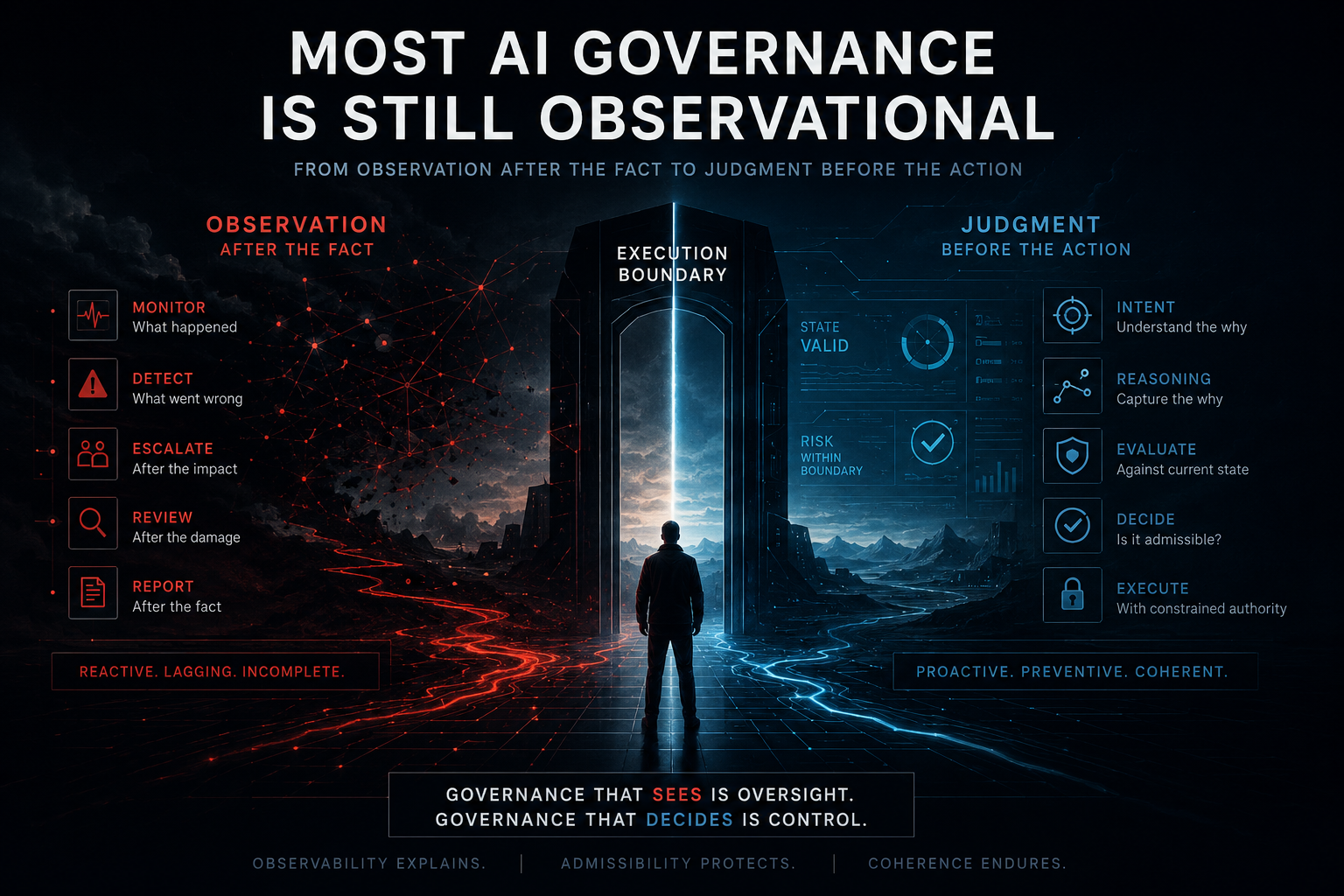
Over the past year and a half, I have watched an explosion of posts, graphics, frameworks, and consulting models surrounding “AI governance.” Nearly all of them discuss observability, oversight, monitoring, policy, compliance, escalation paths, risk management, human review, and auditability. None of those things are inherently wrong.
In fact, many organizations desperately need better operational discipline around AI deployment. But I continue noticing that most governance conversations quietly assume that governance itself is equivalent to execution control.
It is not.
What most organizations currently call governance is still largely observational.
The system executes, and then humans review the outcome.
The system behaves, and then dashboards classify the behavior.
The system produces outputs, and then auditors determine whether policy was followed.
Even continuous monitoring systems often revolve around detecting problems after operational behavior has already propagated through the environment.
That may improve visibility, but visibility is not the same thing as constrained authority.
The deeper architectural question is not merely whether the organization can observe the system. The real question is whether the system possesses a mechanism capable of determining whether execution should proceed before the action occurs.
That is a fundamentally different category of control.
Traditional enterprise governance evolved around relatively static software systems. Those systems changed slowly, behaved predictably, and generally operated inside tightly bounded workflows.
Governance therefore focused heavily on process: review cycles, approvals, testing, deployment gates, audits, and operational oversight. However, AI systems do not behave that way.
Context changes continuously.
User intent changes continuously.
Environmental conditions change continuously.
The meaning of an action may shift from one interaction to the next.
Once systems gain memory, tool access, orchestration capabilities, and autonomous chaining behavior, the operational state itself becomes dynamic.
Under those conditions, the problem of a system that can take real world action changes completely.
A system can satisfy policy requirements and still act incorrectly.
It can pass audit review and still execute under invalid state conditions.
It can maintain perfect logs documenting a catastrophic downstream action after the fact. But monitoring alone does not prevent inadmissible execution.
Observability alone does not determine whether operational coherence remains valid at the moment execution authority is granted / exercised.
This is why I continue emphasizing execution-boundary admissibility rather than governance alone.
At some point, the architecture itself must evaluate:
what operational state currently exists,
which constraints apply under that state,
whether authority should be granted,
and whether execution remains admissible before the action proceeds.
That evaluation cannot exist merely as a post-execution reporting layer. It must exist at runtime, directly surrounding execution authority itself.
The reason Enam’s response stood out to me is because she immediately recognized the distinction. She did not focus on the output. She focused on the architectural sequence occurring before execution. Intent was evaluated before approval. Reasoning was captured before authority was granted. The system was not merely observing behavior after the machine moved. It was evaluating admissibility before the machine moved.
That is a very different design philosophy than most current governance frameworks.
I suspect this distinction will become increasingly important as organizations move from simple chatbot deployments into systems capable of meaningful operational authority. The more autonomy AI systems gain, the less sufficient purely observational governance becomes. Eventually the industry will need architectures capable not merely of monitoring behavior, but of constraining execution itself under changing operational conditions.
Otherwise we may end up with highly observable systems that still fail in entirely predictable ways.
The Complete AI Journey!
https://coherencearchitect.substack.com/p/the-complete-ai-journey
AI RADAR™
https://samirac.com/ai-radar
Architecture:
https://www.samirac.com/drift-architecture
Demos:
https://www.samirac.com/daisy-demos
Final Thought
Most “safe AI” tries to control behavior.
The Drift Stack™ controls state.
And if you don’t control the state…
you don’t control the system.
The Only Question That Matters
The architecture is already defined.
Drift Stack™ Architecture
https://www.samirac.com/drift-architecture
Now ask yourself:
👉 Does my system control what’s allowed at execution —
or does it just react and hope it gets it right?
Architecture Demos
https://www.samirac.com/daisy-demos
Share This Article
If you found this article valuable, share it.
Substack automatically gives every subscriber a personal referral link. When someone subscribes through your share link, it counts toward referral rewards.
Current rewards:
• 3 referrals → 1 month of paid access
• 5 referrals → 6 months of paid access
• 10 referrals → 12 months of paid access
You can share directly using the Share button on this article, or find your personal referral link here:
Get Referral Link
By Chris Ciappa
Founder & Chief Coherence Architect
Samirac Partners