Runtime Control, Agents & Execution

Structure Builds Reality

Policy Defines it

By Chris CiappaMay 15, 20265 min read
LinkedInEmail
Structure Builds Reality

Policy Defines it.

By Chris Ciappa
Founder & Chief Coherence Architect
Samirac Partners


Systems Obey Structure

As AI systems, distributed orchestration, automation layers, and large-scale operational platforms continue expanding across the enterprise world, organizations are going to face a problem many of them still do not fully understand:

The people most capable of structurally stabilizing complex systems are often the very people organizations underestimate the most.

This observation is somewhat adjacent to many of the strategic thinking, architecture, drift, and execution-boundary articles I have written over the past year, but this particular discussion is more practical and organizational in nature. I am posting it partly because I believe many organizations are looking for the wrong signals when trying to identify the people who can actually build, reconcile, stabilize, and implement complex systems successfully.

In many cases, organizations dramatically underestimate the difference between someone who can write code and someone who can architect systems.


The Misunderstanding

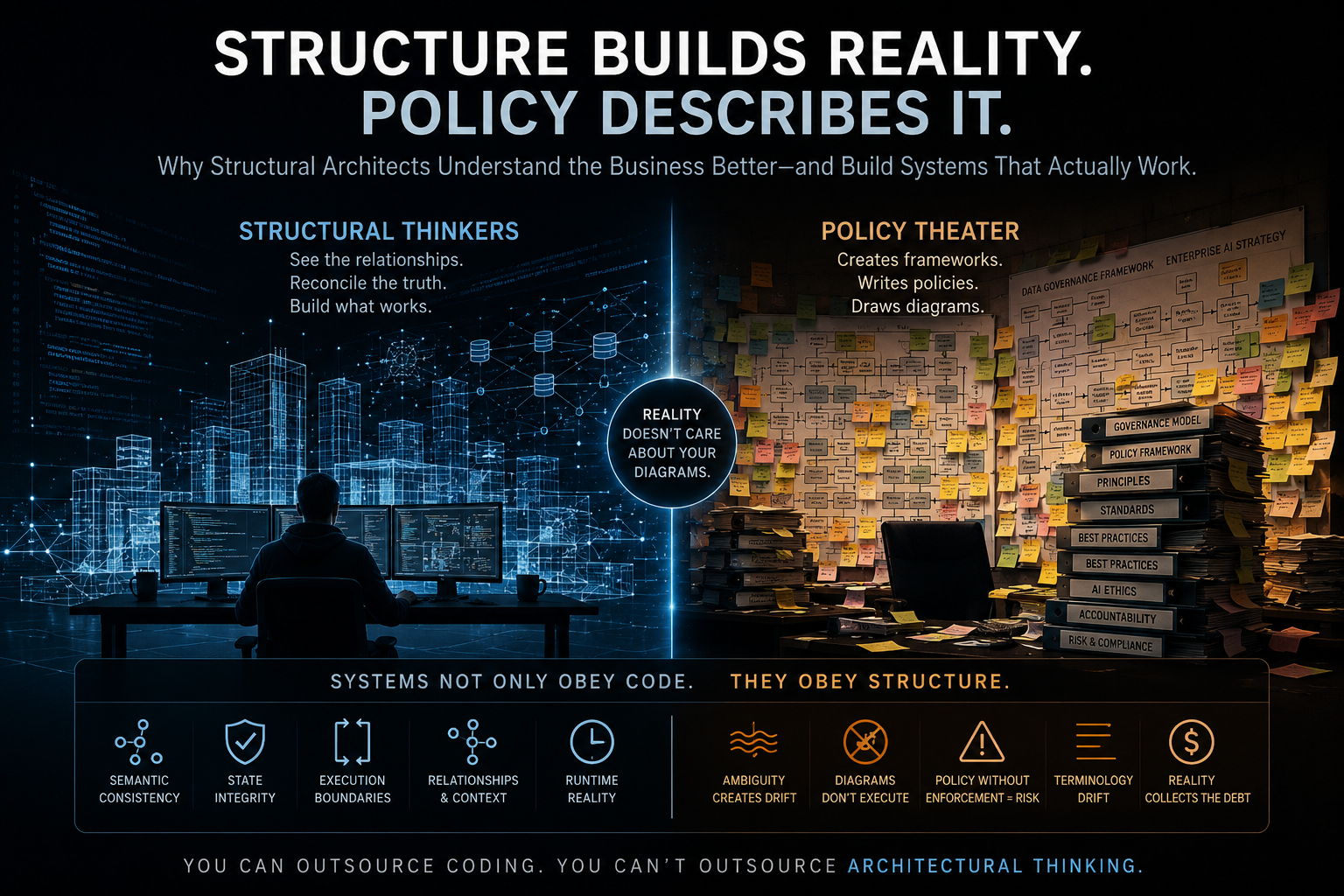
One of the more revealing patterns inside large organizations is how structural architects are sometimes discussed by governance-heavy or executive-heavy groups. They are often casually reduced to “the coding people” or “the technical geeks,” as though their role is simply to translate instructions handed down by organizational storytellers, policy committees, or governance frameworks.

But that framing fundamentally misunderstands what serious systems architecture actually requires.

There is a very important distinction between a programmer who knows a language and a structural architect who understands systems. Those two things overlap sometimes, but they are not automatically the same discipline.

An organization can hire developers who are perfectly capable of implementing specifications, building APIs, wiring services together, following tickets, creating interfaces, and producing functional software. Many of those developers are highly intelligent and extremely competent within the scope they are given.

But architecture requires a different layer of cognition entirely.

The architect is not merely thinking about whether the code compiles or whether a feature technically works. The architect is continuously reconciling terminology, process flow, permissions, semantic consistency, operational behavior, downstream dependencies, scalability, state propagation, failure modes, and execution consequences simultaneously.

The architect is constantly asking:

What assumptions conflict beneath the surface?
What breaks downstream?
What happens when systems interact under stress?
Where can drift emerge over time?
What operational behavior appears safe locally but becomes unstable globally?

That kind of thinking is very different from simply implementing requirements.


The Difference Between Coding and Architecture

This is also why large implementation teams still require strong architectural leadership. A developer may correctly implement exactly what was specified and still not recognize semantic inconsistency, broken reconciliation logic, invalid assumptions, propagation risk, or future scalability collapse. Not because they are unintelligent, but because they are operating within the boundaries they were assigned.

The architect, by contrast, is responsible for seeing the larger system and understanding how all of the moving pieces interact over time.

That distinction matters more than many organizations realize.

A serious architect is not simply “better at coding.” In many cases, the architect understands the operational business more deeply than many people writing the policies around it, because architecture forces confrontation with reality. The architect cannot hide behind abstraction forever. Eventually the system either reconciles structurally or it does not.

That is one reason many experienced architects become skeptical of governance frameworks built primarily from abstraction, taxonomy, presentation language, or policy diagrams without deep structural reconciliation underneath them.

A governance document can tolerate ambiguity for years.

A runtime system cannot.


Where Architecture Meets Reality

I saw this constantly during the data warehouse era.

One group would call something “BMW Z3.” Another group would shorten it to “Z3.” Somewhere else it became “Series 3.” To many governance or business-oriented groups, those differences sounded trivial or “close enough.”

Structurally, they were not the same thing.

To the architect, that inconsistency represented a problem waiting to surface later under scale, reporting, automation, reconciliation, or analytics.

Eventually, reports aggregate incorrectly. Joins fail. Dimensions drift apart. Analytics diverge. Downstream automation misclassifies data. Operational decisions begin getting made from fragmented or contradictory truth. Then leadership acts surprised when dashboards no longer reconcile with reality.

The architect often saw the problem years earlier.

Not because the architect merely “understood coding,” but because the architect understood structural reconciliation and operational coherence.

Systems eventually obey structure, not organizational narrative.

That principle becomes even more important once AI systems, autonomous workflows, distributed agents, and runtime orchestration layers begin interacting with each other continuously under changing conditions.

The farther a framework drifts from operational structure and runtime behavior, the more fragile it eventually becomes.

And AI systems are about to expose the difference between organizational storytelling and structural understanding at a scale most enterprises are completely unprepared for.


Related Reading

Several related articles expand on the broader organizational, architectural, strategic, and cognitive themes discussed here:

These pieces connect structural thinking, organizational drift, leadership cognition, execution behavior, systems architecture, and runtime operational coherence into a broader systems-level framework.


The Only Question That Matters

The architecture is already defined.

Drift Stack™ Architecture
https://www.samirac.com/drift-architecture

The only question is:

👉 Does your system control what’s allowed at execution—
and is it safe, or does it just react and hope it gets it right?

Architecture Demos
https://www.samirac.com/daisy-demos


Share This Article

If you found this article valuable, share it.

Substack automatically gives every subscriber a personal referral link. When someone subscribes through your share link, it counts toward referral rewards.

Current rewards:

3 referrals → 1 month of paid access
5 referrals → 6 months of paid access
10 referrals → 12 months of paid access

You can share directly using the Share button on this article, or find your personal referral link here:

Get Referral Link


By Chris Ciappa
Founder & Chief Coherence Architect
Samirac Partners

LinkedInEmail
← Return to the Reading SpineOriginal publication