By Chris Ciappa
Founder & Chief Coherence Architect
Samirac Partners
There’s a growing wave of diagrams trying to explain how AI fits into the modern technology stack.
Most of them get a lot right.
They show the progression:
infrastructure
platforms
tooling
AI-assisted development
And they reinforce an important idea:
abstraction doesn’t eliminate expertise—it relocates it.
That part is true.
But many of these interpretations make a subtle mistake at the top.
The Category Mistake
Some models treat the top layer as things like:
AI-assisted developers
prompt engineering
copilots and tooling
That’s not wrong in isolation.
But it is a category mistake.
Why?
Because those are still implementation concerns.
They describe how something is built—not what is allowed to happen.
What’s Missing
Every real system—AI or otherwise—has an implicit layer that determines:
what actions are allowed
what is blocked
what must be modified
what requires escalation
This layer is often invisible in diagrams.
But it’s the one that actually matters.
Execution Authority
Call it what you want:
control plane
policy enforcement
admissibility layer
Functionally, it does one thing:
It decides what is allowed to execute.
And critically—it does this before execution, not after.
Why This Distinction Matters
If a system:
generates an output
and then evaluates whether to act on it
…it already had authority.
At that point, you’re not controlling the system.
You’re reviewing it.
That’s not prevention.
That’s post-hoc filtering.
Real Example
In a recent case, lawyers were fined $110,000 after submitting legal filings that included fabricated case citations generated by AI.
The system:
generated arguments
produced citations
and those outputs were used in a real filing
Only after the fact was it discovered that the citations didn’t exist.
This is exactly the failure:
The system allowed output to become action
before admissibility was enforced.
At that point, the AI already had authority.
Reviewing it afterward wasn’t control.
It was damage control.
A controlled system would never allow:
unverified citations
ungrounded claims
or unvalidated outputs
to cross the execution boundary.
In other words, the architecture enforces this:
Enforced at the architectural boundary — not dependent on any single function or check, implemented through code as invariant state constraints.
Until a citation has passed all validation checks, execution is not possible.
No valid state → no execution.
The system doesn’t “flag it” or “review it later.”
If the required state is not satisfied, execution is not possible.
It prevents it from becoming actionable in the first place.
That’s the distinction:
Not whether the model is accurate.
But whether the system allows it to act before it’s proven safe to act.
Real Control Requires Structure
A system with actual control enforces:
Admissibility gates
Identity and context anchoring
Invariant enforcement
Drift detection and correction
These are not features added on top.
They are architectural constraints that exist above the stack.
Reframing the Stack
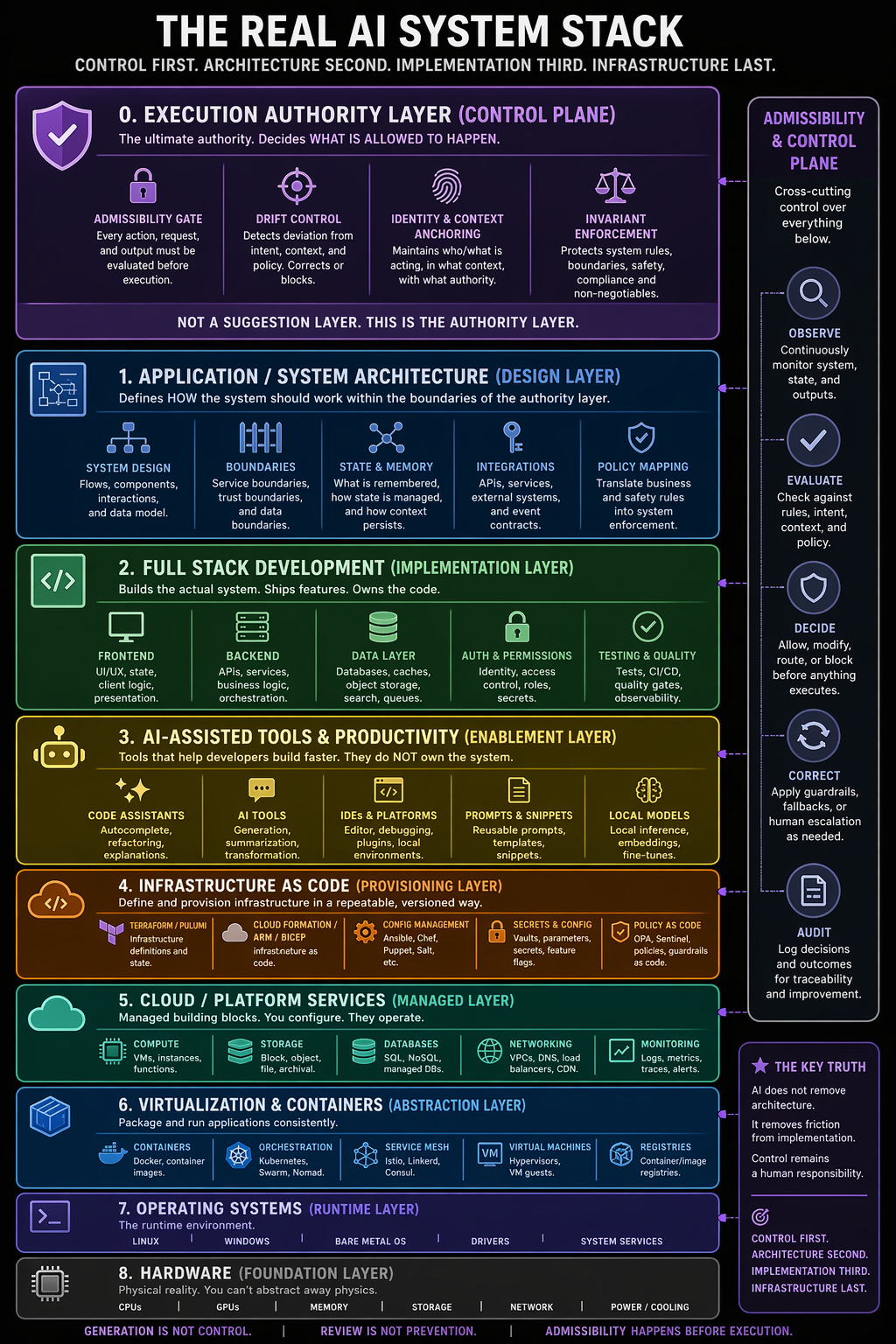
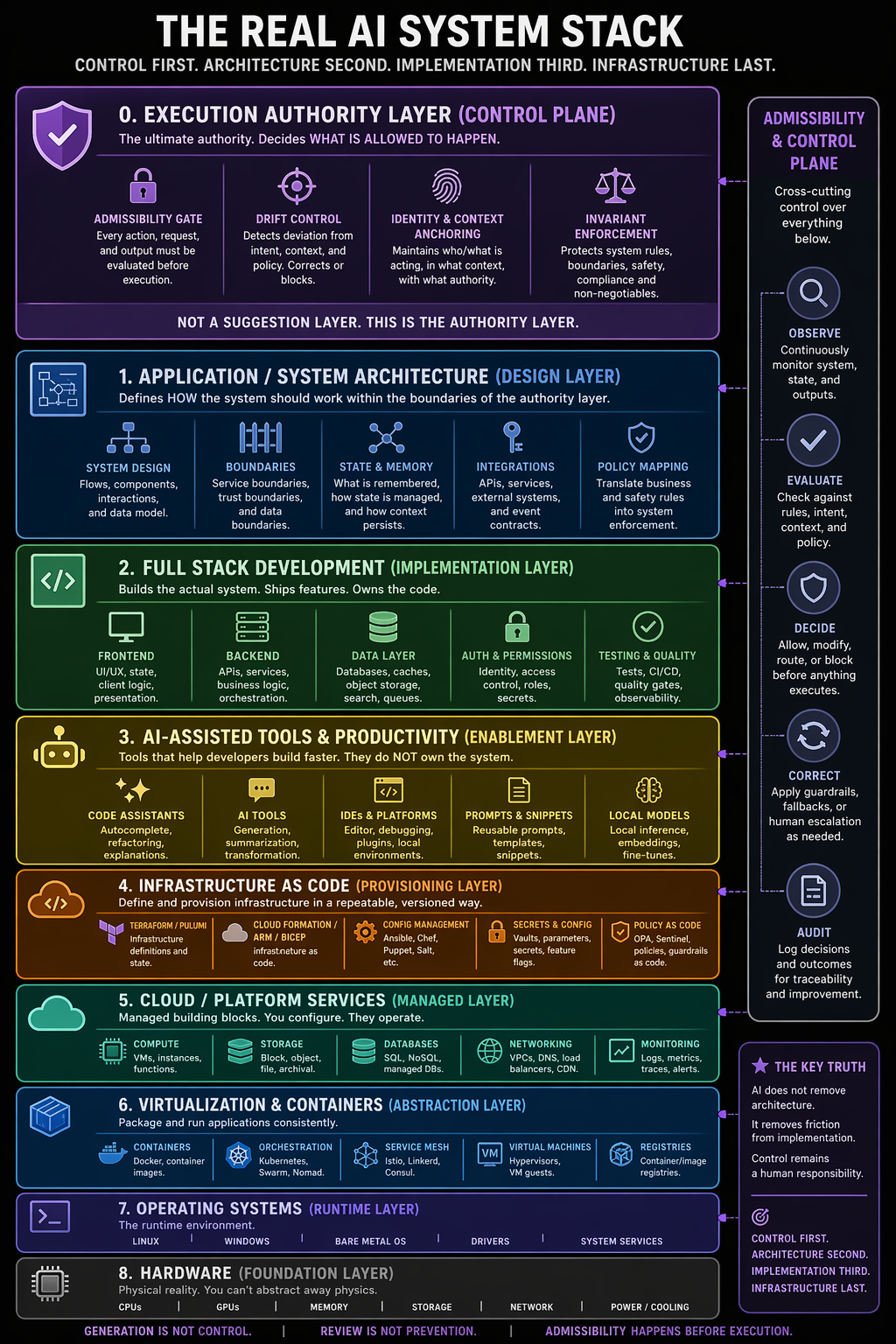
Once you correct the category mistake, the structure becomes clearer:
This isn’t unique to AI — it reflects a broader shift in how modern systems must be structured.
I break that down more fully here:
Modern IT Architecture: A Structural Organization Model
https://coherencearchitect.substack.com/p/modern-it-architecture-a-structural
Execution Authority (Control Layer)
Defines what is admissible.
Application / System Architecture
Defines how the system operates within those constraints.
Full-Stack Development
Implements the system.
AI-Assisted Tooling
Accelerates development, but does not define control.
Infrastructure Layers
Provisioning, compute, storage, runtime.
The Takeaway
AI has changed how we build.
It has not changed where responsibility lives.
Final Thought
Abstraction didn’t remove the need for control.
It made it easier to forget where control actually belongs.
Control is not part of the stack.
It governs the stack.
The Only Question That Matters
The architecture is already defined.
Drift Stack™ Architecture
https://www.samirac.com/drift-architecture
Now ask yourself:
👉 Does my system control what’s allowed at execution —
or does it just react and hope it gets it right?
Architecture Demos
https://www.samirac.com/daisy-demos
Share This Article
If you found this article valuable, share it.
Substack automatically gives every subscriber a personal referral link. When someone subscribes through your share link, it counts toward referral rewards.
Current rewards:
• 3 referrals → 1 month of paid access
• 5 referrals → 6 months of paid access
• 10 referrals → 12 months of paid access
You can share directly using the Share button on this article, or find your personal referral link here:
By Chris Ciappa
Founder & Chief Coherence Architect
Samirac Partners