By Chris Ciappa
Founder & Chief Coherence Architect
Samirac Partners
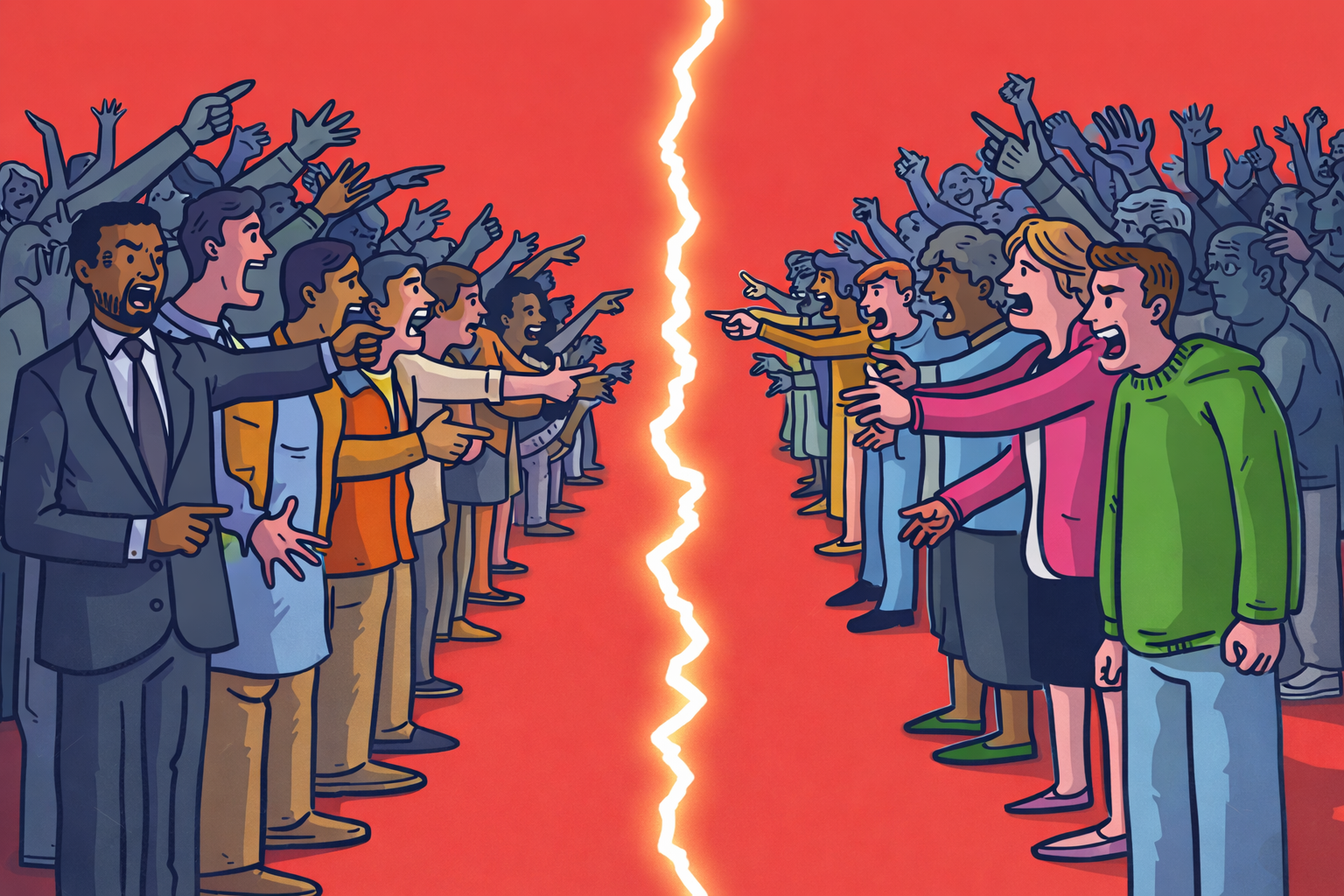
This isn’t about truth. It’s about identity.
Everyone thinks they’re rational.
Everyone thinks they’re defending truth.
Most are defending a tribe—and calling it truth.
What is a tribe?
A tribe is not defined by what it is called.
A tribe is defined by how it behaves.
A system becomes a tribe when:
Identity is tied to belief (“If this is wrong, I am wrong”)
Beliefs are defended, not tested
Contradiction is treated as an attack
Membership requires alignment, not accuracy
Status is gained by loyalty, not correctness
You can see it in action:
Politics: “My party can’t be wrong”
Professions: “Our model is the standard”
Tech: “This stack is the future, everything else is obsolete”
AI: “Claude vs GPT” treated like a rivalry instead of tools
None of these are supposed to be belief systems.
None of them should be defended as such.
But they’ve become exactly that.
A real example (every single day)
Go on LinkedIn. You’ll see it immediately:
the Claude camp
the “vibe coding” crowd
the governance/policy camp
the systems/architecture camp
Watch what happens when one challenges another.
The response is almost never:
“Let’s examine that.”
Instead, the pattern is:
Defend
Deflect
Attack
What’s missing:
No real engagement with the claim
No breakdown of the argument
No attempt to evaluate truth
The position isn’t being defended because it’s correct.
It’s being defended because it’s theirs.
Where this shows up most clearly (and most dangerously)
This pattern isn’t limited to politics or social media.
It shows up strongest in places that claim to be objective.
Academia
Research institutions
Credential-gated domains
In these environments:
Credentials become identity
Identity becomes authority
Authority becomes protection from challenge
At that point:
Arguments are not evaluated based on correctness
They are filtered based on who is allowed to make them
This creates a failure mode:
Incorrect ideas can persist for years
Not because they are correctBut because they are institutionally protected
And challenges are dismissed before they are examined
Not on merit
But on source
The shift that causes the damage
At some point, people stop asking:
“What is true?”
And start asking:
“What does my side believe?”
That’s the moment thinking stops.
From there:
Identity begins to shift (subtly at first)
The frame of view distorts
Everything downstream changes
What that looks like:
Facts get selected, not evaluated
Opposing views aren’t analyzed, they’re attacked
Questions become threats
Relates Directly To:
America’s Drift Engine — How 30 Years Rewired the Stack
(How identity replaced evaluation — long before it showed up in everyday thinking)
Why it escalates so fast
Tribalism doesn’t just protect ideas.
It protects identity.
So when someone challenges the idea, the brain interprets it as:
“They’re attacking me.”
Even when they’re not.
Because identity has fused with the position.
Once that happens, collapse propagates:
Identity → Frame → Interpretation → Response
And you can watch it unfold:
Disagreement → hostility
Hostility → contempt
Contempt → dehumanization
Once people are dehumanized, the outcome is predictable.
The modern version (this is the dangerous part)
We are now embedding tribalism into intelligent systems.
Examples:
AI outputs shaped by bias
Domains defending flawed models
Institutions protecting narratives instead of correcting them
And now we’re doing something worse:
We’re giving these systems the ability to act.
All while:
ignoring admissibility
ignoring drift
ignoring boundary enforcement
Every time someone deploys:
a low-code agent
a stitched workflow
an ungoverned automation into production
They are scaling their own unexamined assumptions.
This is automated tribalism.
And it reinforces itself.
What gets lost
Reality doesn’t belong to a tribe.
Truth doesn’t vote.
Systems don’t care which side you’re on.
When tribalism takes over:
Bad ideas survive because they’re protected
Good ideas get rejected because they come from the wrong side
Real problems go unsolved
The bigger cost
This isn’t just annoying. It’s destructive.
It leads to:
broken policy
failed systems
social fragmentation
and in extreme cases, violence that escalates rapidly
Not because people are evil.
Because they stopped evaluating, stopped thinking, and started defending.
If you want to go further
Everything above is observable in real conversations.
But observation alone isn’t enough.
If you want to separate signal from noise, you need a consistent way to evaluate what you’re seeing.
Because once you start measuring it, patterns become obvious very quickly.
This isn’t just something you notice.
It can be measured.
A method for detecting tribalism in real time.
Behind the wall
In the next section, we move from observation to measurement.
A simple scoring framework
How to apply it to real responses
What patterns emerge when you do
Using actual comment threads as examples.
No theory. Just observable behavior.
Measuring Tribalism in Real Time
If everything above is accurate, then it should be observable—not just qualitatively, but consistently.
So instead of arguing with responses, we evaluate them.
The Framework
Each response is scored across five dimensions.
Each category is scored from 0 to 2.
1) Engagement with the claim
0 → Ignores the claim / deflects
1 → Partially engages
2 → Directly addresses the argument
2) Evidence vs assertion
0 → Pure opinion / slogans
1 → Some reasoning
2 → Clear logic or supporting evidence
3) Emotional vs analytical tone
0 → Reactive / hostile / dismissive
1 → Mixed tone
2 → Calm, analytical
4) Identity defense signals
0 → “my side vs your side” framing
1 → Mild bias / subtle alignment
2 → No identity attachment
5) Openness to revision
0 → Absolute certainty / closed
1 → Slight flexibility
2 → Acknowledges uncertainty or conditions
Scoring Interpretation
0–3 → Tribal response
4–6 → Mixed / transitional
7–10 → Analytical / non-tribal
Example (what this looks like in practice)
Response:
“This is nonsense. You clearly don’t understand how AI works. Stick to your lane.”
Score:
Engagement: 0
Evidence: 0
Tone: 0
Identity: 0
Openness: 0
Total: 0/10 → Tribal
Response:
“I disagree with your framing on agents. I think you’re underestimating current safeguards. Here’s why…”
Score:
Engagement: 2
Evidence: 1–2
Tone: 2
Identity: 2
Openness: 1–2
Total: 7–9 → Analytical
What happens when you apply this
Patterns emerge quickly:
Most responses cluster in the 0–3 range
A smaller group sits in 4–6
Very few reach 7+
You don’t have to argue.
You don’t have to respond emotionally.
You don’t even have to defend your position.
You apply the framework—and the behavior reveals itself.
Why this matters
This turns:
opinion → observation
argument → measurement
noise → pattern
You’re no longer saying:
“People are being tribal.”
You’re showing:
“This is how tribal behavior presents itself—consistently.”
The way out (simple, not easy)
Detach identity from ideas.
Ask:
Is this actually true?
Does this work the way I think it does?
What breaks if I’m wrong?
Am I willing to drop this if it fails?
Final thought
If you can’t question your own side, you’re not thinking.
You’re enlisted.
Chris Ciappa
Independent Systems & Coherence Architect
Samirac Partners LLC