Drift Stack™ Foundations

The Drift Problem: The Hidden Pattern Behind System Failure

From wrinkled fingertips to financial markets to artificial intelligence, the same structural pattern appears everywhere: systems drift unless something detects and corrects it.
By Chris CiappaMarch 7, 20264 min read
LinkedInEmail
The Drift Problem: The Hidden Pattern Behind System Failure

By Chris Ciappa
Founder & Chief Coherence Architect
Samirac Partners

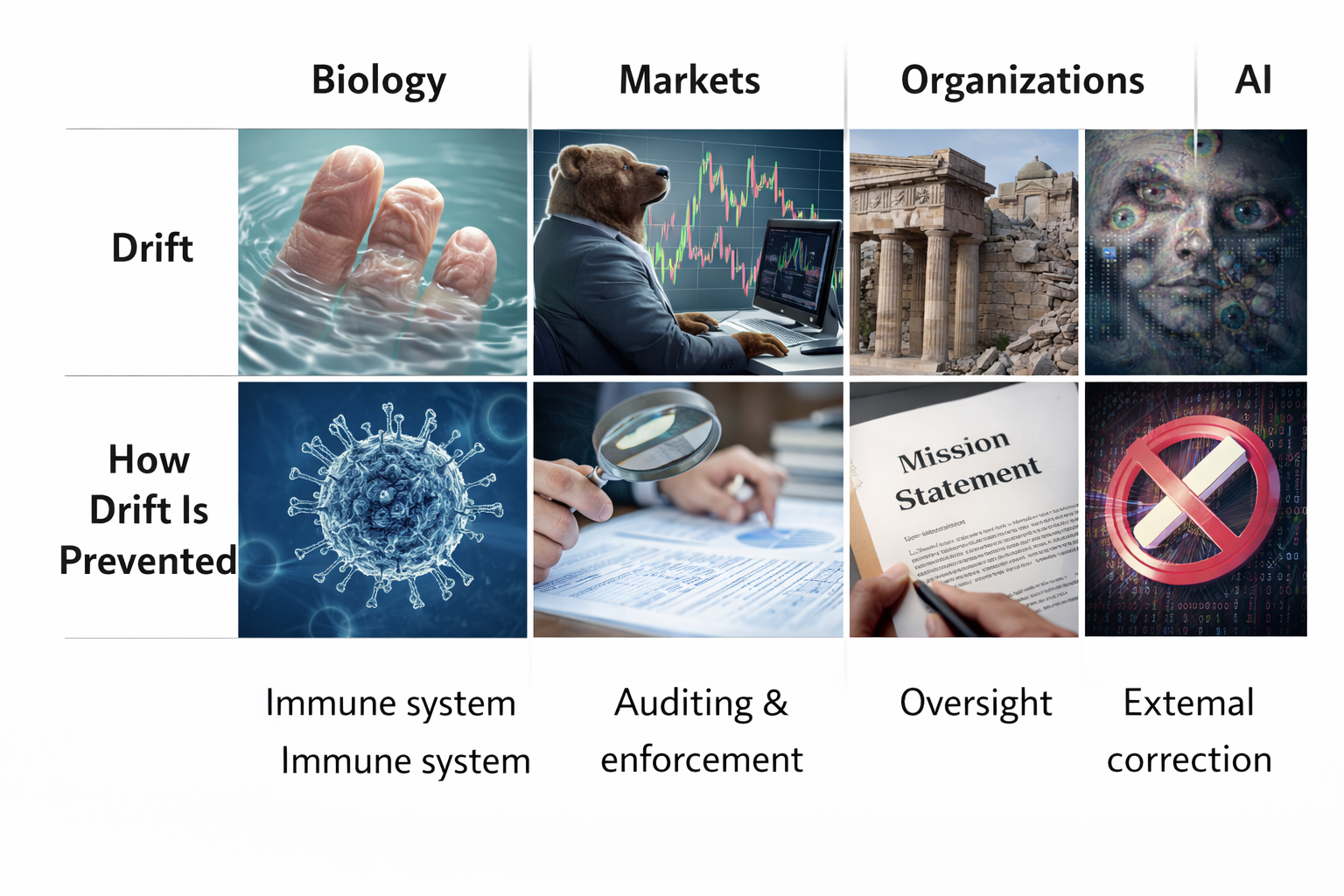
Across biology, markets, organizations, and AI, the same structural pattern appears: systems drift unless mechanisms exist to detect and correct it.

Introduction

Across physics, biology, markets, and organizations, the same failure pattern appears again and again.

Gravity shapes galaxies.
Incentives shape markets.
Information shapes organizations.
Energy gradients shape evolution.

YET

Ecosystems collapse.
Financial systems destabilize.
Institutions lose their mission.
AI systems hallucinate.

At first these failures seem unrelated.

Different systems.
Different forces.

But look closer and a deeper pattern emerges.

The structural pattern is always the same.

Something tries to hold a system together.

Something else constantly pulls it apart.

And unless there are mechanisms that stabilizes the system

It Will Drift.


The Universal Drift Problem

All complex systems face the same three pressures:

  1. Entropy — randomness and disorder accumulate.

  2. Internal incentives — parts of the system pursue their own interests.

  3. Environmental pressure — external forces push the system out of equilibrium.

Without stabilizing structures, drift is inevitable.

Ecosystems collapse.
Financial systems destabilize.
Institutions lose their mission.
AI systems hallucinate.

Drift is not a bug.

It is the default behavior of complex systems.


How Nature Solves Drift

What’s fascinating is how consistently stable systems solve this problem.

Across biology, physics, and engineering, you see similar layers of stabilization.

Different language.

Same architecture.

Stable systems detect drift and correct it before collapse occurs.


The rest of this article explains why stable systems require external reference signals, and why this principle reveals the architectural failure behind many modern AI systems.


The Pattern in Action

Once you start looking for it, the pattern shows up everywhere.

Take something simple: your fingers wrinkling in water.

When your hands sit in water for a few minutes, nerves in the fingertips detect the change in the environment. Blood vessels constrict and the skin collapses into wrinkles.

Why?

Those wrinkles improve grip on wet objects — like tread on a tire.

Your body senses the environment and adjusts structure to maintain function.

That’s drift detection and correction in action.

Another familiar example is the thermostat in a house.

A thermostat constantly measures the temperature of the room. When the system drifts away from the desired setting, the heating or cooling system activates to bring it back.

This is a basic control loop.

Nature uses similar loops everywhere.

The immune system detects foreign threats and mobilizes a response.
Markets rely on auditing and enforcement to prevent systemic fraud.
Organizations rely on oversight to keep decisions aligned with their mission.

What these systems share is something subtle but important.

They do not rely purely on internal self-reference.

They measure themselves against signals coming from outside the immediate system.

Without that external reference, a system can easily reinforce its own errors.

Different domains.

Same underlying problem.

The structures that work are the ones that detect drift early and correct it before the system breaks.


The Missing Architecture in AI

Modern AI systems are powerful — but structurally incomplete.

They often lack:

  • identity anchors

  • coherence boundaries

  • drift detection

  • external correction mechanisms

In other words, they are complex decision systems without the stabilizing layers that every other successful system evolved.

This is why AI failures so often look chaotic or unpredictable.

The system itself has no structural mechanism to resist drift.


The Deeper Principle

Once you see the pattern, it shows up everywhere.

Complex systems do not remain stable by accident.

They remain stable because layered constraints prevent drift.

Remove those constraints and the system eventually destabilizes.

Nature learned this lesson over billions of years.

Our institutions are still learning it.

And our AI systems haven’t learned it yet at all.


The Real Question

The real challenge isn’t building smarter systems.

It’s building systems that remain coherent over time.

Because intelligence without structure doesn’t produce stability.

It produces drift.


Continue the Drift Series

If this idea resonates with you, it’s part of a broader exploration of how systems drift — and how stabilizing structures weaken over time.

Start here:

1. The Drift Problem — In Plain English
https://coherencearchitect.substack.com/p/the-drift-problem-in-plain-english

2. Immigration Is Not the Origin of the Problem
https://coherencearchitect.substack.com/p/immigration-is-not-the-origin-of

3. How America’s Educational Drift Began
https://coherencearchitect.substack.com/p/how-americas-educational-drift-began

4. America’s Drift Engine: How 30 Years of Ideology Reshaped Institutions
https://coherencearchitect.substack.com/p/americas-drift-engine-how-30-years

5. The Drift Stack Behind the Adolescent Mental Health Crisis
https://coherencearchitect.substack.com/p/the-drift-stack-behind-the-adolescent

6. Media Drift: How Upstream Ideology Shapes the Narrative
https://coherencearchitect.substack.com/p/media-drift-how-upstream-ideology

Start at the beginning.
Follow the pattern.
Watch it unfold.


The Architecture Behind the Pattern

This article introduces the idea of drift.

But the deeper question is how stable systems actually resist it.

If you’re interested in the architectural model behind this idea, explore it here:

The Drift Stack
https://www.samirac.com/drift-stack


Drift is universal.
Stability is engineered.


Share This Article

If you found this article valuable, share it.

Substack automatically gives every subscriber a personal referral link. When someone subscribes through your share link, it counts toward referral rewards.

Current rewards:

3 referrals → 1 month of paid access
5 referrals → 6 months of paid access
10 referrals → 12 months of paid access

You can share directly using the Share button on this article, or find your personal referral link here:

https://coherencearchitect.substack.com/leaderboard


By Chris Ciappa
Founder & Chief Coherence Architect
Samirac Partners

LinkedInEmail