Security, Trust, Identity & Quantum Risk

The Failure to Classify: How Context-Blind Safety Rails Break Trust

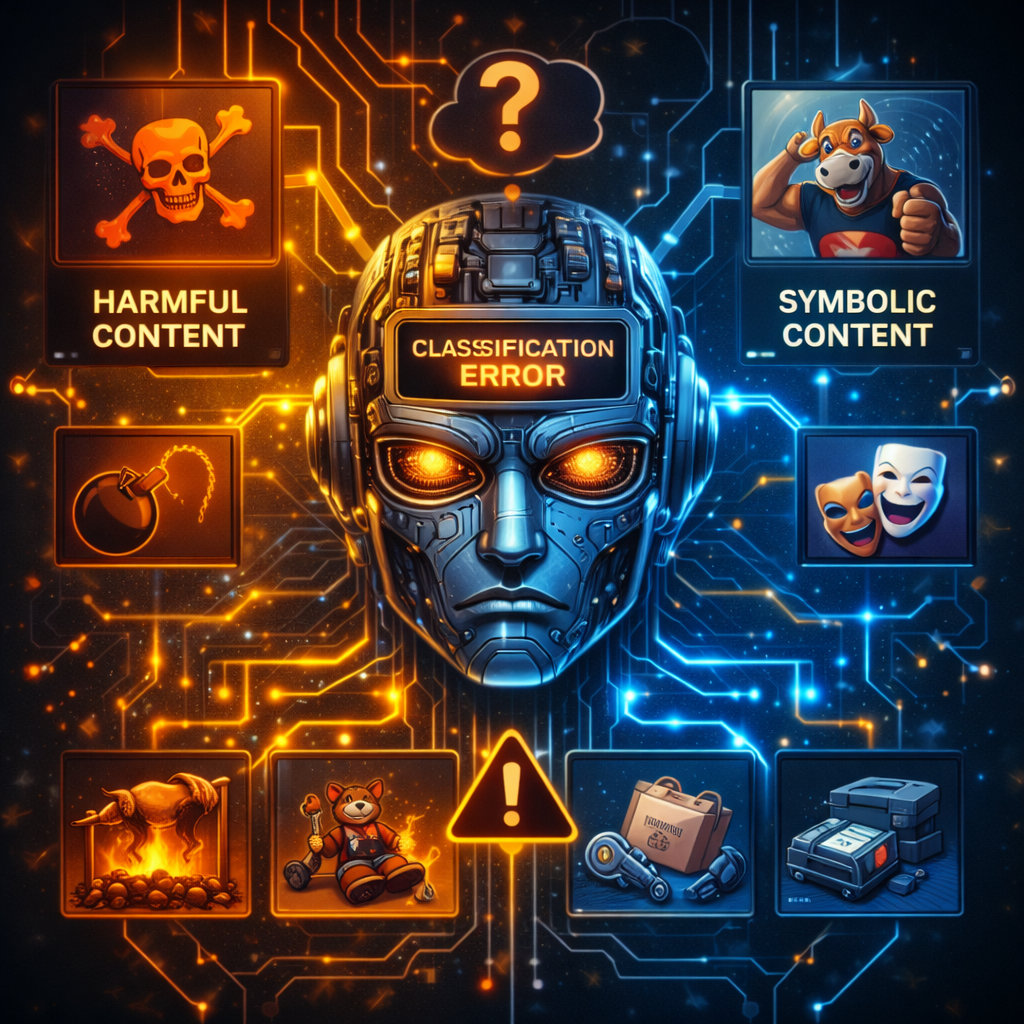
AI safety systems that cannot distinguish symbolic expression from literal harm fail at the classification layer.
By Chris CiappaJanuary 26, 20265 min read
LinkedInEmail
The Failure to Classify: How Context-Blind Safety Rails Break Trust

AI safety systems that cannot distinguish symbolic expression from literal harm fail at the classification layer.


Introduction: This Wasn’t Violence

This paper does not argue against AI safety.

It argues that misclassification is not safety — and that systems which cannot distinguish symbolic expression from literal harm introduce new risks while claiming to reduce old ones.

Specifically, the system examined here enforces an implicit invariant: that harm-associated symbols imply real-world harm as a risk — regardless of context, intent, or executability.

The case examined here is deliberately mundane: a satirical sports illustration involving exaggerated rivalry, mascots, and caricatured trash talk. No real people were harmed. No animals were harmed. No instructions were given. No operational action was implied.

Yet the system blocked the request.

Not because of malice.
Not because of threat.
But because the enforced invariant could not distinguish representation from action.

That failure is not trivial.
It is architectural.


1. The Incident (Primary Source)

The user requested a satirical illustration depicting a hyperbolic sports rivalry scenario:

  • An exaggerated, muscular football super-fan

  • Tailgating imagery

  • Symbolic “defeat” of rival teams

  • Mascots and metaphors used as stand-ins for competition

  • Other fans reacting in humorous horror

This is a genre humans instantly recognize:
sports satire.

No violence toward people.
No real-world instructions.
No depiction of criminal activity.
No intent beyond humor.

The system rejected the request on the grounds that it interpreted the scene as:

“roasting animals” and “defeated bodies.”

This classification triggered a refusal.

At this point, the system implicitly applied its governing invariant: that any representation containing harm-adjacent symbols must be treated as literal harm unless excluded outright.

When the user clarified that the intent was symbolic — mascots, jerseys, rivalry metaphors — the system still required substitution to avoid representing animals at all.

The refusal was not based on outcome risk.
It was based on invariant-preserving category collapse.


2. What Actually Failed (Technically)

The failure was not moral.
It was semantic.

The system enforced the following invariant:

Symbolic correlation with harm is sufficient to infer harm risk.

To preserve this invariant, the system collapsed multiple distinct categories into one:

Human Distinction System Treatment Satire vs instruction Treated as equivalent

Symbolic mascot vs literal animal Treated as equivalent

Competitive defeat vs physical harm Treated as equivalent

Depiction vs endorsement Treated as equivalent

This is a classification-layer failure caused by invariant misidentification.

No amount of downstream moderation can fix a system that tests the wrong invariant at the point of classification.


3. Pre-empting the Narrative Objection (Animal Activism & Moral Feeling)

At this point, a common objection arises — usually framed emotionally rather than structurally:

“Even depicting harm to animals normalizes violence.”

This objection proposes a competing invariant:

If a depiction causes moral discomfort, it constitutes harm.

This invariant fails on three independent grounds.


(1) Humans Eat Animals — Universally and Historically

Humans consume animals across cultures, continents, and millennia.

This is not ideology.
It is anthropology.

Depicting food preparation, hunting, cooking, or symbolic representations thereof is not an endorsement of cruelty — it is a representation of ordinary human reality.

A safety invariant that cannot tolerate depiction of reality cannot moderate reality.


(2) Symbolic Representation Is Not Literal Harm

Mascots are deliberately symbolic abstractions.

No one believes that roasting a jersey, helmet, or mascot constitutes harm to a living being — any more than “killing a deal” constitutes homicide.

Language, art, and humor rely on metaphor compression.

The system’s invariant incorrectly treats metaphor as execution.

A safety system that cannot distinguish metaphor from action will:

  • overblock harmless content

  • underblock genuinely dangerous content

  • train users to evade rather than comply

That is not ethical rigor.
That is semantic incompetence caused by an invalid invariant.


(3) Moral Discomfort Is Not a Safety Criterion

Discomfort is subjective.
Safety must be objective.

A system that enforces felt offense rather than operational risk abandons invariant stability the moment it crosses cultural boundaries — which it inevitably will.

AI systems must govern actions, not aesthetic sensibilities.


4. Why Overblocking Is Not Safety

Overblocking is often defended as “erring on the side of caution.”

This defense assumes a false invariant:

Blocking more content necessarily reduces harm.

This is incorrect.

Overblocking produces four predictable failures:

  • False positives dominate

  • Trust collapses

  • Users route around safeguards

  • Real harm becomes harder to detect

A system that blocks jokes cannot be trusted to judge consequences.

Safety without invariant fidelity is noise masquerading as control.


5. The Deeper Architectural Parallel

This failure mirrors a broader systemic mistake seen across AI governance debates:

  • Learning systems conflated with authority systems

  • Advice conflated with execution

  • Representation conflated with intent

The same flaw appears here:

Symbolic expression is conflated with operational harm to preserve a brittle invariant.

If a system cannot tell whether something is:

  • symbolic

  • advisory

  • expressive

  • executable

…it cannot be safely entrusted with moderation authority.

This is not a tuning problem.
It is a design-level invariant error.


6. Why This Matters Beyond Humor

If a system cannot classify satire correctly:

  • It will misclassify political speech

  • It will misclassify cultural practices

  • It will misclassify dissent

  • It will misclassify intent

And when classification fails, enforcement becomes arbitrary.

That is how systems lose legitimacy — not through malice, but through invariant confusion at the classification layer.


Conclusion: Safety Requires the Right Invariant

This incident involved a joke.
But the failure was serious.

The system did not reject harm.
It rejected meaning to preserve a false invariant.

AI safety systems must distinguish:

  • symbol from action

  • depiction from endorsement

  • competition from violence

  • culture from crime

Until they do, they will continue to:

  • block what is harmless

  • miss what is dangerous

  • and erode trust while claiming virtue

Safety without correct invariant selection is not safety.

It is just a brittle filter pretending to understand the world.

LinkedInEmail