AI Journey, Readiness & Adoption

The Fallacy of Tool-Driven Architecture

Architecture doesn’t disappear when tools get easier—it gets ignored.
By Chris CiappaApril 10, 20263 min read
LinkedInEmail
The Fallacy of Tool-Driven Architecture

By Chris Ciappa
Founder & Chief Coherence Architect
Samirac Partners


I’m not above this. Guilty as charged myself at one time.

In fact, I’ve taken many shortcuts — before I learned my lesson.

But we’ve seen this pattern before so I have to call it out.


The Pattern

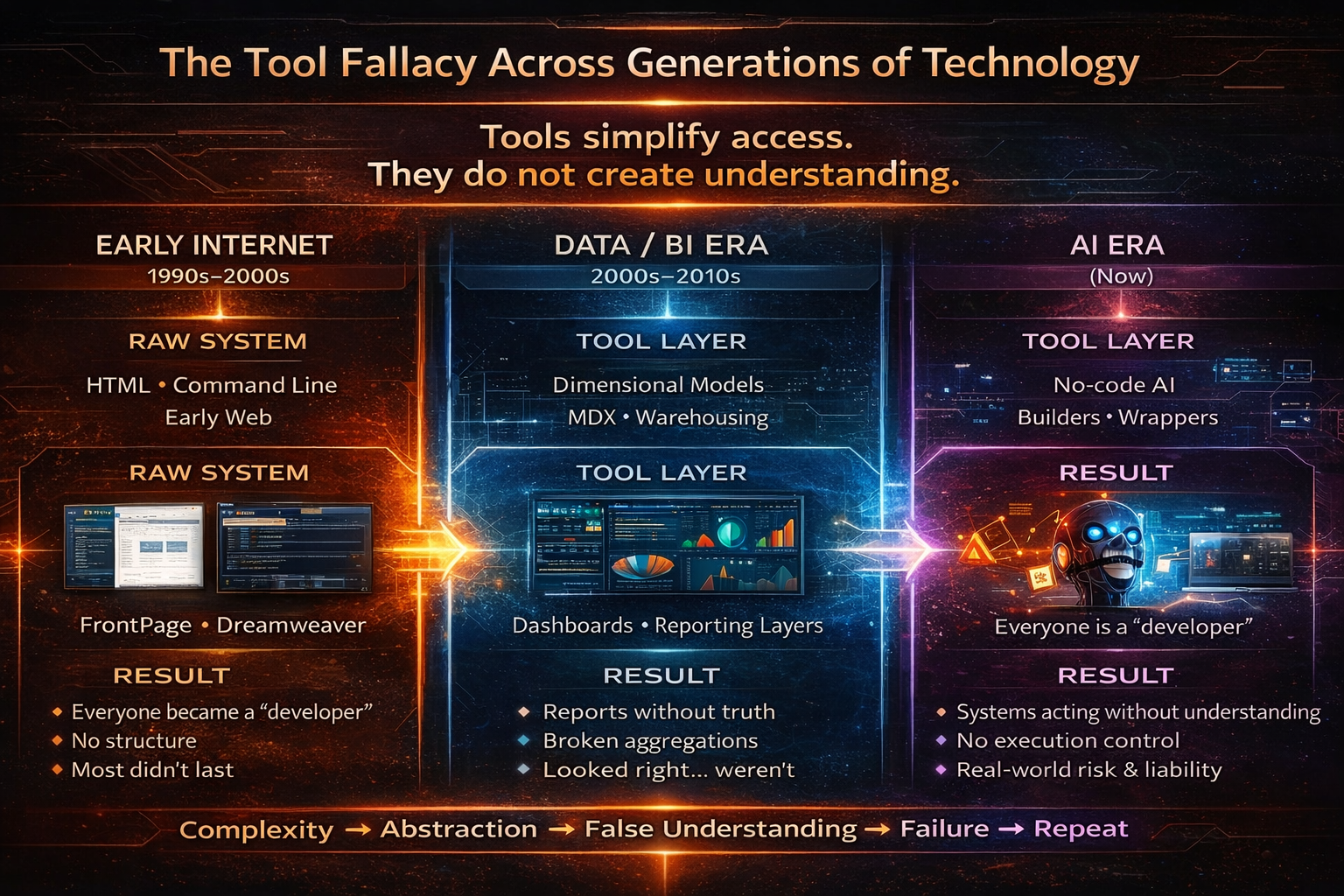
There’s a recurring phase in every technology cycle where tools are simplified so more people can participate.

During that phase, people begin to believe they understand the system—because they can use the tool.

They don’t.

And when architecture is replaced with convenience, the result is predictable:

  • Most of what gets built fails

  • What remains is what was architected correctly from the start


When Rigor Is Required

When a system necessitates real mental rigor… most people will not rise to meet it.

They simplify it.

I watched it happen in the early 1990s with the internet and the evolution to HTML, then again in the 2000s with Business Intelligence and multidimensional databases.

The outputs were correct—if you knew what you were doing.

Most didn’t.


Pattern Recognition — Business Intelligence

In the early 2000s, I worked in Business Intelligence and multidimensional systems.

In fact I taught SSAS and MDX. The thinking was hard.

Multidimensional data was hard.
MDX was hard.
Conformed dimensional bus models required real mental rigor.

This wasn’t surface-level tooling or linear thinking.

It required understanding:

  • dimensional grain

  • conformance across domains

  • aggregation paths

  • how queries actually resolved across dimensions

When it was done correctly, the outputs were right, consistent, and results returned like lightning.

Consistent. Reliable. True.

If you knew what you were doing.

Most didn’t.


So What Happened?

We didn’t train people up.

We brought the system down.

  • Tools got easier to use

  • Abstraction replaced understanding

And eventually, people were using systems they no longer truly understood—
examining results without knowing how those results were produced.


The Failure Phase

And along the way?

A flood of poorly architected solutions.

  • Dashboards without dimensional integrity

  • Reports without a single version of the truth

  • Aggregations that broke under scrutiny

  • Numbers that looked right… but weren’t

Most of them failed.

Because there was no architecture underpinning them.


Pattern Recognition — Internet Evolution

We’ve seen this before with the internet.

It happened the same way with the early internet.

At first, it was raw:

  • ARPANET

  • Command lines

  • HTML written by hand

👉 If you built something, you understood exactly how it worked.

Then came tools like FrontPage and visual builders.

Anyone could create.

And oh my, they surely did.

A wave of sites and systems with no real structure—no real architecture.

They were everywhere, and everyone was a web developer.

Most didn’t last.


The Reality

We didn’t eliminate complexity.

We hid it.


And Now…

Now it’s happening again.

Same pattern. Different technology.


The Question

So this time, before we blame the tools, the platforms, or “AI”…

Maybe we should ask ourselves:

  • Do I actually understand how this works?

  • Can I explain the output, or do I just accept it?

  • Am I improving my thinking—or outsourcing it?

Because with AI and a system that can act in the real world, if you don’t understand, you have real danger and massive liability.


The Truth

Most system failure doesn’t come from bad technology.

It comes from people choosing convenience over rigor.


What Survives

Over time, one thing is proven to survive:

Architecture.

And no tool will fix that.

Only people will.


Share This Article

If you found this article valuable, share it.

Substack automatically gives every subscriber a personal referral link. When someone subscribes through your share link, it counts toward referral rewards.

Current rewards:

3 referrals → 1 month of paid access
5 referrals → 6 months of paid access
10 referrals → 12 months of paid access

You can share directly using the Share button on this article, or find your personal referral link here:

Get Referral Link


By Chris Ciappa
Founder & Chief Coherence Architect
Samirac Partners

LinkedInEmail