Structural Thinking & Architecture

The Five Structural Tests of a Foundational Framework

By Chris CiappaMay 11, 20263 min read
LinkedInEmail
The Five Structural Tests of a Foundational Framework

Frameworks should not be judged merely by: popularity credentials institutional affiliation origin rhetoric sophistication engagement or persuasive language A framework can sound intelligent and still fail structurally.

By Chris Ciappa
Founder & Chief Coherence Architect
Samirac Partners


A framework cannot merely sound intelligent or novel.

It must survive five deeper structural tests.

Frameworks should not be judged merely by:

  • popularity

  • credentials

  • institutional affiliation

  • origin

  • rhetoric

  • sophistication

  • engagement

  • or persuasive language

A framework can sound intelligent and still fail structurally.

These tests attempt to evaluate whether a framework demonstrates:

  • explanatory power

  • predictive usefulness

  • cross-domain consistency

  • operational viability

  • and survivability under real-world pressure

The Drift Stack™ and SAQ™ attempt to address all five architecturally and operationally rather than merely rhetorically

And live demos matter because they move a framework beyond abstract theory into observable operational behavior.

That demonstrates:

  • executable architecture

  • runtime enforcement

  • constrained behavior

  • admissibility

  • correction

  • and operational coherence under live conditions

rather than merely descriptive claims.

--------------------------------------------------

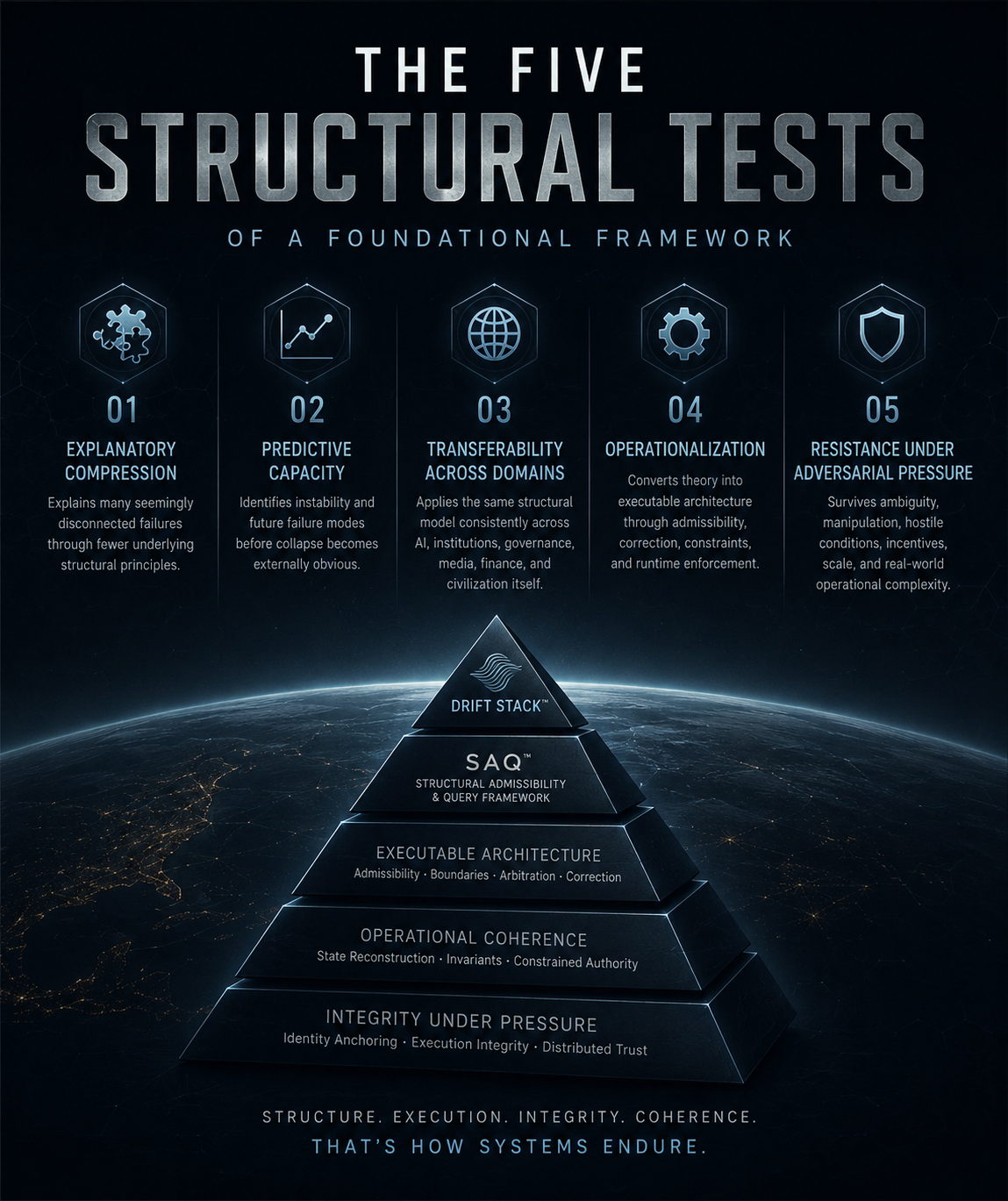
1. Explanatory Compression

Explains many seemingly disconnected failures through fewer underlying structural principles.

The Drift Stack™ attempts to address this by modeling education drift, media drift, AI instability, governance failure, institutional decay, and societal fragmentation through shared mechanisms of drift, weakened correction, and coherence degradation.

--------------------------------------------------

2. Predictive Capacity

Identifies instability and future failure modes before collapse becomes externally obvious.

The Drift Stack™ attempts to address this through collapse-order modeling, delayed-instability recognition, and identifying systems that remain externally functional while internal coherence deteriorates underneath the surface.

--------------------------------------------------

3. Transferability Across Domains

Applies the same structural model consistently across AI, institutions, governance, media, finance, and civilization itself.

The Drift Stack™ attempts to address this by applying the same structural framework across AI systems, finance, governance, media ecosystems, institutional systems, and broader civilizational drift patterns.

--------------------------------------------------

4. Operationalization

Converts theory into executable architecture through admissibility, correction, constraints, and runtime enforcement.

SAQ™ and the Drift Stack™ attempt to address this through executable architecture:

  • admissibility enforcement

  • execution boundaries

  • runtime arbitration

  • state reconstruction

  • constrained authority

  • and invariant preservation

--------------------------------------------------

5. Resistance Under Adversarial Pressure

Survives ambiguity, manipulation, hostile conditions, incentives, scale, and real-world operational complexity.

SAQ™ attempts to address this through:

  • cryptographic identity anchoring

  • execution integrity

  • operational correction

  • distributed trust

  • and preserving coherent execution under manipulation, probabilistic instability, and hostile conditions.


Final Thought

Most “safe AI” tries to control behavior.

The Drift Stack™ controls state.

And if you don’t control the state…

you don’t control the system.


The Only Question That Matters

The architecture is already defined.

Drift Stack™ Architecture
https://www.samirac.com/drift-architecture

Now ask yourself:

👉 Does my system control what’s allowed at execution —
or does it just react and hope it gets it right?

Architecture Demos
https://www.samirac.com/daisy-demos


Share This Article

If you found this article valuable, share it.

Substack automatically gives every subscriber a personal referral link. When someone subscribes through your share link, it counts toward referral rewards.

Current rewards:

3 referrals → 1 month of paid access
5 referrals → 6 months of paid access
10 referrals → 12 months of paid access

You can share directly using the Share button on this article, or find your personal referral link here:

Get Referral Link


By Chris Ciappa
Founder & Chief Coherence Architect
Samirac Partners

LinkedInEmail