By Chris Ciappa
Founder & Chief Coherence Architect
Samirac Partners
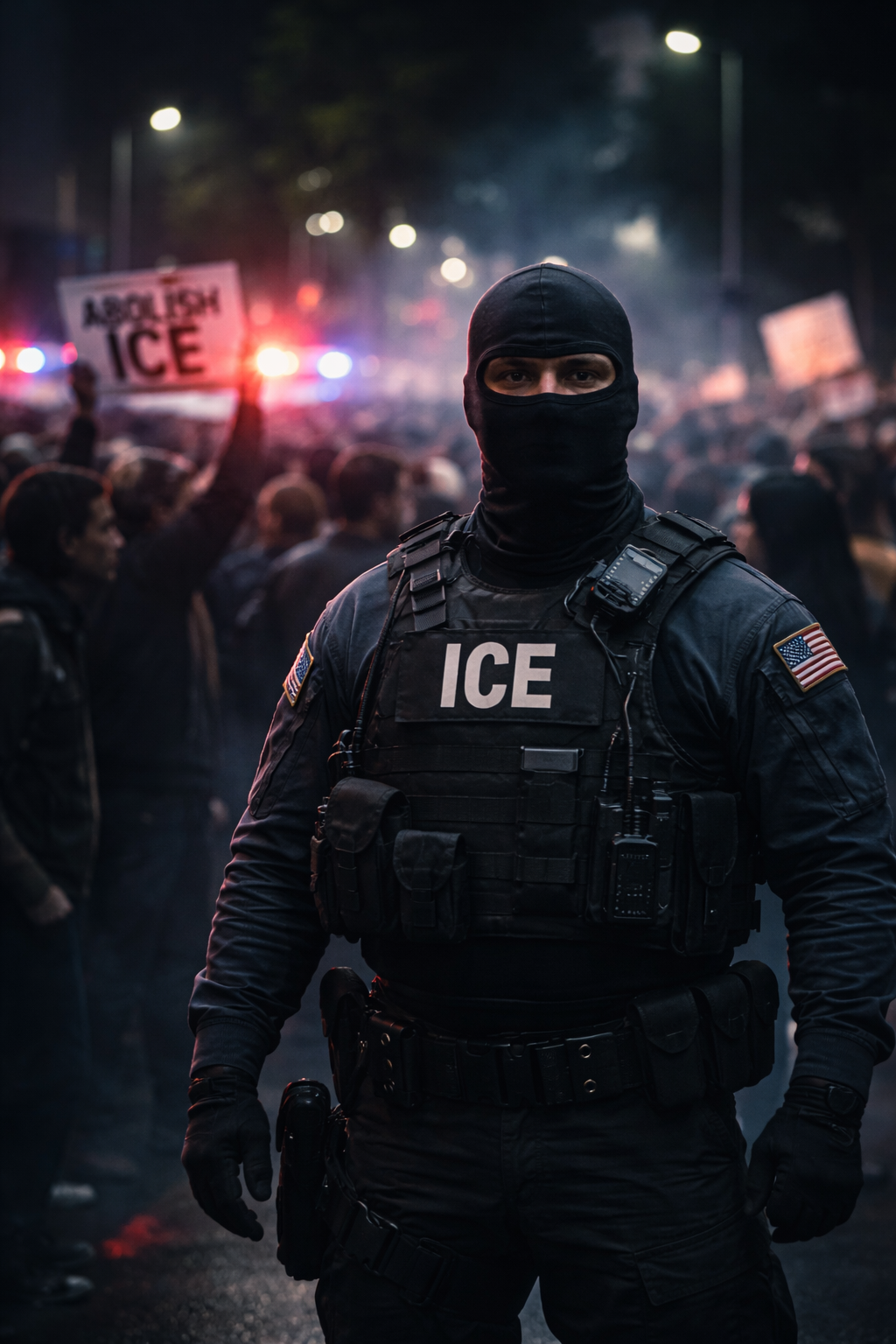
How threats, violence, and political confrontation reshaped the immigration debate—until the response itself became the controversy.
The use of face coverings has become one of the most visible flashpoints in the national debate over immigration enforcement.
By Chris Ciappa
Founder & Chief Coherence Architect
Samirac Partners
How threats, violence, and political confrontation reshaped the immigration debate—until the response itself became the controversy.
One of the most visible criticisms of ICE operations has been the use of face coverings by agents during arrests and raids. Critics argue that masked officers undermine transparency and accountability, and some local governments have proposed restrictions on the practice.
Federal officials, however, say the masks are primarily used for personal safety rather than anonymity. Immigration agents have increasingly become targets of harassment, doxxing campaigns, and violent threats directed not only at the officers themselves but also at their families. In some cases, activists have published agents’ names, photographs, and home addresses online, exposing them and their relatives to potential retaliation.
The Department of Homeland Security has reported a significant rise in hostility directed toward immigration enforcement personnel, including a 1300% increase in assaults, a 3200% increase in vehicular attacks, and an 8000% increase in death threats against officers.
Officials also point to the growing organization of activist networks that monitor enforcement operations and encourage efforts to interfere with or impede immigration arrests—actions federal authorities say increase the risk of volatile encounters during enforcement operations.
In that environment, agencies argue that concealing officers’ identities during field operations is not intended to evade accountability but to reduce the risk of retaliation against agents and their families once an operation is over.
The increasingly volatile atmosphere surrounding immigration enforcement has, in some cases, escalated beyond protest and political confrontation.
In September 2025, a gunman identified as Joshua Jahn carried out a sniper attack on an Immigration and Customs Enforcement field office in Dallas, Texas. Jahn fired multiple rounds from a rooftop toward the facility before dying by suicide. One detainee was killed and two others were critically wounded.
Investigators later revealed that the attacker had left behind handwritten notes indicating his intent was to target ICE personnel and maximize damage to the facility. Federal officials said the attack appeared intended to terrorize immigration officers and damage the facility where agents worked daily.
The tragic outcome was that detainees — not the intended targets — were struck by the gunfire.
While such attacks remain rare, the incident underscored the heightened tensions surrounding immigration enforcement and prompted increased security precautions at some ICE facilities.
The confrontational environment surrounding immigration enforcement has also extended beyond activist groups. In some cases, elected officials themselves have become directly involved in disputes with federal authorities during enforcement actions.
One recent example involved LaMonica McIver, who was charged by federal authorities with assaulting, impeding, and interfering with law enforcement officers during a confrontation outside the gates of Delaney Hall, a privately operated ICE detention facility in Newark. According to federal prosecutors, the incident occurred during a protest outside the facility and involved physical contact with officers attempting to control access to the site.
McIver has denied wrongdoing and characterized the charges as politically motivated, while supporters have framed the confrontation as part of broader opposition to federal immigration policy. Critics, however, point to the case as an example of how disputes over immigration enforcement can escalate when political leaders themselves become directly involved in protest actions.
These incidents occurred months before the most recent debate over ICE officers wearing face coverings during enforcement operations.
In the months following the Dallas attack and a series of confrontations at enforcement facilities, federal officials reported increased threats, harassment, and doxxing campaigns directed at immigration officers and their families. Protective measures—including concealing officers’ identities during field operations—were introduced in part to reduce the risk of retaliation.
By early 2026, however, the public debate had shifted. Critics increasingly framed masked officers as “anonymous agents” or “masked gunmen,” arguing that the practice undermines transparency and public accountability.
Supporters of the policy counter that the masks are a response to the increasingly hostile environment surrounding immigration enforcement rather than its cause. From that perspective, the face coverings reflect a precaution adopted after months of threats, confrontations, and targeted violence against immigration personnel.
The dispute illustrates how the national debate over immigration enforcement has evolved into competing narratives about accountability, safety, and the role of federal law enforcement.
The controversy surrounding immigration enforcement is not occurring in isolation. It reflects a broader pattern that can be observed across many areas of modern public life: societal drift.
Drift occurs when the narrative surrounding an issue gradually disconnects from the sequence of events that produced it. Over time, the original causes of a situation fade from public discussion, while the responses to those causes become the focus of criticism.
In the case of immigration enforcement, the timeline illustrates this pattern clearly. A series of escalating confrontations—including violent attacks, threats against officers, doxxing campaigns, and direct interference with enforcement actions—prompted federal agencies to adopt protective measures intended to safeguard personnel.
One of those measures was the use of face coverings during enforcement operations to reduce the risk of retaliation against officers and their families.
Yet months later, the public debate increasingly centered not on the threats that prompted the precaution, but on the precaution itself. The narrative shifted from concerns about violence and harassment directed at immigration officers to accusations that masked agents represented secrecy, intimidation, or unlawful behavior.
In this way, the response became reframed as the origin of the problem.
This type of narrative inversion is a common feature of societal drift. When the sequence of events becomes blurred, public discourse can begin to treat protective actions as though they were the cause of the conflict rather than a reaction to it.
The result is a debate in which two competing narratives emerge. One views the masks as a practical response to a hostile enforcement environment. The other interprets them as evidence of a lack of transparency or accountability.
Understanding how those narratives diverged requires examining the full chain of events rather than focusing only on the most visible symbol of the controversy.
In highly polarized political environments, leaders themselves often become symbols in the broader struggle over societal anchors. Supporters may view certain figures as defenders of institutional stability and constitutional order, while opponents may see those same figures as disruptive or controversial. These competing perceptions can intensify political conflict and make it harder to maintain shared reference points for public debate.
Societies do not collapse in a single moment. They drift.
The drift begins when the sequence of events that created a conflict is forgotten, and responses to that conflict are recast as the cause. Anchors—law, constitutional order, and shared standards of accountability—exist to prevent that inversion. Without them, even the meaning of events begins to move.
For a deeper explanation of societal drift and institutional
If this article resonated with you, it’s part of a broader exploration of societal drift and how institutional anchors weaken over time.
Start here:
1. Immigration Is Not the Origin of the Problem
https://coherencearchitect.substack.com/p/immigration-is-not-the-origin-of
2. The Drift Problem — In Plain English
https://coherencearchitect.substack.com/p/the-drift-problem-in-plain-english
3. How America’s Educational Drift Began
https://coherencearchitect.substack.com/p/how-americas-educational-drift-began
4. America’s Drift Engine: How 30 Years of Ideology Reshaped Institutions
https://coherencearchitect.substack.com/p/americas-drift-engine-how-30-years
5. The Drift Stack Behind the Adolescent Mental Health Crisis
https://coherencearchitect.substack.com/p/the-drift-stack-behind-the-adolescent
6. Media Drift: How Upstream Ideology Shapes the Narrative
https://coherencearchitect.substack.com/p/media-drift-how-upstream-ideology
By Chris Ciappa
Founder & Chief Coherence Architect
Samirac Partners