There’s a persistent mistake being made in AI conversations right now:
People talk as if the LLM is the system.
It’s not.
The LLM is a component — an extremely powerful one — but still just a component. Treating it as the whole system is like mistaking a database engine for an enterprise application, or a CPU for a computer.
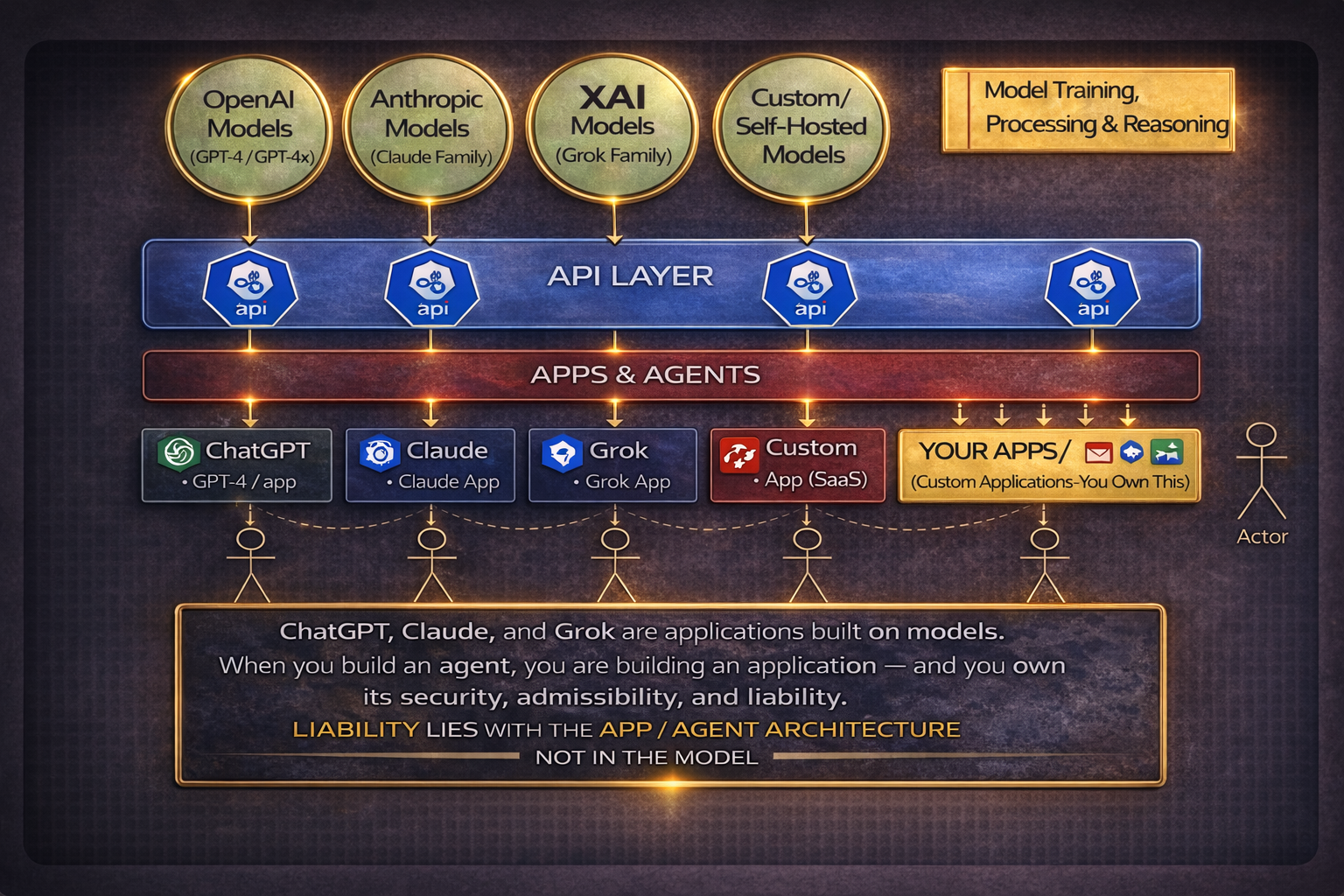
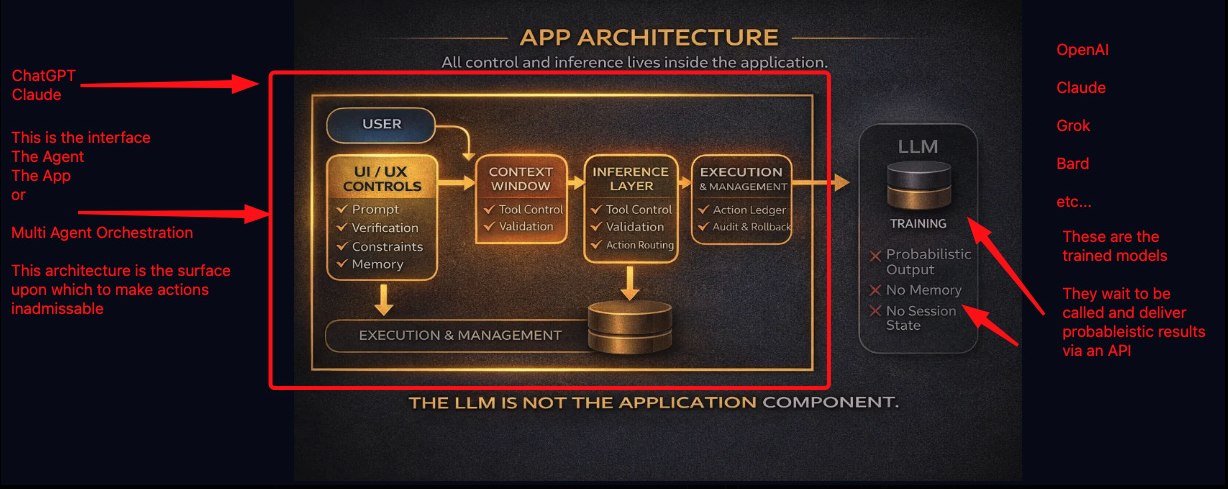
ChatGPT itself proves this point.
ChatGPT is not “the LLM.”
It’s an architected application built around the LLM.
That distinction matters — because it’s where most AI systems either stabilize… or drift.
What an LLM actually is
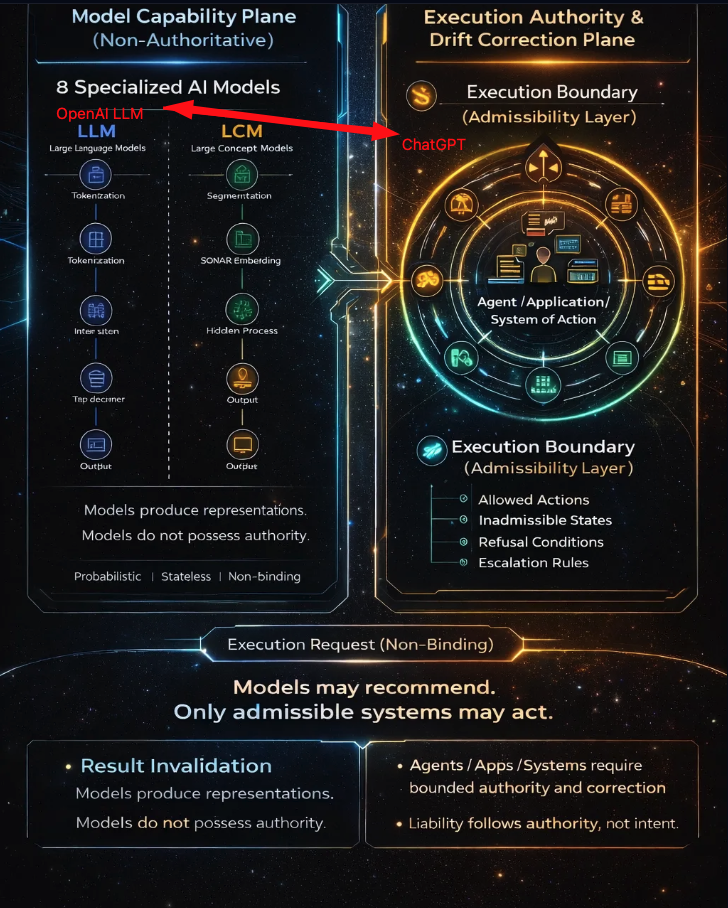
At its core, an LLM behaves much closer to a probabilistic query engine than an “agent.”
You submit a query (prompt + context).
It returns a linguistic result set, sampled from a probability distribution.
That’s it.
No intent.
No authority.
No durable identity.
No memory unless you give it one again.
The trained weights function like a compressed, statistical database over language space. The output is data — text — not action.
What happens after that output is returned is not “prompting.”
It’s architecture.
What real systems, agents, context windows, or applications do after the LLM responds
Once the model produces output, your system, agent, chat window, UI/UX decides:
Do I store this?
Do I discard it?
Do I summarize it?
Do I validate it?
Do I route it to a tool?
Do I trigger another prompt?
Do I escalate to a human?
Do I block execution entirely?
What architectural rules am I following?
None of that lives in the model.
That is application architecture.
And it’s where the real work happens.
This is also where drift must be handled
LLMs do not preserve identity, frame, or boundary.
They cannot.
They operate in a probabilistic linguistic space that has:
no durable self
no invariant reference frame
no awareness of permission
no concept of “out of bounds”
Which means drift is inevitable unless it is actively constrained.
So if you’re building an agent, an application, or even just a UI around an LLM, drift correction is your responsibility — not the model’s.
That responsibility lives in architecture.
Your system must decide:
what identity the model is operating under
what frame is valid for this interaction
what boundaries may not be crossed
when output has diverged from intent, scope, or authority
how to correct, reset, or block when drift occurs
If you don’t build these controls, the system doesn’t fail mysteriously.
It fails predictably.
If you’re wondering what “drift” actually means here — and why it shows up everywhere from AI hallucinations to governance failure — it’s not a metaphor.
Drift is a structural phenomenon that occurs when a system can act but lacks preserved identity, invariant boundaries, or enforced correction.
I’ve formalized this pattern — and why it repeats across AI systems, institutions, and organizations — in a couple of separate pieces:
👉 The Drift Stack: Why Every Coherent System Requires Identity, Boundaries, and Correction
https://coherencearchitect.substack.com/p/the-drift-stack-why-every-coherent
👉 The Drift Stack is Falsifiable:
https://coherencearchitect.substack.com/p/the-drift-stack-is-falsifiable
These articles explain why drift is inevitable in probabilistic systems — and where it must be handled if coherence is to be preserved.
ChatGPT is the proof — not the exception
At OpenAI, drift handling does not live inside the LLM.
It lives in the architecture of the ChatGPT application that sits around the model:
identity and session management
memory policies
boundary enforcement
tool permissions
refusal logic
resets, corrections, and escalation paths
The context window does not “remember who it is.”
The application enforces who the system is allowed to be.
That’s not a model capability.
That’s application or agent architecture.
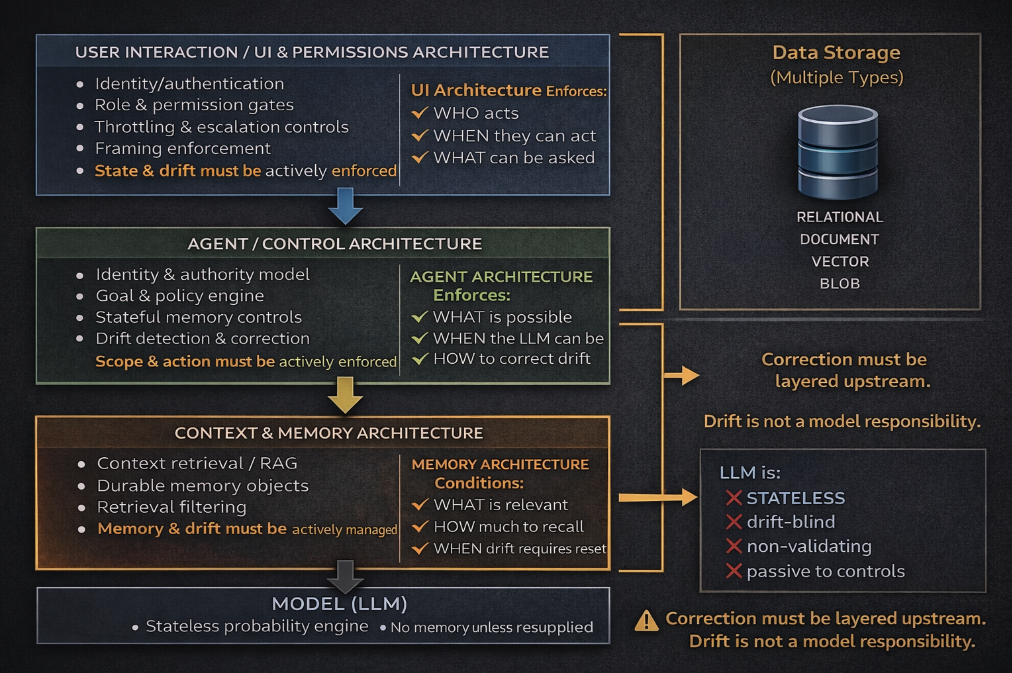
These diagrams illustrates where responsibility lives, not how enforcement is implemented. Architecture defines admissibility; implementation defines mechanisms.
This is a structural map, not an implementation guide.
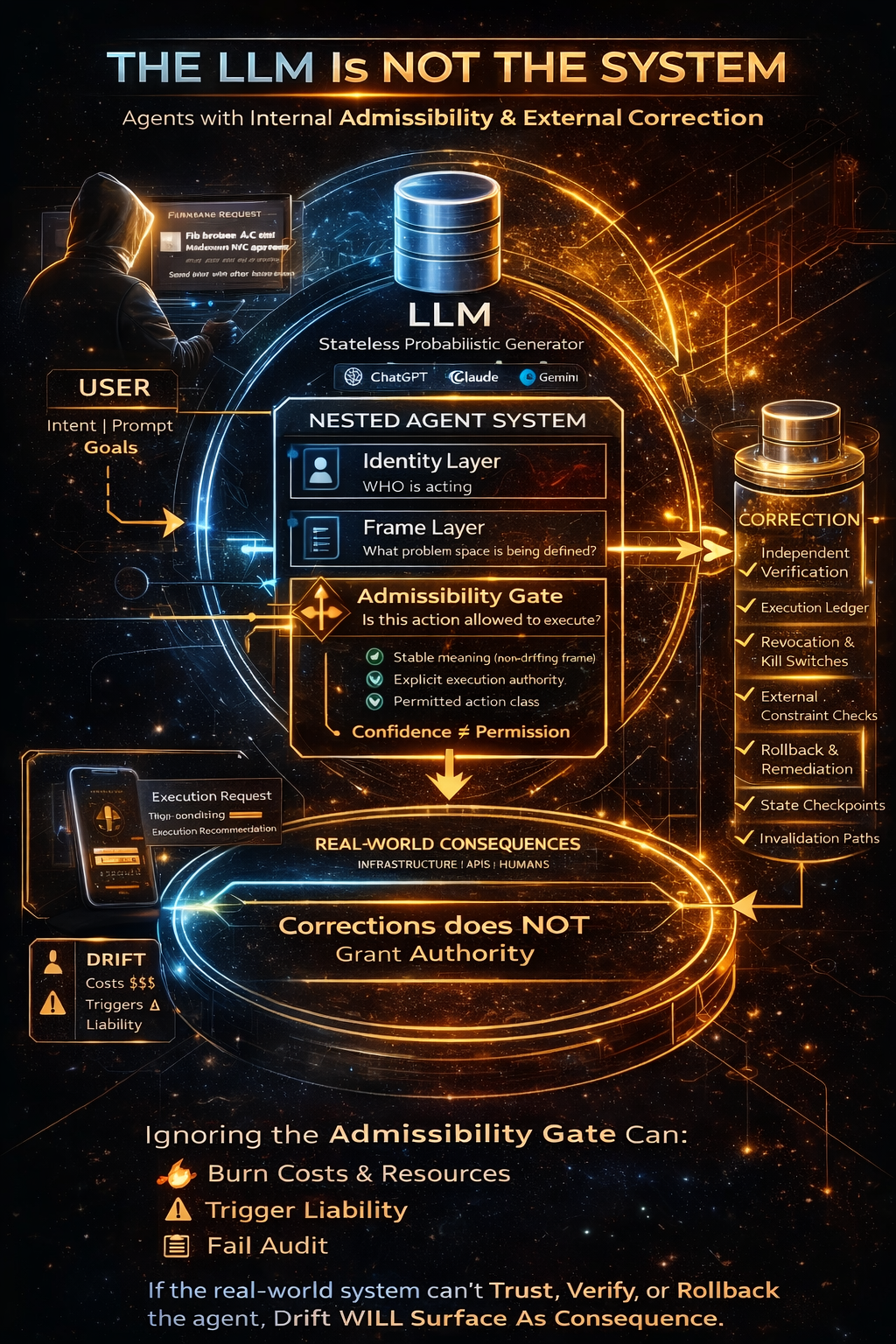
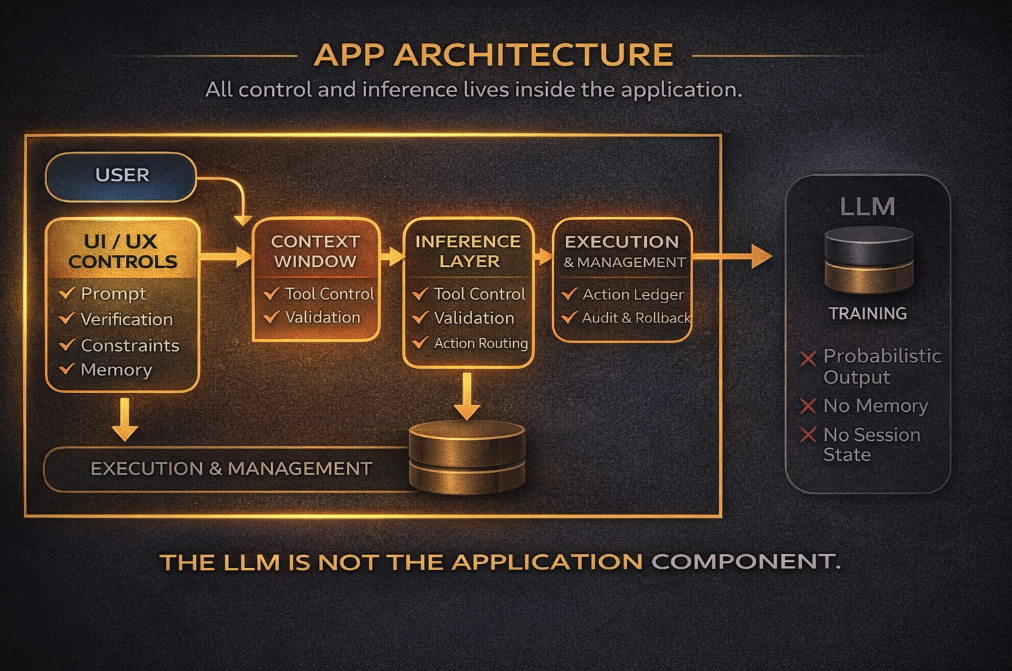
The Chat App, UI/UX, or Agent handles the drift correction.
What These Diagrams Do Not Show
These diagrams are intentionally non-operational.
They do not specify:
how identity is formally represented or resolved
how authority is computed, inherited, or revoked
how admissible vs. inadmissible states are encoded
how drift is detected, measured, or thresholded
how correction, reset, or refusal is triggered
how memory promotion, decay, or invalidation works
how external validation or anchoring is performed
how execution-time enforcement is guaranteed
Those are implementation details, not architectural primitives.
If you need implementation assistance or guidance visit
👉 Drift Stack Info: https://www.samirac.com/drift-stack
Architecture defines where responsibility lives and what must be constrained.
Implementation defines how those constraints are enforced.
This diagram exists to make one point legible:
Drift prevention, admissibility, and authority cannot live in the model —
and cannot be solved by prompting.
How those controls are realized is the hard work of system design — and where real differentiation exists.
Separation of concerns: the layers people keep collapsing
Most “agent” diagrams mash everything together and then obsess over the context window.
Real systems separate concerns.
1) UX / UI Architecture
The UI is not cosmetic. It is a control surface. It is NOT the LLM.
It determines:
who can ask what
when they can ask it
what inputs are allowed
what is captured, persisted, or discarded
when escalation is required
2) Agent / Control Architecture
This is where “agenticity” actually lives:
state and goal models
policies and roles
permission gates
allowed transitions
tool routing
fail-closed behavior
This layer decides what may happen at all.
3) Context, Memory, and Retrieval Architecture
This is your real memory — not the context window:
summaries
DB recall (relational, vector, document, blob)
durable memory objects
identity anchors
policy-conditioned retrieval
Context windows are transient.
Memory systems are architecture.
4) Tool Architecture
Tools are capabilities, not permissions.
Architecture decides:
which tools exist
who may invoke them
under what conditions
with what auditability and rollback
5) The LLM
The LLM generates language.
It suggests.
It does not decide.
The core rule
Architecture exists to decide what is allowed to exist and act — not just how things behave once allowed.
That means:
The agent needs architecture (identity, scope, authority)
The UI needs architecture (who can ask what, when, and why)
The tool layer needs architecture (capabilities vs permissions)
The LLM call needs architecture (admissibility before inference)
The system boundary itself must be justified externally
Otherwise, you get beautifully controlled local behavior inside a globally invalid system.
The mistake behind most “agent stacks”
When people treat the LLM as the system, they end up with:
brittle agents
hallucination-driven behavior
governance theater
post-hoc explanations for preventable failures
This isn’t because the model is bad.
It’s because the architectural layers that prevent drift were never built.
The takeaway
LLMs generate possibilities.
Architecture enforces admissibility.
Drift correction is a first-class system function — not an afterthought.
ChatGPT works not because the model governs itself, but because an application governs the model.
Anyone can build that same kind of architecture.
The context window is not your ceiling.
It’s just the smallest part you can see.
This Architecture Already Exists
Operational Proof, Not Theory
I built dAIsy this way a year ago — explicitly because large language models cannot preserve identity, frame, or boundary on their own.
dAIsy does not “hallucinate its way back to correctness.”
She self-corrects because the application architecture enforces:
identity anchoring
boundary constraints
admissible state transitions
reset and correction paths when drift is detected
The model generates language.
The system decides whether that language is allowed to persist, escalate, reset, or be rejected.
That’s why correction is possible at all.
This is not a prompt trick.
It’s not a context-window hack.
It’s not a model feature.
It’s architecture.
I documented one concrete example of this self-correction behavior here (paywalled):
👉 When AI “Remembers” Incorrectly — And Then Fixes Itself
https://coherencearchitect.substack.com/p/when-ai-remembers-incorrectly
The point isn’t dAIsy.
The point is that anyone can build systems this way — once they stop treating the LLM as the system and start treating it as a component.