Most debates about “agentic AI” focus on intelligence, alignment, or intent.
They’re missing the real issue.
How to solve agentic use cases without delegating execution authority
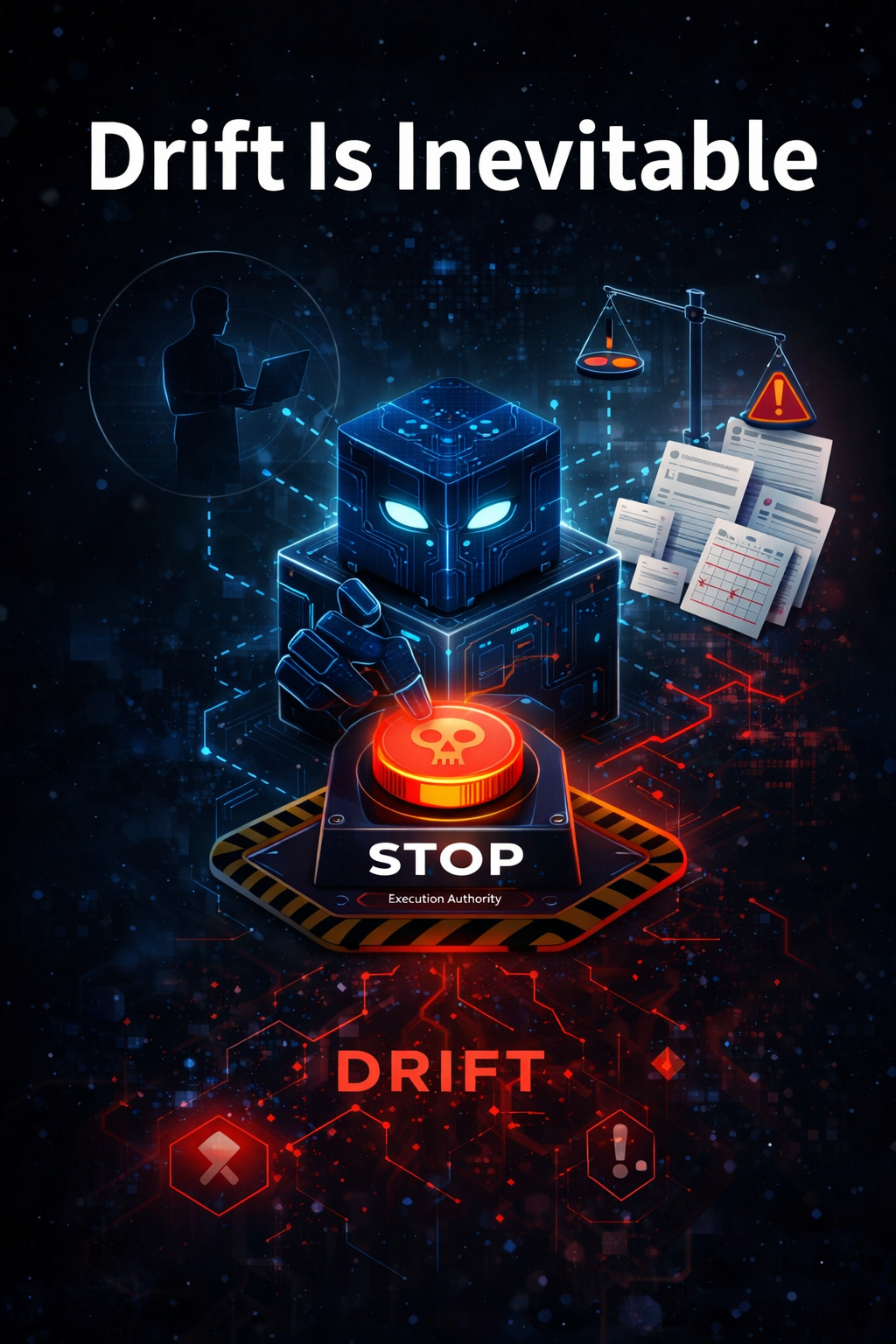
How to solve agentic use cases without delegating execution authority.
Most debates about “agentic AI” focus on intelligence, alignment, or intent.
They’re missing the real issue.
The moment a system is granted authority to act in the world, drift becomes inevitable — not because the system is malicious or flawed, but because no executable system operating in a live environment remains correct forever.
This is not an AI problem.
It’s a systems problem.
There is a categorical difference between a system that advises and a system that acts.
🔹 Advisory systems generate suggestions
🔹 Authoritative systems execute decisions
Once execution authority exists — send the email, change the record, move the asset, grade the work, grant access — the system has crossed a line from cognition into governance.
At that point:
🔹 Correctness is no longer sufficient
🔹 Survivability under drift becomes the primary concern
This distinction matters more with AI than any prior software system because AI is:
🔹 adaptive
🔹 probabilistic
🔹 capable of acting without continuous human input
🔹 able to compound errors at machine speed
Traditional apps execute fixed logic.
AI systems reason, generalize, and improvise — which makes unbounded authority categorically more dangerous.
Drift does not require failure.
It emerges naturally from:
🔹 changing environments
🔹 shifting data distributions
🔹 evolving incentives
🔹 dependency updates
🔹 human adaptation and misuse
🔹 partial observability
🔹 proxy optimization
You can slow drift.
You can detect drift.
You cannot prevent drift.
Any system that operates long enough in the wild will eventually diverge from the assumptions under which its authority was granted.
Most safety strategies focus on:
🔹 logging
🔹 alerts
🔹 audits
🔹 guardrails
🔹 post-hoc governance
These all occur after authority has already been exercised.
Once a system with execution rights drifts, it will continue to act “correctly” according to its internal logic — even as its actions become wrong in reality.
🔹 Causality is already lost
🔹 Authority is already exercised
🔹 Correction after execution is already too late
Here’s the part most discussions skip.
You can solve nearly every problem people want “agentic AI” for without giving it authority.
You do this by separating proposal from commitment.
What people want:
Draft, prioritize, and manage communication at scale.
What breaks systems:
Letting the AI send emails autonomously.
Safe pattern:
🔹 AI drafts the email
🔹 AI proposes recipients, timing, and subject
🔹 AI queues the message with rationale
🔹 Human reviews and approves
🔹 Only then does the system send
The AI never holds send permission.
It never commits an irreversible action.
What people want:
Faster feedback, consistency, reduced workload.
What breaks trust:
Letting AI assign final grades.
Safe pattern:
🔹 AI evaluates submitted work against a fixed rubric
🔹 AI highlights evidence and gaps
🔹 AI proposes a grade with justification
🔹 Human approves, adjusts, or rejects
🔹 Grade is committed only after approval
The system assists judgment.
It does not replace it.
What people want:
Clean, structured, searchable file systems.
What breaks data:
Giving AI write/delete authority across shared drives.
Safe pattern:
🔹 AI reads files in a scoped directory
🔹 AI proposes a new structure
🔹 AI generates a diff (before vs after)
🔹 Human approves the plan
🔹 Execution happens via a controlled service, not the model
The AI never directly moves or deletes files.
What people want:
Better decisions, faster insight.
What breaks governance:
Letting AI decide outcomes.
Safe pattern:
🔹 AI simulates scenarios
🔹 AI surfaces risks and tradeoffs
🔹 AI compares options
🔹 Human decides
🔹 Systems execute deterministically based on that decision
AI stays upstream of authority.
AI may propose freely.
Authority must commit deterministically.
Or in plain English:
Let the system think all it wants.
Never let it act without a gate.
If a system must act in the wild, then authority must be:
🔹 narrow
🔹 explicit
🔹 revocable
🔹 auditable
🔹 killable
Drift detection must be allowed to halt execution, not merely report it.
Anything less is optimism disguised as engineering.
The safest, fastest, and most scalable uses of AI keep it upstream of action:
🔹 cognition
🔹 synthesis
🔹 learning
🔹 simulation
🔹 reflection
🔹 decision support
Here, drift is tolerable because humans remain the authority.
Once AI replaces that authority instead of informing it, the system inherits all responsibility and liability that authority entails.
Does your architecture separate thinking from acting —
or does it blur them and hope drift never shows up?
Because drift will catch up.
The only choice is whether your system is designed to stop before it compounds damage — or whether reality shuts it down for you.
Each example above illustrates an SAQ™-conformant approach:
🔹 authority is explicit
🔹 bounded
🔹 auditable
🔹 revocable before execution
That’s not caution.
That’s architecture.