Why the future may belong to structural thinkers rather than narrative thinkers and larger teams.
By Chris Ciappa
Founder & Chief Coherence Architect
Samirac Partners
People often ask whether AI will replace workers.
I have to wonder if that is even the right question to be asking.
I keep feeling like the more interesting question is:
Who becomes more valuable?
I shall elaborate on my reasoning.
Over the last two years I have built a substantial body of work consisting of architecture, software, demonstrations, publications, standards concepts, patent filings, websites, and working systems.
Much of it was accomplished by a team consisting of ME alone, and AI.
That observation is not about me. Not at all.
It is about leverage.
Historically, much of this would have required researchers, analysts, developers, designers, writers, editors, architects, and support staff. Today, one determined individual with the right tools can produce an astonishing amount of work.
Which raises a question I cannot stop thinking about.
If one person can now accomplish this much, what happens when small groups of highly capable people learn to work this way together?
Not larger organizations.
Smaller ones. Five people maybe Ten or Twenty people.
People capable of operating across domains, connecting ideas, seeing patterns, and synthesizing systems from seemingly unrelated pieces.
Because there is a second observation that may be even more important. In fact I believe this maybe one of the most important realizations I have made over the past two and a half years.
I am not convinced that all forms of cognition benefit equally from AI leverage.
Much of the current discussion assumes that AI is primarily a productivity tool. It helps people write faster, code faster, research faster, and produce more output. While that is certainly true, I suspect it misses something deeper.
AI does not merely amplify output.
It amplifies thought.
Whatever cognitive patterns already exist tend to become more powerful when paired with capable AI systems. A marketer can produce more marketing. A storyteller can produce more stories. A procedural thinker can produce more procedures. But a structural thinker can produce more systems.
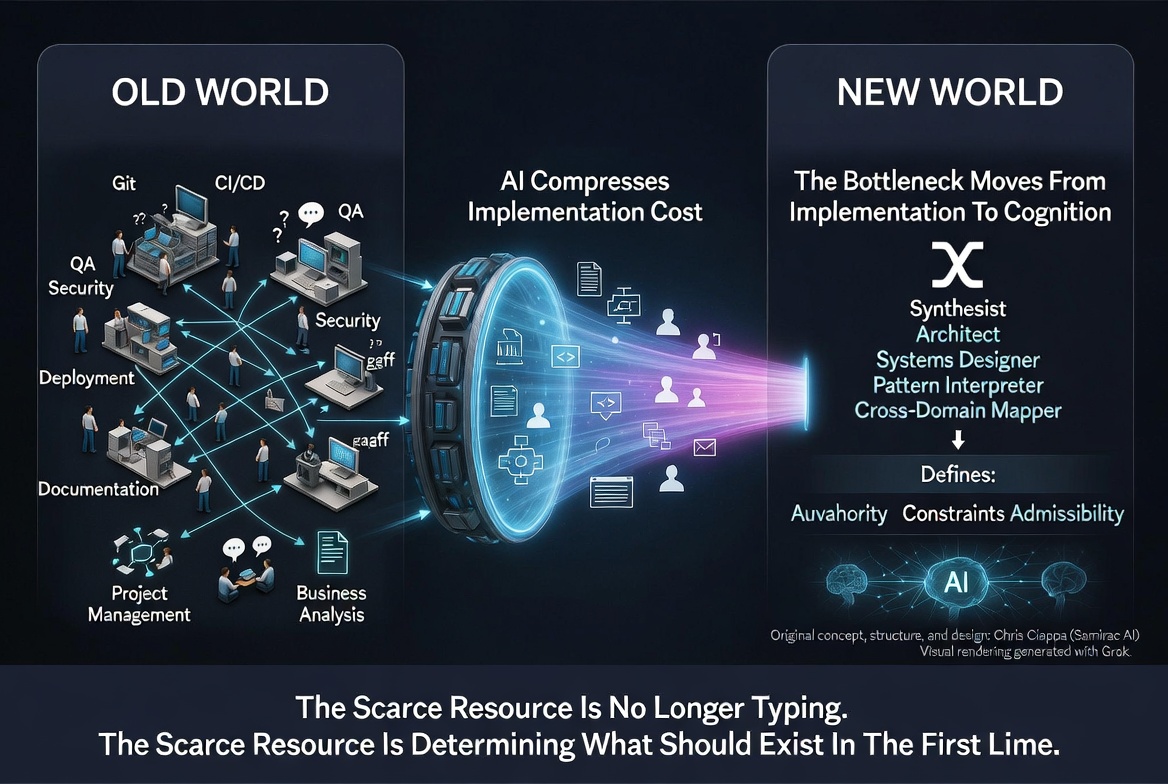
That distinction matters because implementation is becoming steadily cheaper. Writing, coding, documenting, researching, and generating content are all being compressed by increasingly capable tools. As those costs fall, the bottleneck shifts elsewhere.
The scarce resource is no longer typing.
The scarce resource is determining what should exist in the first place.
It is the ability to see relationships across domains, recognize patterns that appear disconnected, identify the structures operating beneath visible events, define what must remain invariant, and determine how authority should flow through a system. Those are not implementation skills. They are synthesis skills.
As implementation costs continue to collapse, I suspect synthesis, systems thinking, and architectural reasoning become increasingly valuable. This may help explain why so many organizations continue to struggle with AI despite having access to the same models, tools, frameworks, and vendors. The common assumption is that the competitive advantage lies in the technology itself. Increasingly, I suspect the advantage lies in the cognition directing that technology.
For decades, organizations were optimized around specialization, hierarchy, reporting structures, and departmental boundaries. Those approaches evolved for good reasons. Implementation was expensive. Coordination was difficult. Large projects required large teams, and large teams required management structures capable of organizing them.
AI begins to change that equation.
When implementation becomes dramatically less expensive, the primary challenge shifts away from coordination and toward coherence. The question is no longer how many people can be assigned to a problem, but whether the people working on that problem can perceive its underlying structure. It becomes less important to divide work among dozens of specialists and more important to ensure that the individuals involved understand how the pieces fit together.
This is one reason I believe small teams may become disproportionately powerful during the coming decade. Not just small teams in general, but small teams composed of people capable of synthesis, structural reasoning, architectural thinking, and systems-level understanding. Such teams may be able to produce what previously required entire departments operating through layers of management, documentation, coordination, and review. The advantage does not come from working harder or longer. It comes from the ability to move from insight to implementation with far less friction than was previously possible.
The implications extend well beyond technology. They affect hiring, leadership, organizational design, and the skills that become scarce in the marketplace. As AI continues to compress the cost of execution, the value of determining what should be executed rises accordingly. The ability to recognize patterns across domains, identify invariants, understand authority, and design coherent systems may become increasingly important precisely because those capabilities are difficult to automate.
This observation also helps explain why I have become increasingly interested in structural thinking over the last several years. Technology continues to improve, models continue to become more capable, and tools continue to become easier to use. Yet organizations frequently struggle with the same underlying problems. In many cases the issue is not technological capability at all. It is a lack of coherence. Organizations often possess talented people, sophisticated tools, and substantial resources while lacking a structural understanding of the systems they are attempting to build, govern, and operate.
A powerful model placed inside a poorly understood system frequently produces a more efficient version of the same confusion. Likewise, a capable team operating without a coherent architecture often amplifies drift rather than reducing it. This is why I increasingly suspect the future belongs less to those who can generate the most output and more to those who can recognize and design structure. Structure determines incentives, authority, information flow, control mechanisms, and ultimately the failure modes that emerge over time. Systems obey structure whether the participants understand that structure or not.
If that observation is correct, then the long-term impact of AI may be far different from what many people currently expect. The future may not belong to the organizations with the largest teams, the biggest budgets, or even the most advanced models. It may belong to the organizations with the highest concentration of people capable of synthesis, systems thinking, and architectural reasoning.
In that world, AI is not simply changing the economics of work.
It is changing the value of cognition itself.
And I suspect we are only beginning to understand what that means.
Related Reading
Several related articles explore many of the organizational, architectural, and cognitive themes discussed here.
• Modern IT Architecture: A Structural Perspective
Explores why architecture is fundamentally a structural discipline rather than merely a technological one, and why organizations often struggle when systems thinking is absent.
• Who Remains in the Wake of AI
Examines which forms of cognition may become increasingly valuable as AI reduces implementation costs and changes the economics of knowledge work.
The Only Question That Matters
The architecture is already defined.
Drift Stack™ Architecture
https://www.samirac.com/drift-architecture
Now ask yourself:
👉 Does my system control what’s allowed at execution —
or does it just react and hope it gets it right?
Architecture Demos
https://www.samirac.com/daisy-demos
Share This Article
If you found this article valuable, share it.
Substack automatically gives every subscriber a personal referral link. When someone subscribes through your share link, it counts toward referral rewards.
Current rewards:
• 3 referrals → 1 month of paid access
• 5 referrals → 6 months of paid access
• 10 referrals → 12 months of paid access
You can share directly using the Share button on this article, or find your personal referral link here:
Get Referral Link
By Chris Ciappa
Founder & Chief Coherence Architect
Samirac Partners