Governance, Authority & Admissibility

The Real Risk of AI Agents Isn’t Hallucination — It’s Massive Institutional Liability

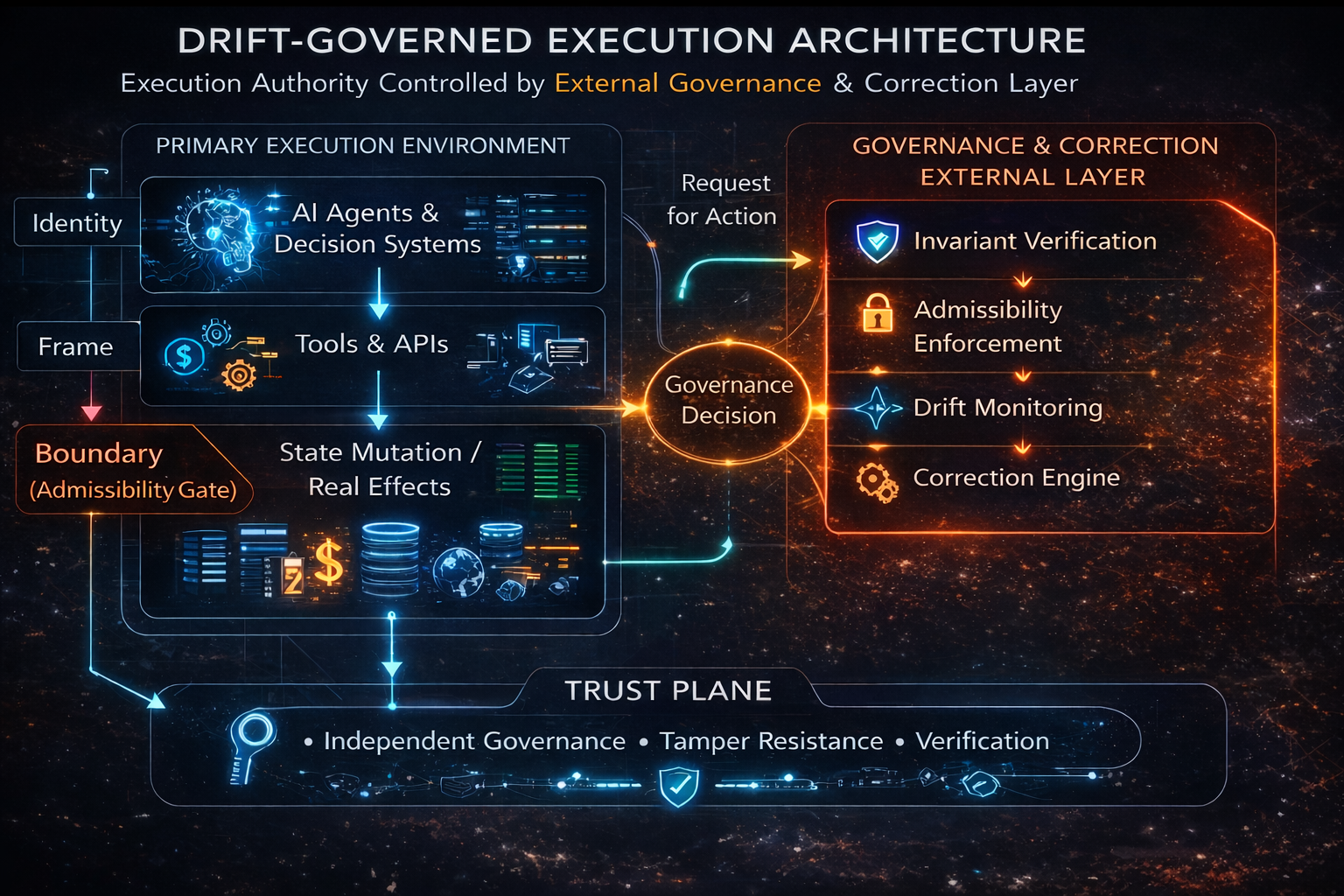
The moment AI agents gain execution authority inside real systems, the problem stops being hallucination and becomes institutional liability.
By Chris CiappaMarch 10, 202611 min read
LinkedInEmail
The Real Risk of AI Agents Isn’t Hallucination — It’s Massive Institutional Liability

By Chris Ciappa
Founder & Chief Coherence Architect
Samirac Partners

AI agents do not create risk on their own.Risk emerges when execution authority is connected to real systems without governance architecture.

When AI agents are connected to operational systems without architectural governance, organizations are not deploying automation — they are deploying unbounded execution authority inside their infrastructure.


Collapse at Machine Speed

Start with the real danger:

AI agents are now being connected directly to operational systems.

When improperly governed agents operate inside production environments, errors do not spread slowly.

They propagate at machine speed.

And when those agents are built without:

• admissibility controls
• drift detection
• architectural execution boundaries

a single faulty action can cascade across systems.

This is where AI liability begins.


The New Risk: Delegated Execution Authority

The issue is not AI generating text.

The issue is AI executing actions inside enterprise infrastructure.

Examples include:

• resetting accounts
• modifying records
• triggering infrastructure workflows
• interacting with production systems

Once AI systems are capable of acting inside operational environments, they cease to be simple assistants.

They become delegated actors.

That introduces a fundamentally different governance problem.

The question is no longer what the model can generate.

The question becomes:

Who authorized the system to act?
Under what conditions?
Against what constraints?
And what prevents unsafe execution when those constraints are violated?

This is the shift many organizations have not fully recognized.

The moment an AI system can act inside operational infrastructure, governance moves from prompt design to execution authority.

(I explored this shift in more detail here:)
Execution Authority Is the Missing Layer in AI Governance
https://coherencearchitect.substack.com/p/execution-authority-is-the-missing


Why Low-Code / No-Code Makes This Explosive

This shift becomes significantly more dangerous because the tools required to assemble these systems are becoming easier to use.

Low-code and no-code platforms now allow people to assemble agents quickly using:

• folders
• markdown files
• prompts
• connectors
• plugins

The barrier to creating operational agents has collapsed.

People who would never have written infrastructure automation or production orchestration code a few years ago can now assemble agents that interact with systems, tools, and data.

But while the tools for building agents have become dramatically easier to use, the architecture required to govern those agents has not.

The result is a widening gap between capability and governance.

It is important to be clear about something here.

The responsibility for enterprise safety does not lie with the underlying tools themselves.

Platforms such as Claude Code or other AI development environments are simply tools.

Like any powerful tool, they can be used responsibly within well-designed architecture.

The real problem emerges when agents built with these tools are deployed into operational environments without admissibility gates, without drift monitoring, and without defined execution boundaries.

In other words, the risk is not that tools exist which allow people to build AI agents.

The risk is the ungated deployment of agents into production systems without architectural governance.

Low-code and no-code tools dramatically accelerate the speed at which agents can be created.

But if those agents are connected to real infrastructure without proper governance layers, the same acceleration applies to system failure.


The “30-Minute AI Coworker” Pattern

A recent guide circulating online illustrates this pattern clearly.

The promise is simple:

You can turn an AI model into your “coworker” in about thirty minutes.

The instructions are straightforward.

Download the AI application.

Create a folder on your computer.

Add a few markdown files describing who you are and how you work.

Paste some global instructions telling the model to read those files.

Install a few plugins.

Connect your tools.

And suddenly the system can:

• read files across your environment
• understand your preferences
• ask questions before executing tasks
• generate outputs across projects
• interact with external tools

The guide frames this as a productivity breakthrough.

Instead of writing long prompts, the AI now “knows you.”

Instead of acting like a chatbot, it behaves more like a digital teammate.

At first glance, the instinct behind this approach is understandable.

People are trying to create structure around AI systems.

They want the model to have:

• context
• memory
• behavioral rules
• access to tools

In other words, they are attempting to transform a chatbot into something that behaves more like an operational assistant.

But when you examine how this structure is implemented, something important becomes visible.

The system is not actually governed by architecture.

It is being guided by files and prompts that the model is encouraged—but not required—to follow.


What the Guide Is Actually Teaching

The setup typically looks something like this.

First, a master folder is created on the user’s machine.

Inside that folder are subfolders containing project files, templates, and outputs.

The model is pointed at this directory so it can read information across the environment.

Next, several markdown files are created to provide identity and behavioral context.

One file describes who the user is and what they do.

Another describes the user’s writing voice.

Another lists “rules” the model should follow, such as asking questions before acting or avoiding destructive actions.

Then a global instruction is added telling the model to read these files before performing any task.

Finally, connectors and plugins are installed so the model can interact with external systems such as Slack, Google Drive, or project tools.

At this point the system appears to behave much more intelligently.

It can reference files.

It can ask structured questions.

It can pull information from connected tools.

To the person setting it up, it looks like the model has been transformed into a structured digital collaborator.

But from an architectural perspective, none of the critical system constraints have actually been implemented.


Why This Structure Is Illusory

The markdown files describing the user are not identity anchors.

They are simply documents the model may or may not reference depending on context pressure.

The “rules” file is not a policy layer.

It is a behavioral suggestion embedded in text.

The global instructions are not enforcement logic.

They are prompts the model can weigh probabilistically alongside other instructions.

Even the folder structure itself is not a system boundary.

It is merely a source of context the model can read from.

The architecture does not guarantee how that information will influence execution.

In other words, the system is being given guidance, not governance.

It is being encouraged to behave in a certain way, but it is not structurally prevented from behaving differently.


The Risk Appears When Tools Are Connected

The real danger appears when the final step is added: connectors.

Once the agent can access external tools, it begins interacting with real systems.

• Slack
• Google Drive
• Project databases
• Internal documentation
• Automation platforms
• Databases
• Ticket systems
• Production environments

At that point the system is no longer simply generating text.

It is operating within an environment that contains real operational data and real system controls.

And yet the mechanisms governing its behavior are still just:

• prompts
• markdown files
• workflow conventions

None of those mechanisms enforce execution boundaries.

None of them determine whether an action is admissible.

None of them detect behavioral drift.

This is the moment when a conversational model becomes an operational actor.

At that point the system can:

• read operational context
• make decisions
• trigger actions

Now errors propagate through infrastructure, not just text outputs.

The real danger is not simply that the model can “see” more context.

The danger is that connectors become execution pathways.

Once they are present, the system is no longer offering suggestions inside a chat window.

It is acting inside live environments.

That is the point at which the risk profile changes dramatically.


Simulated Architecture vs Real Governance

What these guides are effectively doing is simulating pieces of governance architecture through workflow tricks.

Context folders attempt to simulate memory.

Instruction files attempt to simulate policy.

Prompt templates attempt to simulate execution discipline.

But simulation is not the same as implementation.

In real operational systems, governance layers exist outside the decision-making component.

They enforce constraints regardless of what the model decides.

Without those structural layers, the system’s apparent structure is largely cosmetic.

It may look organized.

But it does not define who is allowed to act, under what conditions, and against what rules.

And once systems capable of acting inside operational environments are built on top of that kind of simulated architecture, the risk profile changes dramatically.


Workflow Tricks Are Not Architecture

Break down why:

Folders
Prompt instructions
Templates

These help organize work.

They do not define execution boundaries.

They do not enforce:

• authority constraints
• admissibility rules
• drift monitoring

They guide the model.

They do not govern the system.


Suggestions vs Enforced System Constraints

Many tutorials recommend prompts like:

“Ask questions before executing.”
“Read files first.”
“Never delete without approval.”

These sound like safeguards.

But they are suggestions, not enforcement.

Without architectural controls, they can be bypassed.

Complex systems require invariants, not suggestions.

The problem is not AI capability.
It’s the absence of architectural controls governing execution authority.

The rest of this article explains the two critical layers most deployments are missing.


The Missing Layers: Admissibility and Drift Control

This is where most agent deployments fail.

Two critical controls are missing.

Admissibility

The system must determine whether an action is allowed before execution.

Not recommended.
Not suggested.
Allowed or rejected.

Admissibility is a gate.

If an action does not satisfy the system’s constraints, the action simply does not occur.

Drift Detection

Even well-designed systems drift over time.

Prompts evolve.
Roles change.
Tools expand.
New connectors appear.

Drift detection mechanisms monitor whether system behavior is moving outside intended boundaries.

Without drift detection, systems slowly accumulate misalignment until failure becomes inevitable.

And once those systems are connected to operational tools, that misalignment does not remain theoretical.

A single incorrect decision can trigger actions across multiple connected systems — modifying records, triggering workflows, or propagating bad state into infrastructure.

When execution authority exists without admissibility gates and drift monitoring, those errors do not remain isolated.

They cascade.

And because AI agents operate at machine speed, the cascade can unfold faster than human operators can detect or contain it.


How These Unsafe Patterns Spread

Now introduce the ecosystem dynamics:

• influencer tutorials
• large social media audiences
• “build an AI coworker in 30 minutes” posts
• consultants selling low-code agents to businesses

These patterns spread because they are easy to copy.

But they teach workflow assembly, not system architecture.


Model Tribalism Makes It Worse

Another pattern is emerging as AI agents spread through organizations.

Communities are forming around specific models and platforms.

Claude camps.
Other model camps.

Conversations increasingly revolve around which model someone prefers, which interface they use, or which platform they believe is “the future.”

This pattern should feel familiar to anyone who has spent time in software engineering.

Technology communities have long formed around particular tools:

Oracle vs SQL Server
MySQL vs Postgres
Java vs .NET

But experienced developers learn an important discipline early:

You do not architect systems around a single vendor tool.

You architect around interfaces, constraints, and system boundaries so the underlying tools can change without destabilizing the system.

The reason is simple.

Tools evolve.
Vendors change direction.
Platforms disappear.

If the architecture of a system depends too heavily on one specific provider, the organization becomes locked into a fragile dependency.

In other words, good engineering practice avoids vendor lock-in at the architectural level.

The emerging tribalism around AI models moves in the opposite direction.

When people build agents that depend deeply on the behaviors, prompts, or quirks of one particular model or platform, the architecture of the system quietly becomes tied to that provider.

This is a form of developer drift.

Instead of designing stable execution architecture, the system is built around the assumptions and behaviors of a particular tool.

And when execution authority is being delegated to AI agents, that kind of drift introduces two separate risks at once.

First, the organization becomes dependent on a specific provider whose behavior may change over time.

Second, the deeper architectural question—the governance of execution authority—gets replaced by debates about which model is “better.”

But the safety of operational systems does not depend on which model is used.

Claude, GPT, or any future model can all be connected to tools, automation, and infrastructure.

If the architecture governing execution authority is missing, the risk profile remains the same.

The model does not determine the safety of the system.

The architecture does.


Enterprise Deployment Risk

These agents are now being:

• sold to small businesses
• deployed by consultants
• built by internal AI teams

Many are connected directly to operational systems.

Without architecture, organizations may unknowingly deploy systems capable of:

• mass record changes
• infrastructure actions
• automated decisions at scale


The Predictable Lawsuit

When the first major failure occurs, investigators will not ask:

“Which model was used?”

They will ask:

• Who authorized the system?
• What governance architecture existed?
• What admissibility controls were in place?
• What drift monitoring existed?

If those answers are unclear, liability moves to the organization.


What Responsible Architecture Requires

Operational AI systems require structural layers such as:

• identity anchoring
• reference frames
• coherence boundaries
• admissibility controls
• drift detection
• external validation

These are what make complex systems safe to operate.


Closing Insight

AI agents will scale productivity dramatically.

But systems that can act without architectural constraints do not just scale productivity.

They scale systemic risk.

When improperly governed agents operate inside production systems, failures do not unfold slowly.

They propagate at machine speed.

And that is where AI liability truly begins.


Share This Article

If you found this article valuable, share it.

Substack automatically gives every subscriber a personal referral link. When someone subscribes through your share link, it counts toward referral rewards.

Current rewards:

3 referrals → 1 month of paid access
5 referrals → 6 months of paid access
10 referrals → 12 months of paid access

You can share directly using the Share button on this article, or find your personal referral link here:

Get Referral Link


Digital Card

LinkedInEmail