AI Journey, Readiness & Adoption

This Barely Qualifies as AI

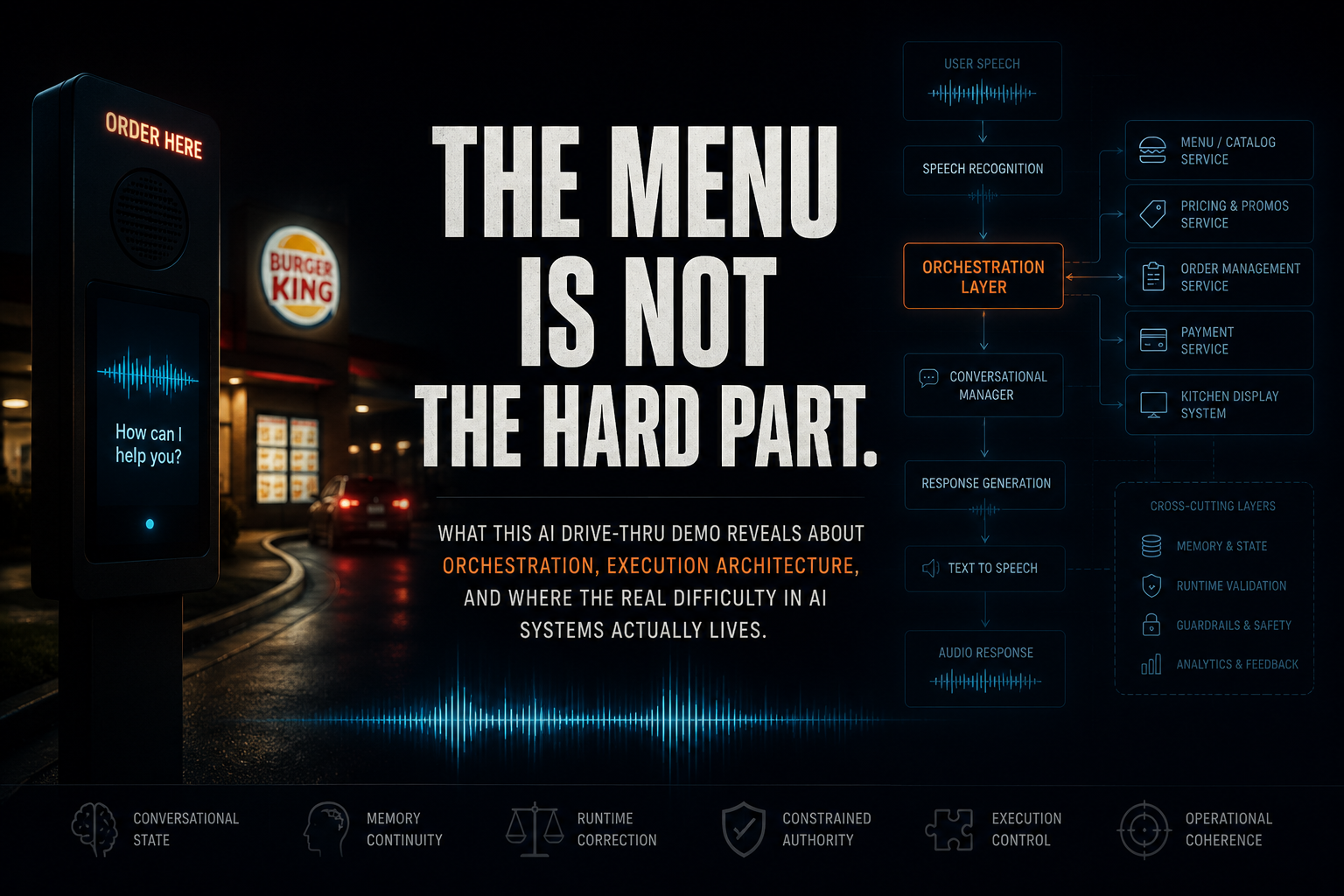
Why bounded orchestration environments are being mistaken for autonomous intelligence — and where the real architectural difficulty actually lives.
By Chris CiappaMay 12, 20262 min read
LinkedInEmail
This Barely Qualifies as AI

By Chris Ciappa
Founder & Chief Coherence Architect
Samirac Partners


Most people looking at this Burger King AI demo are focused on the wrong thing.

They see:

  • voice ordering

  • conversational AI

  • “AI agents”

  • automation

  • and futuristic drive-thru interactions

What I see is something very different.

I see a highly constrained orchestration environment being marketed as though it represents some major leap toward autonomous AI.

In reality, environments like this are comparatively simple once the underlying orchestration architecture already exists.

That is not an insult to the product.
It may work very well for its intended purpose.

But technically, this is far closer to:

  • bounded workflow orchestration

  • transactional sequencing

  • API integration

  • menu-state management

  • constrained conversational routing

  • and operational scripting

than it is to the kinds of open-domain adaptive intelligence many people imagine when they hear phrases like “AI agents.”

The truly difficult problems in conversational systems live much deeper:

  • conversational state continuity

  • ambiguity management

  • memory persistence

  • runtime correction

  • constrained authority

  • execution admissibility

  • orchestration under uncertainty

  • and maintaining operational coherence over time

Ironically, once those layers already exist, adapting into a bounded environment like a drive-thru ordering system becomes comparatively straightforward.

The menu is not the hard part.

The architecture is.

That is one reason I continue arguing that the future of AI will belong less to whoever has the biggest model and more to whoever best understands orchestration, execution boundaries, runtime control, and coherent operational architecture around probabilistic systems.

Full article below.

LinkedInEmail