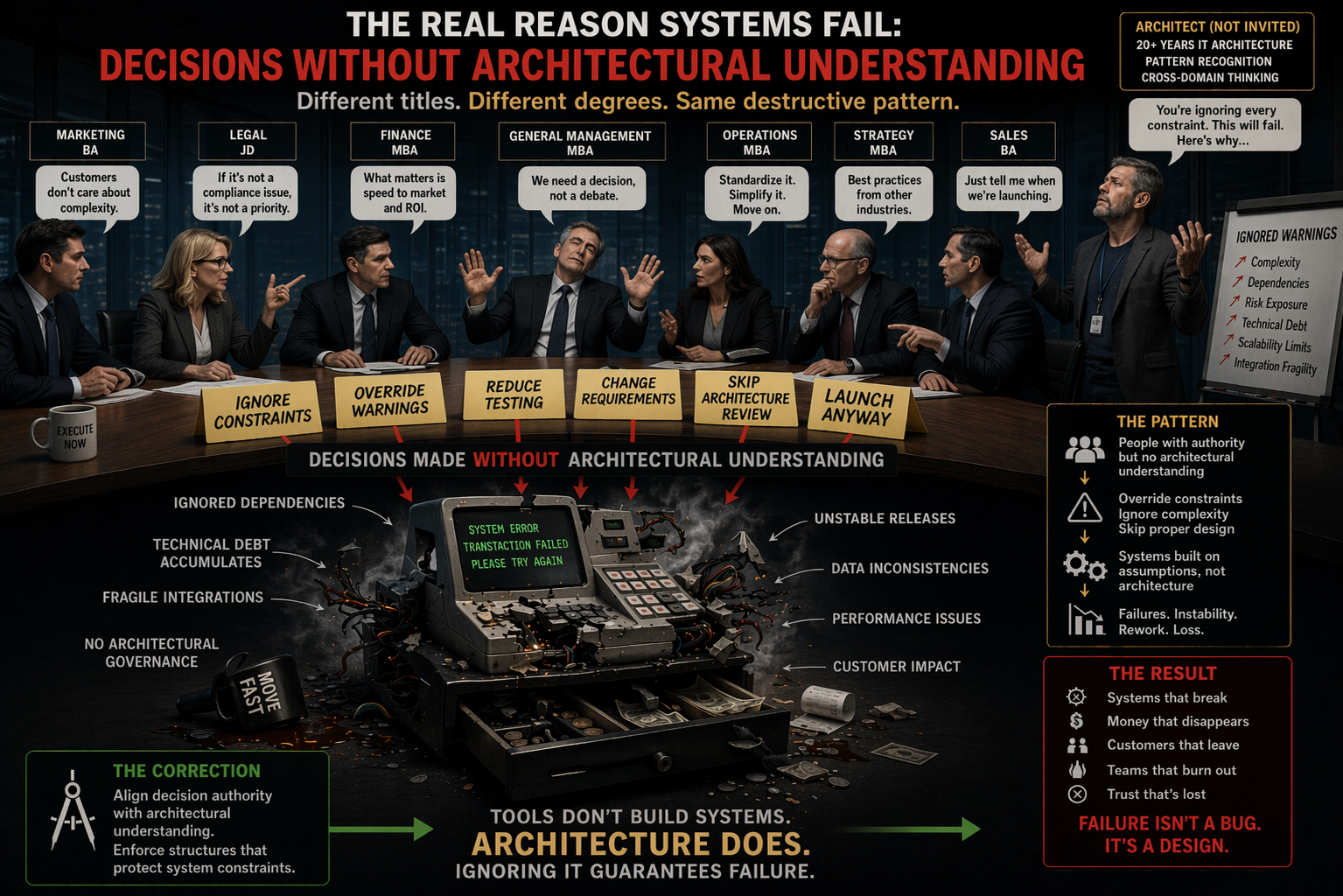
There’s a pattern that shows up over and over again in technical failures.
Different industries. Different technologies. Different decades.
Same outcome.
Not because engineers didn’t know what they were doing.
Not because the tools weren’t good enough.
But because the people making architectural decisions didn’t understand the architecture.
This Isn’t About “Technical vs. Non-Technical”
Let’s get something out of the way.
This isn’t:
“non-technical people are the problem”
or “only engineers should lead”
That’s lazy thinking.
The real issue is much more precise:
When decision-making authority exceeds architectural understanding, systems become unstable.
And when that happens consistently enough…
Failure isn’t a possibility.
It’s a trajectory.
The Pattern, Repeated
Healthcare.gov Rollout
The goal was simple: launch a national healthcare marketplace.
The reality:
multiple contractors
no unified system architecture
political deadlines overriding technical readiness
Warnings were raised.
They were ignored.
The system launched anyway—and failed immediately under load.
What went wrong?
Not a lack of engineering talent.
👉 Leadership forced execution without understanding the system’s architectural constraints.
Target Canada Expansion Failure
Target expanded into Canada with a new supply chain and inventory system.
On paper, everything was ready.
In practice:
inventory data was wrong
systems weren’t aligned
shelves were empty
The result:
massive losses
full withdrawal from the country
What went wrong?
👉 Leadership treated a complex system like a spreadsheet rollout—ignoring the realities of data integrity, system dependencies, and operational flow.
Denver International Airport Baggage System Failure
A fully automated baggage system was commissioned for a major airport.
Ambitious. Innovative. Impressive.
And completely unworkable.
Bags flew off tracks
Systems jammed constantly
Delays stretched for years
What went wrong?
👉 Leadership pushed for a level of automation that exceeded what the system could realistically support—ignoring complexity warnings from engineers.
FBI Virtual Case File Project Failure
A major case management system for the FBI.
$170 million spent
Constant requirement changes
No stable architecture
The system was ultimately scrapped.
What went wrong?
👉 Leadership continuously redefined the system without architectural grounding—destabilizing it faster than it could be built.
What These Failures Have in Common
These weren’t isolated mistakes.
They share a structural pattern:
Constraints were overridden
Complexity was underestimated
Systems were treated as simpler than they were
Decisions were made without understanding downstream impact
And most importantly:
The system had no protection against bad decisions at the top.
The Real Failure Mode
Most people look at these cases and say:
“bad execution”
“poor project management”
“integration issues”
Those are symptoms.
The deeper issue is this:
Architectural decisions were made by people who didn’t understand the architecture.
That creates a dangerous dynamic:
Engineers raise concerns
Leadership overrides them
Systems are pushed beyond safe limits
And once that loop starts…
Failure becomes inevitable.
Why This Keeps Happening
Because modern tools create the illusion of simplicity.
Dashboards look clean.
Systems feel manageable.
Progress appears visible.
So leadership assumes:
“We understand enough to steer this.”
But they’re not seeing:
hidden dependencies
scaling constraints
state interactions
failure modes
They’re making decisions on the surface…
while the system operates underneath.
This Is Not a People Problem. It’s a Structure Problem.
The issue isn’t that leaders are incapable.
It’s that organizations often lack:
architectural governance
constraint enforcement
mechanisms that prevent invalid decisions from being executed
So the system becomes vulnerable to:
👉 well-intentioned decisions made at the wrong level
The Lesson
You don’t fix this with:
better tools
better prompts
better project plans
You fix it by aligning:
decision authority with architectural understanding
Or by enforcing structures that prevent decisions from violating system constraints in the first place.
Related Reading
The failures above happened across different industries and different generations of technology, but the underlying structural problem is remarkably consistent. These articles continue that argument from leadership competency into architecture, system design, and AI deployment.
When Leadership Lacks Architectural Competency, Systems Fail
When people who do not understand the architecture are given authority to determine how the system is built, architectural constraints eventually collide with organizational decisions. This article examines that leadership failure directly.
Modern IT Architecture: A Structural Organization Model
Architecture is not simply a collection of technologies, diagrams, vendors, or project plans. It is the structure that determines how authority, systems, dependencies, controls, and responsibilities fit together—and what happens when one of them fails.
Architecture Is What Saves You
Large-scale systems eventually expose every assumption made during design. Good tools and talented people cannot compensate indefinitely for architecture that does not properly manage state, authority, dependencies, boundaries, and failure.
The Fastest Way to Build the Wrong System
Speed is useful after you understand what should be built. Before that, speed simply allows an organization to make architectural mistakes faster. The pressure to demonstrate progress can become particularly dangerous when technical readiness is subordinated to deadlines, tools, or executive expectations.
AI Lifecycle Maturity Model™
AI makes this old leadership problem considerably more consequential because systems are increasingly being given the ability to reason, use tools, participate in workflows, and eventually execute actions. Capability does not mean an organization is ready to deploy it. The maturity model examines the broader organizational conditions required before AI moves safely into production.
Before You Deploy AI, Find Out Where You Actually Stand
The historical failures in this article all contain a lesson that matters enormously now: an organization can possess excellent technology while lacking the architectural, operational, governance, or leadership maturity required to use it successfully.
That is precisely the problem AI RADAR™ was built to examine.
AI RADAR evaluates organizational AI maturity and readiness across the conditions that actually determine whether AI belongs in production—including deployment strategy, execution authority, governance, operational risk, financial impact, architecture, and execution readiness.
AI RADAR™ — AI Readiness & Deployment Assessment
Before asking:
“What AI should we deploy?”
it may be worth answering the more important question:
“Are we structurally ready to deploy it at all?”
Then I would go directly into your existing:
Final Thought
This pattern isn’t new.
It didn’t start with AI...