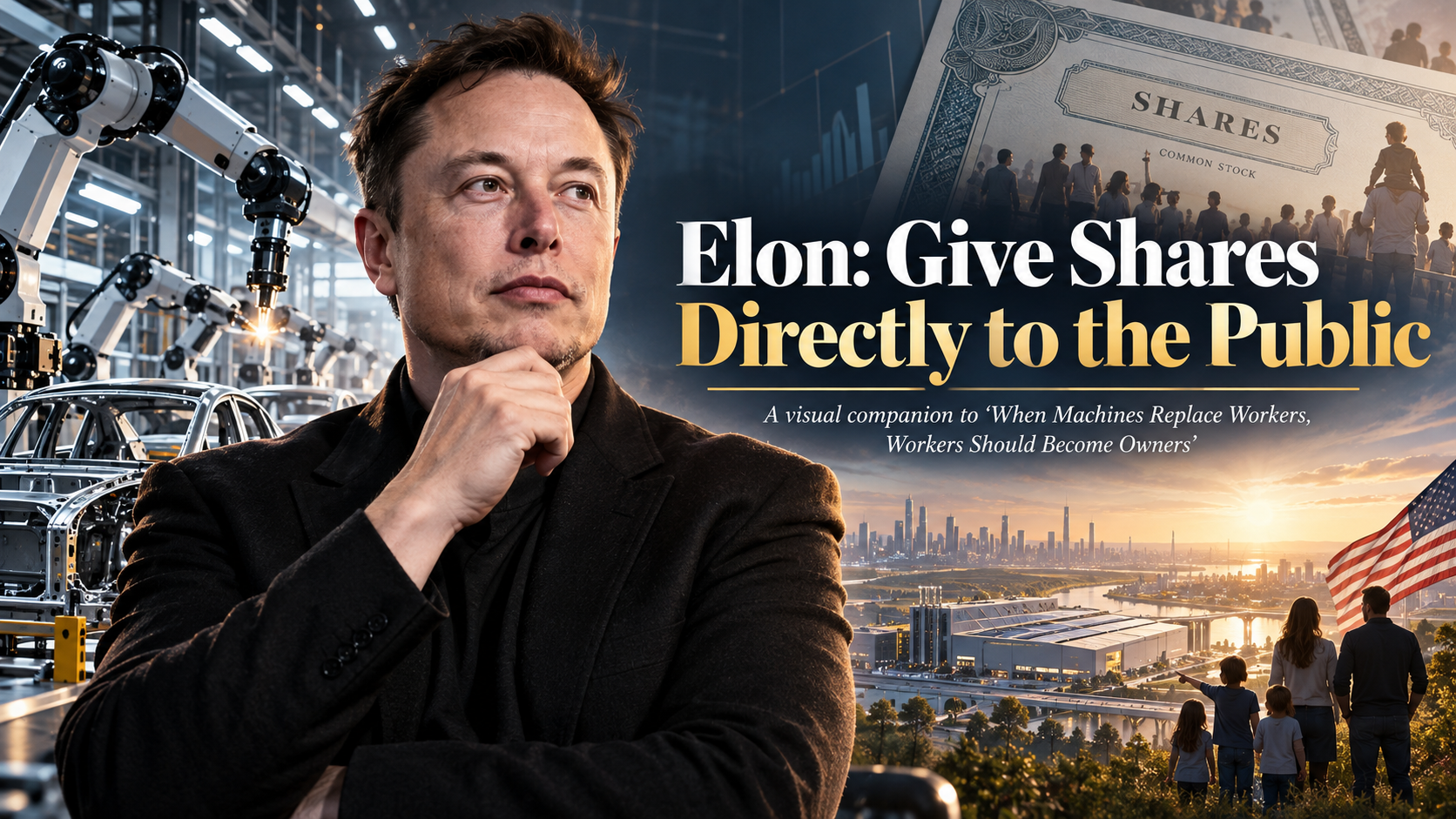
I've been thinking quite a bit about what happens to our economy when artificial intelligence, robotics, and automation begin replacing human labor on a massive scale.
⠀
Not just programmers or customer service representatives, either. I'm talking about truck drivers, warehouse workers, accountants, analysts, administrative employees, manufacturing personnel, and eventually entire categories of employment that have supported American families for generations.
⠀
We can debate how quickly this happens, but I think we'd be foolish to ignore where technology is taking us.
⠀
I recently heard someone discussing this problem who concluded that widespread automation would eventually make universal basic income necessary.
⠀
Essentially, eliminate enough jobs and the government will have to provide people with money to survive.
⠀
That bothers me.
⠀
Not because I don't believe we should help people who need help. We absolutely should. But I have a serious problem with the idea that our technological future inevitably leads to millions of people becoming permanently dependent on government distributions simply because machines can now perform the work they used to do.
⠀
What happens to ambition, ownership, independence, personal responsibility, or the ability to build something meaningful and leave it to your children?
⠀
Are we really going to develop the most productive technology in human history and then conclude that the best economic arrangement we can come up with is for government to collect and redistribute the resulting wealth?
⠀
I don't believe that.
⠀
I think there's another way, and it starts with looking at the problem from a completely different direction.
⠀
The Problem Isn't Automation. It's Who Owns the Productivity.
⠀
Consider a transportation company employing 1,000 truck drivers.
⠀
Over time, that company introduces autonomous vehicles and eventually eliminates most of those driving positions.
⠀
The trucks still move the freight. In fact, they may do it substantially better. They can operate longer hours, optimize routes, reduce downtime, and become progressively more efficient as the technology improves.
⠀
So what actually happened?
⠀
The company didn't lose the productive capacity those employees provided. It replaced the labor required to produce it.
⠀
The company may now transport more freight at a lower operating cost, generating substantial savings and potentially much greater profits.
⠀
Its shareholders benefit.
⠀
But what happens to the thousand people whose labor helped build and sustain that enterprise?
⠀
They lose their income.
⠀
And the company, under the traditional arrangement, has largely fulfilled its obligations by providing whatever severance, unemployment contributions, or other legally required benefits apply.
⠀
Now multiply that scenario across manufacturing, finance, retail, transportation, logistics, agriculture, software development, and every other industry where machines are increasingly capable of replacing human labor.
⠀
We're no longer talking about ordinary unemployment.
⠀
We're talking about changing the fundamental relationship between labor, capital, ownership, and economic participation.
⠀
Traditionally, most people participate in the economy by working. They earn wages, spend money, hopefully save something, and perhaps accumulate productive assets over time.
⠀
But what happens when the economy no longer requires human labor at anything approaching its historical scale?
⠀
The productive capacity hasn't disappeared.
⠀
The wages have.
⠀
And that's the problem I think we need to solve.
⠀
What If Automation Had to Replace the Income It Eliminates?
⠀
Here's what I'm proposing.
⠀
When a sufficiently large company eliminates a position because technology has replaced the work, that company should be required to provide the displaced employee with productive ownership or investment assets sufficient to replace the income they were earning.
⠀
Not simply a token stock grant, a small severance package, or some arbitrary participation in future profits.
⠀
I'm talking about replacing the employee's income.
⠀
Suppose someone has worked for a publicly traded corporation for fifteen years and earns $80,000 annually.
⠀
The corporation introduces an automated system that performs their work at a fraction of the ongoing cost and eliminates their position.
⠀
Fine. I have no objection to technological progress, and I'm certainly not suggesting companies should continue employing people to perform work that no longer needs to be done.
⠀
But I don't believe that corporation should be permitted to eliminate the person's economic participation merely because it found a more efficient way to produce the same result.
⠀
If technology replaces the employee's labor, then some of the capital benefiting from that replacement should become the employee's capital.
⠀
The company would be required to establish an income-producing ownership position designed to replace that $80,000 annual salary.
⠀
That might involve a class of company shares carrying distribution rights, a combination of equity and bonds, or another properly funded investment arrangement. Treasury securities might even be part of the income-producing structure.
⠀
The specific financial instruments can be worked out.
⠀
What matters is that the employee now owns productive assets that generate income instead of depending entirely on a paycheck.
⠀
And here's where this gets interesting.
⠀
The company continues improving its technology. Its operating costs decline, productivity improves, and if the business succeeds, its profits grow.
⠀
The employee continues receiving investment income and, where the ownership structure provides it, participates in that growth.
⠀
The person is no longer earning money by performing the work.
⠀
They're earning money because they own productive capital.
⠀
That's the Robert Kiyosaki principle applied to a very different economic problem.
⠀
Instead of depending exclusively on labor to produce income, people begin acquiring assets that produce income for them.
⠀
And if we're moving toward an economy where machines perform an increasing share of the work, I think that transition becomes essential.
⠀
But Isn't That Taking Wealth From Existing Shareholders?
⠀
I can already hear the objection.
⠀
"You can't force corporations to give employees ownership. That's diluting shareholders, interfering with private property, and penalizing the people who invested in the company."
⠀
All right. Let's examine that.
⠀
Suppose a corporation spends $10 million annually employing a workforce that technology can replace.
⠀
It makes a substantial capital investment, automates those operations, and eventually reduces the recurring cost of performing that work to $3 million annually, including the necessary maintenance, operating expenses, and capital costs.
⠀
For the sake of this example, assume that produces $7 million in annual economic savings after the relevant costs.
⠀
Who receives that $7 million?
⠀
Under the traditional arrangement, the financial benefit flows to the corporation and ultimately its owners, while the displaced employees lose their wages.
⠀
And here's why I think that becomes a problem.
⠀
The employees weren't displaced because the company stopped needing the economic activity they performed.
⠀
They were displaced because capital became capable of performing that activity more efficiently.
⠀
The economic activity continues. The value continues. The ownership participation does not.
⠀
Now, I'm not suggesting the corporation surrender the entire $7 million. That would make no sense. Companies need incentives to invest, innovate, grow, and assume risk.
⠀
But why should 100 percent of the productivity benefit necessarily accrue to existing capital owners while the people whose labor was replaced receive no continuing participation at all?
⠀
That's the question.
⠀
Yes, issuing additional shares can dilute existing shareholders, and treasury shares still represent real economic value. A stock split, by itself, doesn't create additional wealth, either.
⠀
I understand that.
⠀
But we're talking about allocating part of a continuing productivity gain to fund income replacement, not pretending that equity is free money.
⠀
Corporations already account for wages, retirement contributions, benefits, debt financing, capital investment, and numerous other obligations in determining whether an investment makes economic sense.
⠀
Why shouldn't the economic cost of replacing human labor become part of that calculation?
⠀
And if a particular automation project cannot generate enough economic value to support the required transition, then perhaps the financial justification for eliminating those positions isn't as compelling as the company originally thought.
⠀
I think that's a perfectly reasonable question for us to ask.
⠀
This Should Apply to Large Companies, Especially Public Corporations
⠀
I'm not suggesting we impose the same obligations on a small family-owned restaurant employing six people that we impose on a multinational corporation employing 100,000.
⠀
Those are fundamentally different enterprises with different capital resources, financing capabilities, and operating realities.
⠀
I would begin by examining companies employing more than approximately 50 or 100 people, with particular attention to publicly traded corporations.
⠀
The precise threshold would need to be modeled, along with the treatment of privately held enterprises.
⠀
And I'd go even further.
⠀
Perhaps large publicly traded corporations should be required to include some form of meaningful employee ownership as part of their compensation structures long before technological displacement occurs.
⠀
Think about that for a moment.
⠀
If employees accumulate shares or other productive interests throughout their working lives, they begin building capital rather than relying exclusively on their wages.
⠀
Over fifteen or twenty years, that could become substantial.
⠀
Then, when automation eventually replaces a position, the company would already have an ownership relationship with the employee, making the transition from employment income to investment income considerably more natural.
⠀
Why shouldn't ordinary workers accumulate ownership in the same companies whose productivity they're helping create?
⠀
People who own substantial shares of successful technology companies can benefit enormously from those businesses without working there.
⠀
Their capital works for them.
⠀
So why shouldn't we create a mechanism through which the employees being displaced by those technologies can become capital owners themselves?
⠀
And What Happens When People Sell the Shares?
⠀
This is where personal responsibility becomes important.
⠀
Suppose someone receives an investment arrangement designed to produce $80,000 annually because technology eliminated their job.
⠀
They now own assets intended to replace the income they previously earned through labor.
⠀
What's stopping them from immediately selling those assets, spending the proceeds, and finding themselves with nothing five years later?
⠀
That's a legitimate question, and I think the answer is straightforward.
⠀
There should be a five-year lockup on the underlying replacement-income capital.
⠀
During that period, the employee receives the income distributions but cannot simply liquidate the principal, pledge it as collateral, or otherwise dismantle the very arrangement intended to provide continuing income.
⠀
And every employee should sign a clear acknowledgment explaining exactly what they're receiving, why they're receiving it, and what their responsibilities are.
⠀
This isn't lottery money.
⠀
It isn't a bonus for losing a job.
⠀
It's productive capital provided for the purpose of replacing employment income.
⠀
After the lockup expires, the assets belong to the employee, subject to the ordinary terms of ownership.
⠀
If they want to retain the shares, collect distributions, and potentially benefit from decades of future growth, wonderful.
⠀
If they want to sell them, invest in something else, buy a business, or use the proceeds differently, that's their decision.
⠀
But if they voluntarily liquidate the assets, spend the proceeds, and eventually run out of money, they shouldn't be entitled to another replacement package from the company simply because they made poor financial decisions.
⠀
And here's why I say that.
⠀
The entire purpose of this arrangement is to create economic independence, not another system of perpetual guarantees.
⠀
Ownership has to mean something.
⠀
It means opportunity, and it means responsibility.
⠀
Now, there's an important distinction between someone voluntarily destroying their investment capital and a company failing because of poor management, bankruptcy, or changing market conditions.
⠀
Those risks have to be addressed in how the replacement-income assets are structured. A sound system wouldn't blindly force someone to depend forever on one concentrated, risky stock position.
⠀
But the principle remains: people should understand the purpose of the assets they've received and accept responsibility for their decisions.
⠀
And if somebody has an unexpected expense, whether it's a medical bill or something else, liquidating the capital that supports their future income shouldn't automatically become the first solution.
⠀
Find another way to address the expense if possible. Earn additional income. Work out financing that doesn't destroy the income-producing assets.
⠀
Protect the capital.
⠀
Because once you begin consuming the assets that produce your income, you're moving right back toward the dependency this system was intended to prevent.
⠀
What About Companies That Don't Pay Dividends?
⠀
Another obvious objection is that many publicly traded companies don't distribute profits through regular dividends.
⠀
That's true.
⠀
Someone could own a million dollars' worth of stock in a successful corporation and still receive no recurring cash distributions.
⠀
And ownership that generates no spendable income doesn't solve the problem of replacing a paycheck.
⠀
That's why the mechanism can't simply say, "Give the employee some shares and we're finished."
⠀
There must be an actual income-producing obligation.
⠀
For instance, the company might establish a special class of ownership carrying defined distribution rights, or it might fund an investment arrangement combining equity participation with income-producing securities.
⠀
And the financial mathematics matter.
⠀
If we expected a portfolio to produce $80,000 annually from a 5 percent yield, that would ordinarily require approximately $1.6 million in invested assets.
⠀
That's a substantial obligation, and in some cases it might exceed the economic benefit of the automation itself.
⠀
So we would need to determine how the obligation is valued, funded, secured, and sustained.
⠀
Perhaps the obligation is structured over time, backed by productive assets, or financed from the savings generated by qualifying automation.
⠀
Those are matters for economic modeling, financial engineering, and legislation.
⠀
But I would not confuse the difficulty of designing the financial mechanism with a reason to abandon the objective.
⠀
The objective is income replacement through ownership.
⠀
The mechanism has to deliver that result.
⠀
And What If Automation Doesn't Make the Company More Profitable?
⠀
That matters, too.
⠀
Technology doesn't automatically create profits simply because a company installs it.
⠀
A corporation can spend a fortune on automation, get the implementation wrong, destroy customer relationships, create operational problems, or find itself competing against other companies that use similar technology to drive prices down.
⠀
So yes, we have to distinguish between projected productivity gains and gains that actually materialize.
⠀
And no, issuing stock doesn't magically eliminate that economic risk.
⠀
But companies already evaluate capital investments using projected returns, financing costs, depreciation, risk, and expected operating savings.
⠀
An income-replacement obligation would become another condition in that investment analysis.
⠀
If you're going to eliminate hundreds of jobs with technology, the financial model should account for the economic transition of the employees being displaced.
⠀
That is precisely why we need a properly structured arrangement rather than a promise that rising stock prices will somehow take care of everyone.
⠀
The replacement-income rights have to be enforceable, and the financial commitments have to be real.
⠀
Otherwise, we've just exchanged one uncertain paycheck for another uncertain promise.
⠀
Think About What Happens Over Twenty or Thirty Years
⠀
Now here's where I think this idea becomes considerably more interesting.
⠀
Imagine someone works for a transportation company for fifteen years, then receives an ownership position when autonomous vehicles replace their job.
⠀
They decide to find another job.
⠀
Why not?
⠀
They now have investment income coming from the transportation company, and they earn additional wages from their new employer.
⠀
Ten years later, that second employer introduces automation and eliminates their position, too.
⠀
Under the same qualifying rules, another income-producing ownership interest is created.
⠀
Now that individual may own productive assets in two different businesses.
⠀
They can continue working elsewhere, invest additional money, start a business, or simply manage the assets they've accumulated.
⠀
And those ownership interests may continue producing income as the enterprises become more efficient.
⠀
Multiply that process across millions of people and multiple generations.
⠀
Instead of technology steadily concentrating productive ownership among people who already possess substantial capital, the process of automation itself begins creating new capital owners.
⠀
Ordinary households could gradually accumulate portfolios of income-producing assets rather than relying entirely on their ability to sell labor.
⠀
And what makes this particularly interesting is that it doesn't require eliminating private ownership or the incentive to create wealth.
⠀
Quite the opposite.
⠀
It expands ownership.
⠀
Private companies still compete. Entrepreneurs still create businesses. Investors still assume risk. Innovation continues to be rewarded, and individuals remain responsible for managing the capital they accumulate.
⠀
The difference is that technological displacement becomes a mechanism for expanding participation in productive capital rather than simply ending participation in productive labor.
⠀
That's a very different vision of an automated economy.
⠀
Elon Musk Just Raised an Interesting Possibility
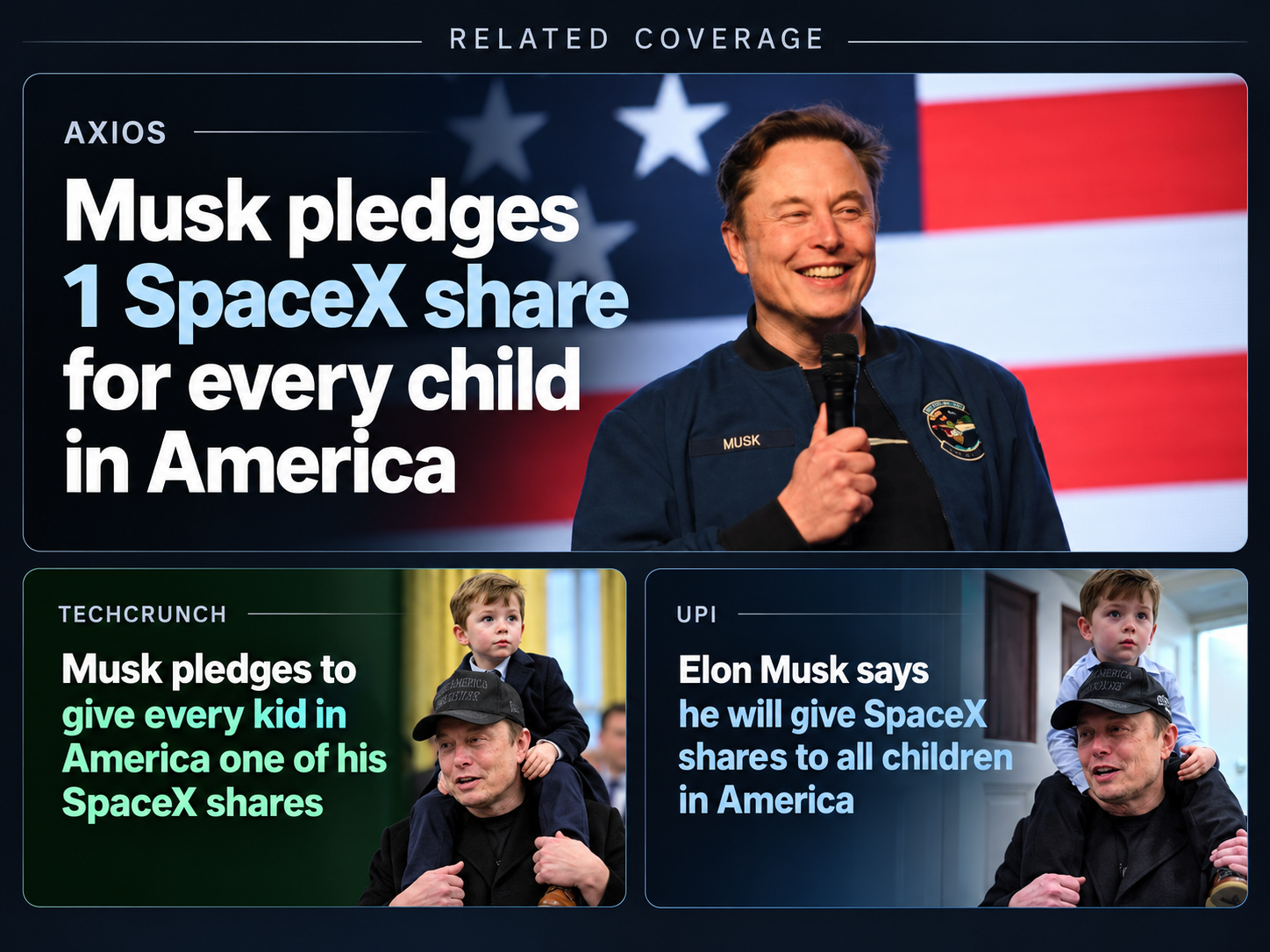
On October 19, 2026, Elon Musk announced something that caught my attention.
⠀
“Next year, I will give one of my SpaceX shares to every kid in America. This will be the first of many.”
⠀
The announcement followed Anthropic's proposal to direct a portion of its shares into a public-benefit fund. Musk's response to that approach was even more interesting to me: “I recommend giving the shares directly to the public.”
⠀
Now think about why that distinction matters.
⠀
A fund can collect corporate wealth, decide how to deploy it, and distribute benefits to people who may never acquire an ownership position of their own. Give those people shares directly, and you've changed the relationship. They own an asset. They can participate in its future value. Potentially, they can pass it on to their children.
⠀
That's much closer to the economic direction I've been describing here.
⠀
Musk's announcement is a pledge, not a completed distribution, and one share of SpaceX won't replace anyone's paycheck. Nor is giving stock to children the same mechanism I'm proposing for workers whose jobs are eliminated by automation. I'm talking about properly funded, enforceable income-producing ownership that replaces lost labor income, rather than a voluntary gift.
⠀
But the principle is worth noticing. Why should the enormous productive capacity we're creating remain concentrated among an increasingly small group of capital owners while everyone else waits for somebody to distribute a portion of the proceeds?
⠀
If we can imagine giving children shares so they have an ownership interest in the economy they'll inherit, why shouldn't we also examine giving displaced workers a meaningful ownership interest in the productive technology replacing their labor?
⠀
And not just a ceremonial share. Enough productive capital to replace the income automation took away.
⠀
That is how you begin moving people from dependence on wages or distributions toward direct economic participation.
⠀
Sources: Musk's October 19 announcement and public-share proposal, reported by Axios; TechCrunch reporting on the pledge and its unresolved implementation.
⠀
Why Not Just Use Universal Basic Income?
⠀
I know there are people who believe universal basic income is the inevitable outcome of advanced automation.
⠀
And perhaps some form of public assistance will continue to be necessary. There will always be people who need help, and there will always be circumstances requiring a social safety net.
⠀
But I don't want the primary economic arrangement of the future to be one where machines produce the wealth, a relatively narrow ownership class captures it, and government becomes responsible for redistributing enough of it to keep everyone else alive.
⠀
Think about the dependencies that creates.
⠀
Who determines the payments?
⠀
Who decides how much people need?
⠀
What happens when government finances deteriorate?
⠀
What happens when the political priorities change?
⠀
And perhaps most importantly, how does a person accumulate independent wealth and pass that wealth to their children if their principal source of income is a government distribution rather than ownership of productive assets?
⠀
That's what bothers me about treating UBI as the default solution.
⠀
We're talking about an extraordinary technological transformation that may enable businesses to produce more with dramatically less human labor.
⠀
Why would we automatically conclude that the people displaced by that transformation should become economic dependents?
⠀
Why not use the transformation itself to create more owners?
⠀
Yes, that involves a mandated transfer of economic value.
⠀
But there's a fundamental difference between the government permanently collecting and redistributing income and a legally structured process that gives individuals productive assets they own.
⠀
The former provides continuing payments determined through public policy.
⠀
The latter provides capital, ownership rights, future economic participation, and the opportunity to accumulate wealth independently.
⠀
And once the capital is theirs, they're responsible for it.
⠀
We Need to Think Beyond the Next Layoff
⠀
The more I think about this, the more convinced I become that we're approaching a problem much larger than the immediate question of which jobs AI will eliminate next.
⠀
The technology is going to improve.
⠀
Robotics will become more capable. Software will become more sophisticated. Companies will discover entirely new ways of producing goods and services with fewer people.
⠀
And assuming we continue advancing technologically, the economic importance of owning productive capital may increase considerably relative to the importance of supplying human labor.
⠀
We can either prepare for that transition or wait until an enormous number of people discover that their ability to earn a living has disappeared.
⠀
I would rather prepare.
⠀
We should begin seriously examining an automation income-replacement requirement for sufficiently large enterprises, particularly publicly traded corporations, and explore whether broad-based employee ownership should become a normal part of corporate compensation.
⠀
The goal would be straightforward: when qualifying technological automation eliminates someone's employment income, the resulting economic transition should provide that individual with a durable, income-producing capital position.
⠀
We'd have to model the financing, shareholder effects, economic incentives, valuation, eligibility, safeguards, and consequences carefully.
⠀
And if a proposed mechanism fails economically, we correct the mechanism.
⠀
That's how you design a system.
⠀
But I don't think we should accept mass technological unemployment followed by permanent government dependency as the inevitable economic future simply because it's the first solution everyone keeps repeating.
⠀
One Final Question
⠀
When a company replaces a thousand workers with machines, who should own the productive capacity that takes their place?
⠀
Of course the people who built the company, invested the capital, developed the technology, and assumed the financial risks deserve to participate in the returns.
⠀
I've never argued otherwise.
⠀
But those thousand employees also spent years helping that enterprise produce value.
⠀
And now the company can potentially continue producing that value, perhaps substantially more of it, without their labor.
⠀
So why must their economic participation end completely at the exact moment the company discovers how to produce more with less?
⠀
I don't think it should.
⠀
If we're going to build an economy in which machines increasingly perform the work, then we should also build an ownership structure that allows the people displaced by those machines to continue participating in the wealth being created.
⠀
And I would much rather see people become investors, asset owners, and economically independent participants in that future than permanent recipients of government assistance.
⠀
The robot doesn't need a salary.
⠀
It doesn't need a retirement account.
⠀
It doesn't need to feed its children, pay a mortgage, or save for the future.
⠀
People do.
⠀
So when a machine replaces a person's labor, why shouldn't the technology that eliminated the paycheck also help create the ownership that replaces it?
⠀
I think that's a question worth taking seriously.