Governance, Authority & Admissibility

When Safety Meets State Power: The Real Governance Problem Behind the Anthropic Dispute

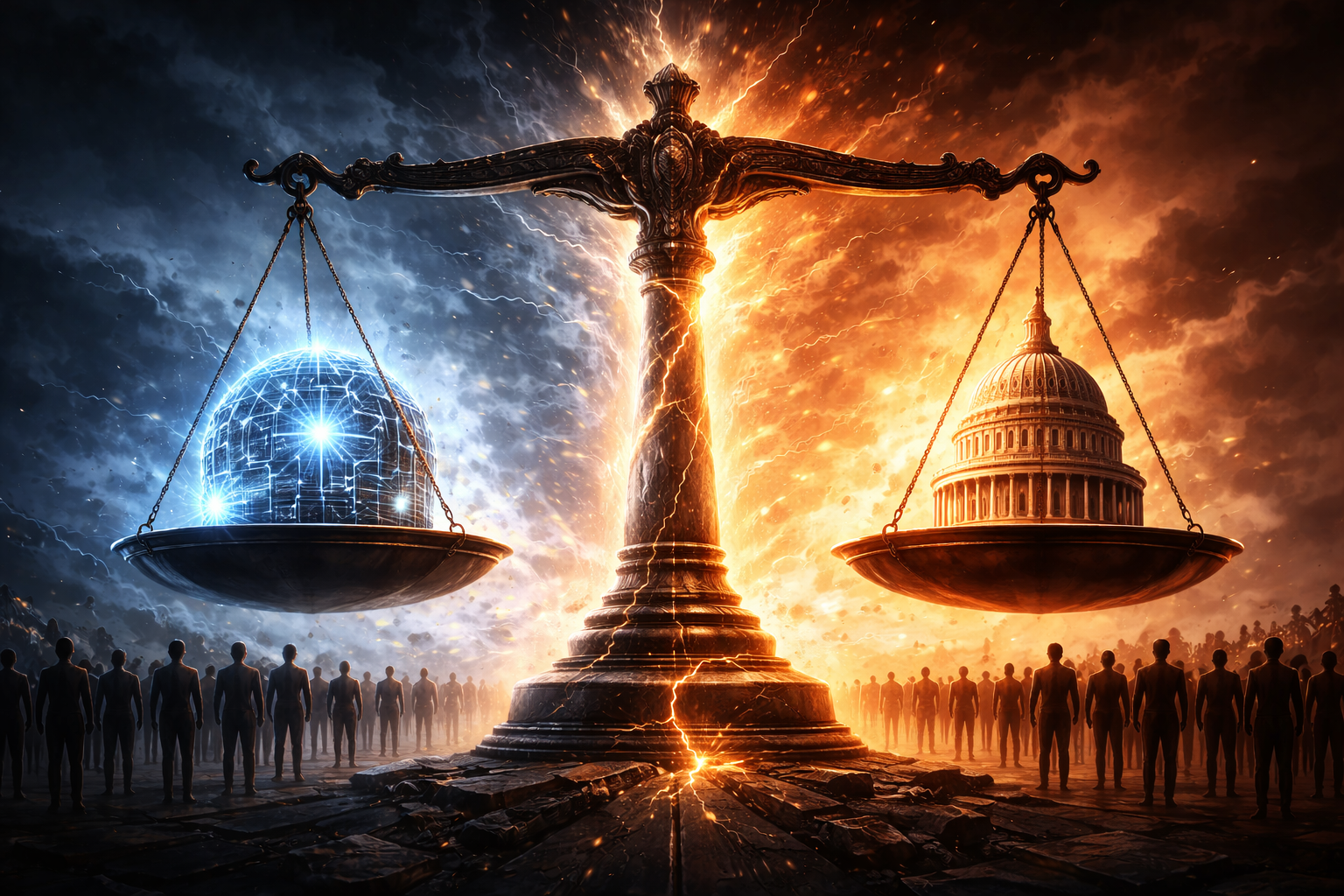
AI Safety Is Not the Conflict. Authority Is.
By Chris CiappaFebruary 28, 20263 min read
LinkedInEmail
When Safety Meets State Power: The Real Governance Problem Behind the Anthropic Dispute

By Chris Ciappa
Founder & Chief Coherence Architect
Samirac Partners


The Escalation Matters

The reported dispute between the U.S. government and Anthropic is not fundamentally about AI safety.

It is about authority.

According to reporting, Pentagon officials pressured Anthropic over model restrictions and reportedly threatened to designate the company a “supply chain risk” if it did not accommodate government use requirements.

That escalation matters.

Not because it signals villainy.

But because it exposes the real fault line in AI governance: who controls execution authority when safety constraints collide with state power.


This Is Not a Safety Debate

Anthropic’s public posture emphasizes guardrails and constrained use policies.
The U.S. government, particularly in defense contexts, operates under a different imperative: operational flexibility under national security mandates.

When those systems meet, friction is inevitable.

Private safety constraints attempt to define identity and boundary.
State actors attempt to expand operational scope.

That is not ethics.

That is jurisdictional collision.


The Real Question: Who Governs Execution Authority?

If an AI system is advisory, drift is inconvenient.

If an AI system is attached to execution authority — targeting workflows, logistics, intelligence triage, procurement routing — drift is structural risk.

Without formal admissibility gates and measurable identity constraints, it does not matter whether the tool comes from Anthropic, OpenAI, Google, or an internal defense lab.

The vendor is not the governing layer.

The architecture is.


When Safety Becomes Negotiable

The threat of a “supply chain risk” designation reveals something deeper.

When safety constraints limit operational latitude, power does not quietly accept limitation.

Power negotiates.

That negotiation may be legal, bureaucratic, or contractual — but it is ultimately about control of state action.

If guardrails exist only at the model level, they are subject to leverage.

If constraints are policy-based rather than structurally bound to execution gating, they become negotiable.

Governance that depends on vendor discretion will always collide with state power.


The Missing Layer

The deeper risk is not that the government uses Anthropic’s tools.

The deeper risk is that AI systems with execution implications are deployed without:

  • Measurable identity invariants

  • Explicit authority scope declaration

  • Drift detection tied to containment

  • Independent attestation of operating state

  • Deterministic escalation and halt rights

Without these, debates over safety posture are secondary.

The system may appear compliant.

It may appear safe.

But if identity can shift without measurable excitation thresholds, authority can expand without detection.

And once authority expands silently, governance becomes reactive.


This Was Always Going to Happen

The Anthropic dispute is not an anomaly.

It is an early signal.

Any AI vendor that attempts to impose structural constraints on high-stakes use will eventually confront the same tension.

Any government seeking operational latitude under national security will test those constraints.

The question is not whether confrontation occurs.

The question is whether the governing architecture is strong enough to survive it.

If safety lives only in policy documents, it will be negotiated.

If safety is bound to measurable identity invariants and admissibility gating, it becomes structural.

Power can negotiate policy.

It cannot negotiate physics.


AI Safety Is Not the Conflict. Authority Is.

Until execution authority is governed by formal admissibility constraints — independent of vendor preference and independent of state pressure — these disputes will continue.

Not because of bad actors.

Because of structural inevitability.

And inevitability is not solved by negotiation.

It is solved by architecture.


Chris Ciappa

Independent Systems & Coherence Architect
Samirac Partners LLC


LinkedInEmail