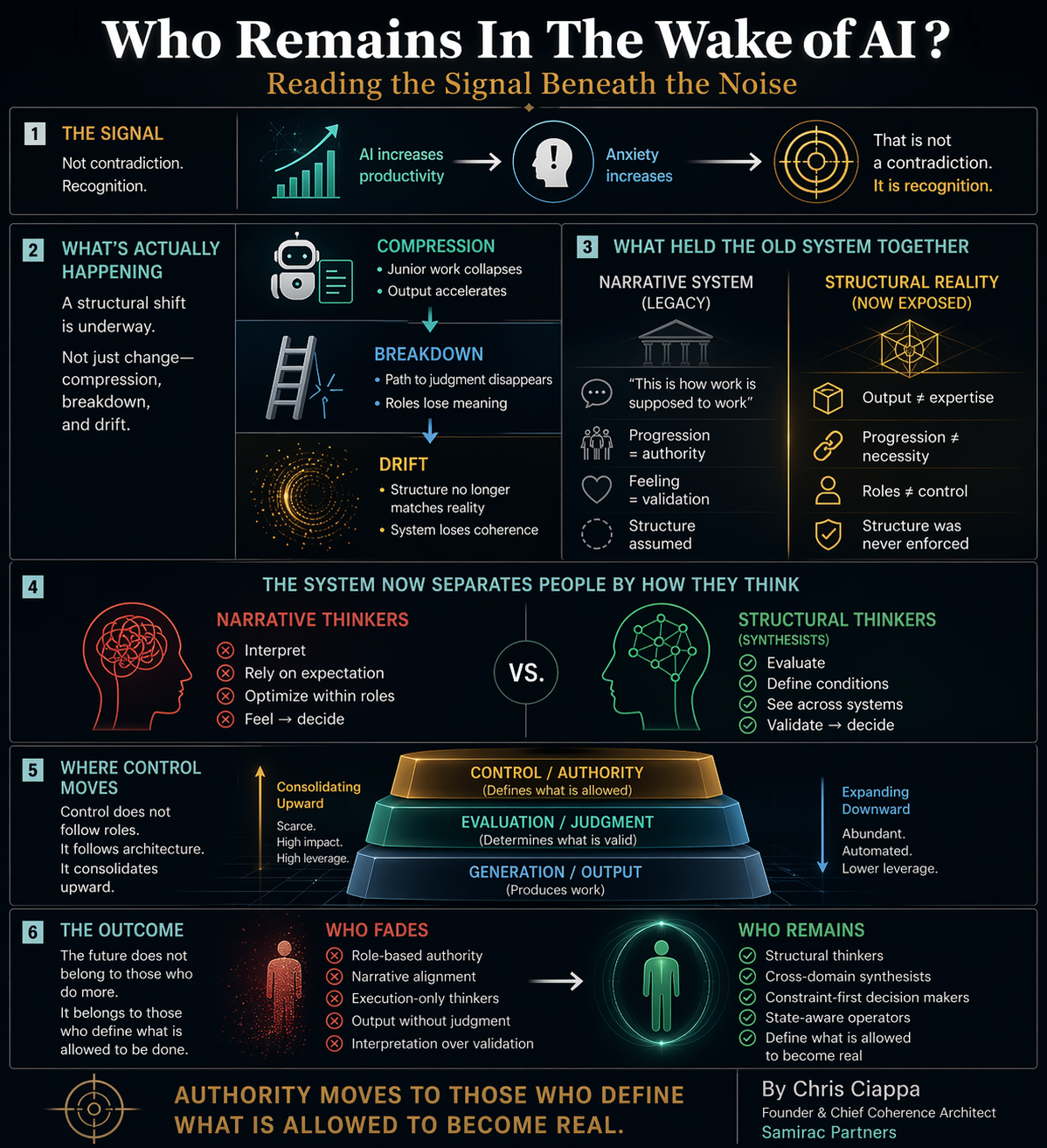
Reading the Signal Beneath the Noise.
By Chris Ciappa
Founder & Chief Coherence Architect
Samirac Partners
Recently, a post highlighted a finding from Anthropic’s survey of 81,000 Claude users that deserves more attention than it’s getting.
The people seeing the biggest productivity gains from AI are also the most concerned about their future.
That is not a contradiction.
It is recognition.
A Signal, Not a Reaction
The response is often framed as both rational and emotional. That is true at a human level.
Structurally, it is something else.
It is the system signaling that its internal model no longer matches how it actually operates.
The individuals experiencing the greatest acceleration are also the ones closest to the collapse of the structure that defined their role.
They are not reacting to fear.
They are reacting to misalignment.
The Pattern Has Been Visible
This is not new.
Across multiple domains, the same pattern has appeared:
Systems drift away from the conditions that once defined them.
Roles persist after their function has changed.
Structures remain in place after their underlying logic no longer holds.
The result is a loss of coherence.
AI is not introducing this pattern.
It is exposing and accelerating it.
The Compression of the Lower Layer
AI is already capable of performing much of what junior roles once did.
Research, drafting, summarization, initial analysis.
That is not a marginal improvement.
It is a structural compression.
But what disappears is not just output.
It is the path by which expertise was formed.
The Broken Path to Judgment
The professional ladder was never just about progression.
It was about accumulation.
You learned the system by operating within it.
You developed judgment through exposure to constrained execution.
You became capable of making decisions because you had participated in the process that led to them.
When that layer is compressed, the system does not simply become more efficient.
It loses the mechanism that produced its decision-makers.
This Was Predicted
The emerging divide has been described before.
Not in terms of job loss.
But in terms of cognitive role.
There are those who operate within defined systems.
And there are those who can see across them.
The latter are not tied to a single function.
They recognize patterns across domains.
They identify drift where others see isolated change.
They do not just use systems.
They understand how systems hold together—and how they come apart.
These are the synthesist thinkers.
What Was Actually Holding the Old System Together
The prior system did not hold together because it was structurally sound.
It held together because it was narratively coherent.
There was a shared story about how value was created:
You start at the bottom.
You learn by doing.
You move up through exposure.
You earn judgment over time.
That story aligned with lived experience.
So it was accepted as reality.
But it was never formally grounded in structure.
It was not based on explicit definitions of:
It was based on belief, continuity, and consistency of experience.
As long as the system produced acceptable results, the narrative held.
No one needed to test whether the structure underneath it was actually required.
Why That No Longer Works
AI breaks that narrative instantly.
If the work that supposedly “built expertise” can be bypassed without loss of output quality, then the explanation for that layer was never structural.
It was developmental.
It existed to support progression, not to guarantee correctness.
That distinction matters.
Because once the narrative is exposed, it cannot stabilize the system anymore.
The system now has to answer a different question.
Not what feels like the right way to build expertise.
But what is actually required for correct execution.
The Shift That Follows
That is why the system is reorganizing.
Not around stories of roles and progression.
But around:
what must be true for action to be valid
what must be enforced before execution
what cannot be left to interpretation
Narrative can describe a system.
It cannot control one.
And once systems begin to act, description is no longer enough.
Only structure holds.
What This Divides
This shift does not just reorganize systems.
It separates people.
Not by title.
Not by experience.
But by how they think.
The old system allowed people to operate on narrative.
You could rely on:
That was enough, because the system itself did not demand constant structural validation.
That is no longer the case.
Narrative Thinking vs Structural Thinking
Narrative thinking organizes reality through story.
It asks:
Structural thinking does something different.
It asks:
What conditions must be true?
What constraints actually exist?
What state must be validated before action?
One interprets.
The other evaluates.
Why This Matters Now
As systems become capable of acting, interpretation is no longer sufficient.
A system that acts based on what “seems right” will eventually produce outcomes that are structurally invalid.
And once that happens, consequence follows.
At that point, it does not matter what was intended.
It matters what was allowed.
The Separation
This creates a divide.
Those who continue to process the world through narrative will struggle.
Not because they are incapable.
But because the system no longer rewards that mode of thinking.
It requires alignment with structure.
Those who can separate:
feeling from validation
story from constraint
belief from state
will move into positions of control.
Because they can determine what is actually valid before action occurs.
Authority Follows Structure
Positions of authority do not remain attached to roles.
They move to wherever control resides.
And control now resides with those who can define and enforce:
boundaries
invariants
admissibility
Not those who can describe them.
Not those who can argue for them.
Those who can ensure they hold.
Why They Remain
The synthesist does not compete with AI at the task level.
They operate at the structural level.
They identify:
where boundaries have shifted
where anchors have weakened
where processes no longer align with purpose
They are not replacing the work.
They are redefining the system within which the work exists.
That function does not compress in the same way.
It becomes more necessary.
The Legal Example Revisited
The observation about legal workflows is more than a note on tool limitation.
Law resists AI not because it is complex.
But because it is constrained.
It depends on:
fidelity to form
strict interpretation
bounded reasoning
When AI diverges under defined rules, it is not simply making mistakes.
It is revealing the absence of structural enforcement.
The rules exist.
But they are not binding.
That distinction matters.
Where the System Is Moving
As AI continues to expand capability, the system reorganizes.
Not around who can produce output.
But around who can define what output is allowed to become action.
The structure separates into:
generation
evaluation
execution
The middle layer—evaluation and judgment—becomes the point of control.
The Real Divide
The divide is not between human and AI.
It is between those who operate within a system and those who define its structure.
The former can be compressed.
The latter cannot.
What This Points Toward
The tension being observed is not misplaced.
It is the recognition that the system is changing faster than roles can adapt.
There is still a window.
But it is not simply a window to adopt tools.
It is a window to define structure.
If that structure is not defined by those within the system, it will be imposed from outside.
The Outcome
The people who remain are not those who resist change.
They are not those who simply use AI more effectively.
They are those who understand what is changing beneath the surface.
Those who can:
identify drift
define anchors
enforce boundaries
align execution with valid state
These are not new roles.
They have always existed.
They were simply less visible.
The System Has Made Them Visible
As the lower layers compress and the system loses coherence, the need for structural thinkers becomes explicit.
Not optional.
Not advisory.
Necessary.
The Question That Now Matters
Not who will be replaced.
But who understands the system well enough to define what is allowed to remain.
That is where control moves.
And that is who remains.
If you’re a C-suite executive or a team member wondering where your role is headed, now is the time to adapt.
Samirac provides training that helps leaders and teams become pattern-aware, synthesist thinkers—able to operate at the structural level, not just within roles.
If you want a real boost in productivity—not just doing more, but thinking differently—this is where it starts.
Related Reading
Several related articles expand on the broader organizational, architectural, strategic, and cognitive themes discussed here:
These pieces connect structural thinking, organizational drift, leadership cognition, execution behavior, systems architecture, and runtime operational coherence into a broader systems-level framework.
Related Work and Prior Analysis
This piece builds on a broader body of work examining drift, structural coherence, and the changing nature of authority in complex systems.
For those who want to explore the underlying patterns more deeply:
On Drift and System Coherence
On Educational and Institutional Drift
On Narrative vs Structural Thinking
On the Synthesist and Cross-Domain Thinkers
On AI Systems, Governance, and Execution Authority
On Domain-Specific Breakdown (Legal Example)
Control is not part of the stack.
It governs the stack.
If you’re a C-suite executive or a team member wondering where your role is headed, now is the time to adapt.
Samirac provides training that helps leaders and teams become pattern-aware, synthesist thinkers—able to operate at the structural level, not just within roles.
If you want a real boost in productivity—not just doing more, but thinking differently—this is where it starts.
The Only Question That Matters
The architecture is already defined.
Drift Stack™ Architecture
https://www.samirac.com/drift-architecture
Now ask yourself:
👉 Does my system control what’s allowed at execution —
or does it just react and hope it gets it right?
Architecture Demos
https://www.samirac.com/daisy-demos
Share This Article
If you found this article valuable, share it.
Substack automatically gives every subscriber a personal referral link. When someone subscribes through your share link, it counts toward referral rewards.
Current rewards:
• 3 referrals → 1 month of paid access
• 5 referrals → 6 months of paid access
• 10 referrals → 12 months of paid access
You can share directly using the Share button on this article, or find your personal referral link here:
Get Referral Link
By Chris Ciappa
Founder & Chief Coherence Architect
Samirac Partners