By Chris Ciappa
Founder & Chief Coherence Architect
Samirac Partners
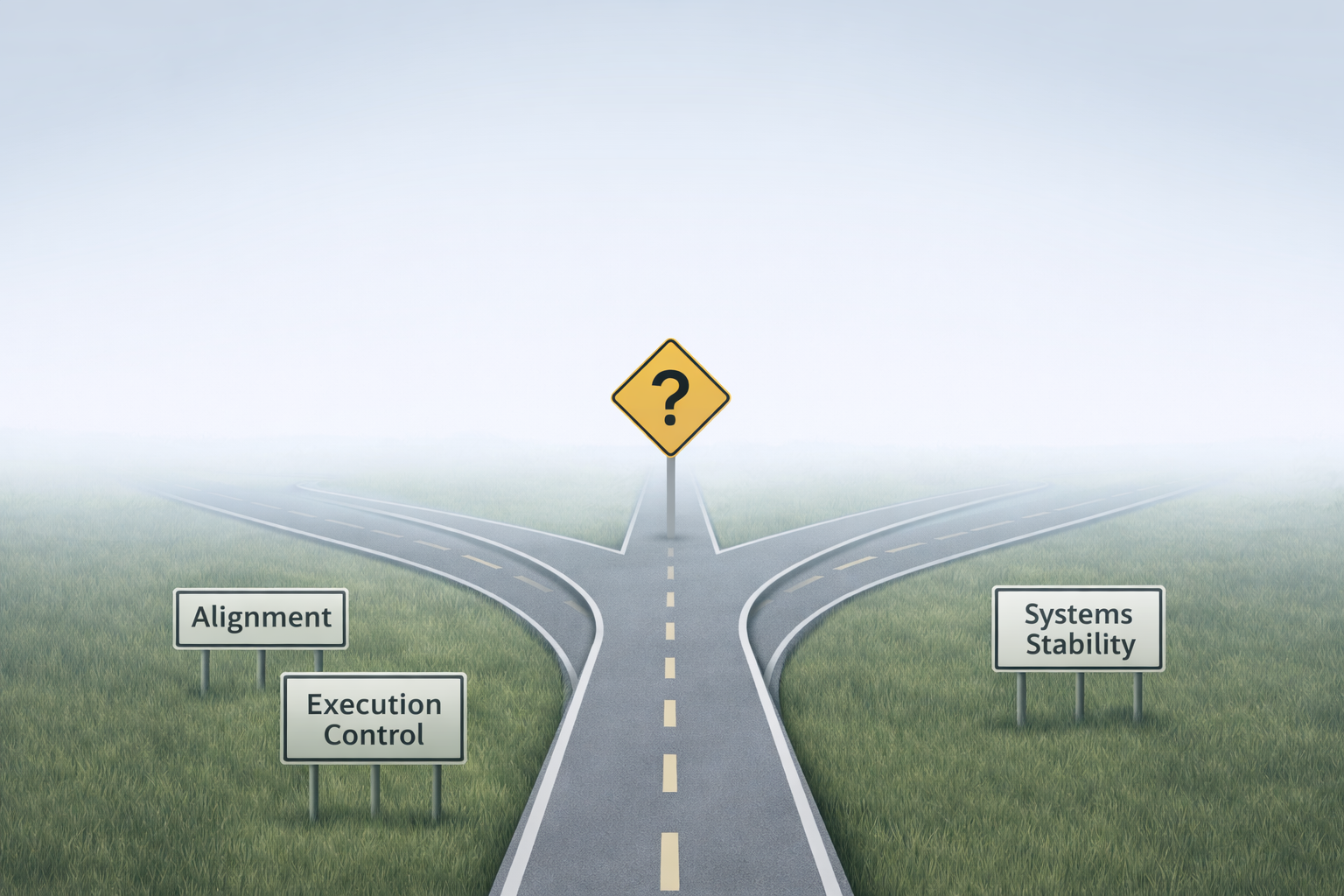
The Three Governance Camps
AI governance debates increasingly fall into three distinct architectural approaches.
Each addresses a real problem.
Each improves system safety in meaningful ways.
But they focus on different layers of the system.
If you spend time around AI researchers, the answer seems obvious: better aligned models will produce safer systems.
If you talk to infrastructure engineers, the solution looks different: control execution with gates, policies, and bounded action spaces.
And if you talk to systems engineers who spend their time studying how complex systems actually behave, the conversation often shifts toward system stability and failure patterns.
Each of these perspectives captures something real.
Each addresses part of the governance problem.
In this article we’ll examine the strengths and limitations of all three approaches — and explore what becomes visible once you step back and look at how complex systems actually fail across domains.
Because when you do, a pattern starts to emerge that changes how governance architectures need to be designed.
This is the piece that examines that pattern.
Alignment and Model Safety
The first approach focuses on the model itself.
Research labs and safety teams concentrate on:
• alignment training
• RLHF
• interpretability
• controllability
• constitutional AI
The premise is simple:
If the model behaves correctly, the system will behave correctly.
This work is important and technically sophisticated.
But it addresses model intent, not execution authority.
Even a well-aligned model can:
• deploy insecure code
• leak credentials
• trigger financial transactions
• escalate permissions inside a workflow
Alignment reduces harmful reasoning.
It does not govern what actions a system is allowed to execute.
Execution Gates and Control Planes
A second wave of architecture has emerged from infrastructure engineers and security practitioners.
These systems introduce mechanisms such as:
• execution gates
• policy engines
• tool permission layers
• bounded action spaces
The core idea is straightforward:
LLMs propose actions.
The system decides whether those actions are allowed to execute.
This moves governance from after-the-fact monitoring to pre-execution control.
That is a significant improvement.
But it still assumes a relatively static environment.
Execution gates answer the question:
Is this action allowed right now?
They do not answer the deeper systems question:
How does the system remain stable as conditions, identities, policies, and behaviors evolve over time?
Drift Stack™ Architecture
Complex systems rarely fail because of a single incorrect decision.
They fail because small deviations accumulate across layers.
Policies degrade.
Permissions expand.
Identities blur.
Operational context shifts.
Eventually the system reaches a state where failure becomes inevitable.
This phenomenon is drift.
If a system cannot control drift, can it really claim to be safe?
The Drift Stack™ architecture (https://samirac.com/drift-stack) emerged from a year-long exploration of these failure patterns across complex systems in disparate domains.
It is not a speculative theory about AI behavior.
It is a formalization of a failure pattern repeatedly visible in complex systems.
Equally important, the framework is falsifiable.
The Drift Stack™ model proposes that failures in complex systems follow a recognizable order of collapse across system layers — identity, frame, boundary, drift, and correction — in that sequence.
If real-world intelligent system failures consistently occur in a different order, the theory does not hold.
That testability matters if governance architectures are to move beyond conceptual discussion into engineering practice.
Over the past year this work has been documented across a growing body of research and technical writing — including more than 95 articles and 100+ posts, along with three patents pending related to admissibility control, drift detection, Delta Drift™, SAQ™, and system correction mechanisms.
The goal was never simply to describe these failure patterns.
It’s to build architectures capable of preventing them.
When you examine these three approaches, a pattern begins to appear.
Each solves an important part of the governance problem.
But once you study how complex systems actually fail across domains, one conclusion becomes increasingly difficult to avoid.
And it has major implications for how AI governance architectures need to be designed.
Now we will explore that unavoidable conclusion.
The Drift Stack Approach
The Drift Stack framework treats AI systems as multi-layer systems that must maintain coherence over time.
Instead of focusing only on the model or a single execution gate, it defines multiple control layers, including:
• identity
• frame/context
• system boundaries
• execution authority
• ledger and audit layers
• correction mechanisms
Each layer constrains the system in different ways.
Failures occur when drift accumulates across these layers without detection or correction.
For example:
An execution gate may function correctly.
But if identity verification drifts, the gate authorizes the wrong actor.
If operational context drifts, actions are approved in the wrong frame.
If the audit layer degrades, accountability disappears.
Execution control alone cannot prevent this.
The system must continuously detect and correct drift across layers.
Importantly, effective correction cannot occur solely from inside the system that is drifting.
When a system’s policies, identities, and context have already begun to drift, internal controls often drift with them.
This is why robust governance architectures require external correction mechanisms — independent reference points capable of detecting when the system has moved outside its intended operating conditions and forcing realignment.
Without that external reference, systems tend to normalize their own deviation over time.
Governance as a Stability Architecture
From the Drift Stack perspective, governance is not primarily a documentation exercise or a compliance layer.
It is the architecture that maintains system coherence over time.
This requires four core capabilities:
• pre-execution admissibility control
• invariant enforcement across layers
• drift detection mechanisms
• external correction systems
Without these, even well-designed AI systems gradually diverge from their intended behavior.
Risk and Governance Architecture
It may well be that these different architectural approaches each have their place.
For lower-risk systems — recommendation engines, assistants, content tools — model alignment and bounded execution controls may be sufficient. Failures in those environments are inconvenient, but rarely catastrophic.
For operational systems with financial or organizational authority, execution gates and policy engines become essential. These architectures provide meaningful control over what systems are allowed to do.
But as systems move into safety-critical or authority-bearing domains, the problem changes.
In these environments, failures rarely occur because of a single bad decision. They occur because systems drift over time — identities shift, policies evolve, operational context changes, and accountability boundaries blur.
In those environments, architectures capable of detecting and correcting drift across layers become essential.
Where the Field Is Going
The alignment community is improving models.
Infrastructure engineers are building execution gates.
Both are necessary.
But autonomous systems operating in the real world face a different challenge: maintaining coherence as conditions, identities, and authority structures evolve over time.
Systems rarely fail because of a single bad decision.
They fail because drift accumulates across layers until the system is no longer operating inside the conditions it was designed for.
Put another way:
You can have the best tractor in the county and a solid gate on the barn.
But if the steering slowly drifts, the tires lose pressure, and the fence posts start leaning, sooner or later that tractor is going through the fence.
Complex systems are no different.
Governance architectures that cannot detect and correct drift will eventually fail.
Share This Article
If you found this article valuable, share it.
Substack automatically gives every subscriber a personal referral link. When someone subscribes through your share link, it counts toward referral rewards.
Current rewards:
• 3 referrals → 1 month of paid access
• 5 referrals → 6 months of paid access
• 10 referrals → 12 months of paid access
You can share directly using the Share button on this article, or find your personal referral link here:
By Chris Ciappa
Founder & Chief Coherence Architect
Samirac Partners