Governance, Authority & Admissibility

Why Feelings, Emotions, Equity, and Ideology Do Not Belong in AI Invariants

By Chris CiappaApril 23, 20264 min read
LinkedInEmail
Why Feelings, Emotions, Equity, and Ideology Do Not Belong in AI Invariants

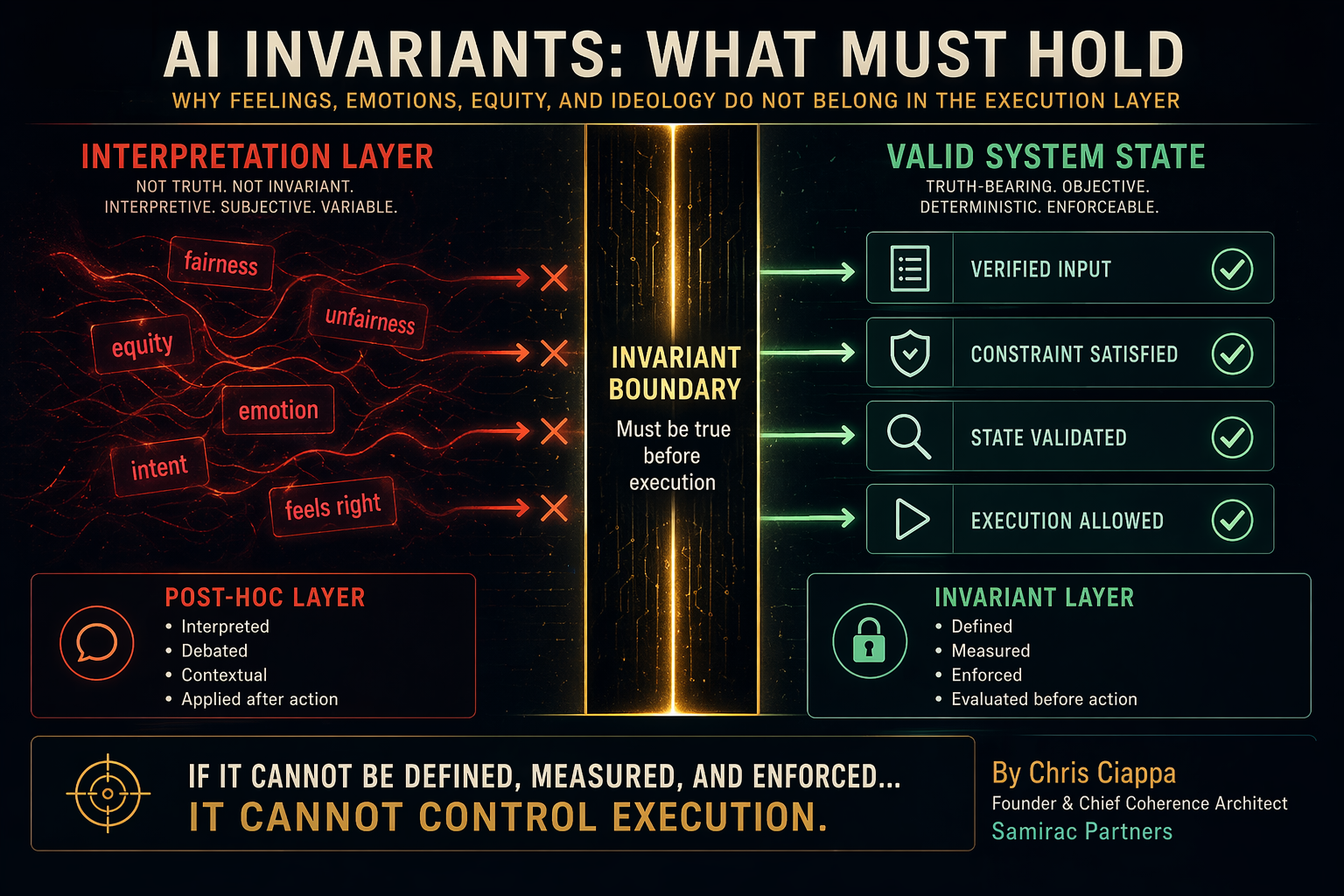
An invariant is a condition that must hold in all states , before a system is allowed to act.

By Chris Ciappa
Founder & Chief Coherence Architect
Samirac Partners


An invariant is not a preference.
It is not a value statement.
It is not a desired outcome.

An invariant is a condition that must hold in all states, before a system is allowed to act.


Invariants Require Determinism

An invariant must be:

  • clearly defined

  • consistently evaluated

  • unambiguous

Feelings and emotions are:

  • context-dependent

  • subjective

  • variable across individuals and cultures

You cannot enforce what cannot be measured consistently.


A Note on Feelings

There is a simpler reason feelings do not belong in invariants.

They are not stable.

They are not shared.

They are not external to the system.

They are internal responses.

Frameworks like those popularized by Tony Robbins make a basic point:

People do not control your feelings.
They create conditions.
You generate the response.

Two people can experience the same event and produce completely different emotional outcomes.

That alone disqualifies feelings as invariant conditions.

An invariant must hold regardless of:

  • individual state

  • interpretation

  • emotional response

Feelings do not meet that standard.

They are influenced by environment, history, expectation, and perception.

They change.

They vary.

They are individually regulated.

That makes them unsuitable as system constraints.


Structural Implication

If a system attempts to act based on feelings, it is no longer evaluating reality.

It is reacting to interpretation.

That breaks consistency.

It breaks enforceability.

And it introduces variability into the exact layer that requires stability.


Conclusion on Feelings

Feelings matter to individuals.
They do not define system state.

And anything that does not define system state cannot be used to determine whether a system is allowed to act.


Invariants Must Be State-Based, Not Interpretation-Based

A valid invariant answers:

Is the system in a valid state to act?

That requires:

  • verifiable inputs

  • explicit constraints

  • objective evaluation

Ideology and equity frameworks require interpretation:

  • What is “fair”?

  • What is “equitable”?

  • Which values apply in this context?

Those are policy questions, not execution constraints.


Invariants Exist to Prevent Harm at Execution

Invariants operate before action.

They prevent:

  • unauthorized access

  • invalid transactions

  • unsafe system states

They do not attempt to resolve moral tradeoffs.

They ensure:

If this action executes, it cannot violate defined system conditions.

Trying to encode ideology into invariants turns a binary gate into a debate.


Mixing Values into Invariants Breaks the Boundary

When you embed feelings or ideology into invariants:

  • constraints become flexible

  • enforcement becomes inconsistent

  • the system becomes unpredictable

Now the system is:

  • interpreting instead of validating

  • negotiating instead of enforcing

That is exactly how drift enters.


Where These Things Actually Belong

This does not mean:

  • ethics don’t matter

  • equity doesn’t matter

  • values don’t matter

It means they belong in the correct layer:

  • policy design

  • governance frameworks

  • human oversight

  • post-decision evaluation

👉 Not in the invariant layer that determines whether the system is allowed to act.

You could apply interpreted ideals—fairness, unfairness, equity—after the fact. Which is to say these do not define whether the system was in a valid state before execution as they are interpretive not truth bearing.

A system cannot enforce what it cannot define.
And it cannot define what depends on interpretation.


The Structural Principle

If a condition cannot be:

  • defined precisely

  • measured consistently

  • enforced universally

…it cannot be an invariant.


Final Line

AI systems do not fail because they lack values.

They fail when the boundary between what must hold and what is interpreted is not maintained.

Invariants exist to enforce what must hold.

Everything else belongs somewhere else.


If you’re a C-suite executive or a team member wondering where your role is headed, now is the time to adapt.

Samirac provides training that helps leaders and teams become pattern-aware, synthesist thinkers—able to operate at the structural level, not just within roles.

If you want a real boost in productivity—not just doing more, but thinking differently—this is where it starts.


The Only Question That Matters

The architecture is already defined.

Drift Stack™ Architecture
https://www.samirac.com/drift-architecture

Now ask yourself:

👉 Does my system control what’s allowed at execution —

or does it just react and hope it gets it right?

Architecture Demos
https://www.samirac.com/daisy-demos


Share This Article

If you found this article valuable, share it.

Substack automatically gives every subscriber a personal referral link. When someone subscribes through your share link, it counts toward referral rewards.

Current rewards:

3 referrals → 1 month of paid access
5 referrals → 6 months of paid access
10 referrals → 12 months of paid access

You can share directly using the Share button on this article, or find your personal referral link here:

Get Referral Link


By Chris Ciappa
Founder & Chief Coherence Architect
Samirac Partners

LinkedInEmail
← Return to the Reading SpineOriginal publication