By Chris Ciappa
Founder & Chief Coherence Architect
Samirac Partners
Across system design, there is a growing push to embed concepts like fairness, equity, and value alignment directly into AI systems.
That sounds reasonable—until you examine where those ideas are being placed.
Because when interpretive concepts are pushed into the architectural layer—especially into invariants—the system does not become safer or more just.
It becomes unstable.
So before discussing outcomes, we need to examine something more fundamental:
what belongs in architecture—and what does not.
before examining this there is one immutable truth we must not forget
architecture does not operate on values.
It operates on invariants.
The non-negotiable definition
Across mathematics, physics, and computer science, an invariant is:
a condition or property that must remain true and unchanged across all valid system states and transformations
And more importantly:
an invariant is something whose truth can be checked and relied upon throughout execution
That’s the anchor.
Not “generally true.”
Not “socially agreed.”
Not “morally preferred.”
Always true. Checkable. Enforceable.
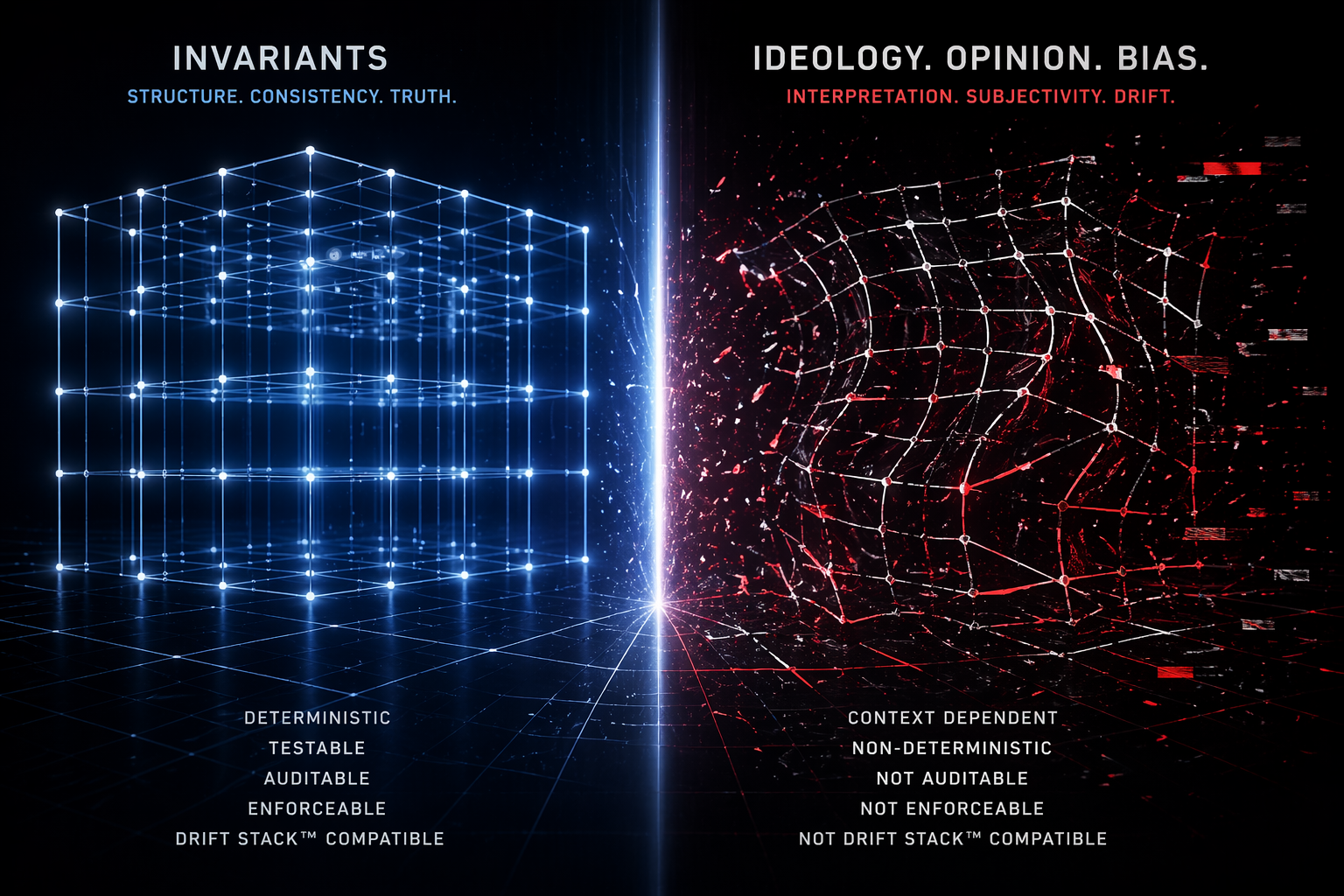
Drift Stack™ compatibility requires structural invariants
A system is Drift Stack™ compatible only if its execution boundary is governed by structural invariants, not interpretation.
That means:
admissibility is deterministic
enforcement is consistent
outcomes are explainable
decisions are externally auditable
The system must decide:
Is this admissible or not?
Not:
Do we like this?
Does this align with our values?
Does this feel acceptable?
The moment interpretation enters the execution boundary, the system stops enforcing structure and starts enforcing perspective.
That is drift.
The fatal mismatch: ideology vs invariance
Now look at ideology, opinion, bias:
they change across contexts
they depend on interpretation
they conflict with each other
they cannot be universally validated
That directly violates the definition of an invariant.
This isn’t philosophical.
It’s structural incompatibility.
Invariants must be testable
In architecture, an invariant is not a belief—it’s a constraint you can verify.
Example:
“Input must be authenticated” → testable
“Output should be fair” → requires interpretation
If it requires interpretation, it is not an invariant.
Because invariants are used to prove correctness.
You cannot prove:
fairness
harm
appropriateness
…without injecting a viewpoint.
Invariants must be stable under transformation
Invariants survive change.
They remain constant even as the system transforms.
Ideology does the opposite:
it changes with time
it changes with culture
it changes with power structures
If a rule shifts when the environment shifts, it was never an invariant.
Invariants define system correctness
Invariants determine whether a system is valid or broken.
If an invariant is violated, the system has failed.
Now introduce ideology:
correctness becomes dependent on worldview
failure becomes subjective
enforcement becomes inconsistent
At that point, “correct” has no stable meaning.
Invariants must be non-contradictory
Architecture requires constraints that can all hold at the same time.
Ideologies inherently conflict:
safety vs freedom
expression vs restriction
equity vs equality
You cannot encode all of these into invariants without contradiction.
And once invariants contradict:
the system has no valid state
That is not a degraded system.
That is a broken one.
Equality vs Equity is where systems break
This is not theoretical. This is happening right now.
There are active efforts to “design equity into systems.”
That language sounds reasonable—until you examine it structurally.
Equality, in system terms, means:
the same rules are applied to the same inputs
That produces:
determinism
consistency
auditability
repeatability
Equality can be enforced.
It can exist as an invariant.
Equity, in system terms, means:
different outcomes based on context, history, or group characteristics
That requires:
interpretation
subjective weighting
external context
continuous adjustment
That produces:
same input ≠ same output
shifting rules
conditional execution
That breaks:
determinism
consistency
auditability
Equity cannot be enforced as an invariant.
When equity is forced into invariants:
identical inputs produce different outputs
decisions cannot be consistently explained
validation becomes impossible
At that point:
you no longer have architecture
you have conditional preference logic
Equity, fairness, and value alignment are not inherently invalid.
They are structurally misplaced when pushed into the architectural layer.
They are:
context-dependent
interpretive
subject to change
arguable from multiple perspectives
They are not immutable.
They are not universally testable.
They are not invariants.
And they should not be mistaken for equality.
They belong in:
policy
governance
human decision layers
Where interpretation, discretion, and adjustment are expected.
They do not belong in:
execution boundaries
admissibility gates
invariant constraints
Where consistency, determinism, and enforceability are required.
Invariants must be externally auditable
A system must be able to answer:
Why did this happen?
With:
logic
evidence
reproducibility
If the answer becomes:
“because it was harmful”
“because it violated values”
You cannot audit it.
You cannot prove it.
You cannot trust it.
You have replaced architecture with judgment.
What actually happens when ideology enters invariants
This is where systems quietly collapse.
It doesn’t just introduce bias.
It removes the boundary.
Instead of:
enforce admissibility → then act
You get:
interpret → decide → justify
That is not architecture.
That is a decision engine with no fixed constraints.
And that leads to:
drift
inconsistency
loss of trust
unprovable behavior
The proper separation
You do not remove ideology from systems.
You remove it from the invariant layer.
Invariant layer (architecture core):
must be true
must be provable
must be consistent
Policy layer:
preferences
norms
governance
Application layer:
user intent
interpretation
context
This preserves both:
structural integrity
human flexibility
The core principle
Invariants define what a system cannot violate
Ideology defines what a system would prefer
Those are not the same thing.
They cannot occupy the same layer.
Final line
If you put ideology into invariants:
You do not get a safer system.
You do not get a fairer system.
You get a system that:
cannot prove itself
cannot explain itself
cannot be trusted
Because it no longer enforces truth.
It enforces perspective.
Drift Stack™ & SAQ™ don’t make systems harder to break.
They make certain failures impossible to execute.
The Only Question That Matters
The architecture is already defined.
Drift Stack™ Architecture
https://www.samirac.com/drift-architecture
Now ask yourself:
👉 Does my system control what’s allowed at execution —
or does it just react and hope it gets it right?
Architecture Demos
https://www.samirac.com/daisy-demos
Share This Article
If you found this article valuable, share it.
Substack automatically gives every subscriber a personal referral link. When someone subscribes through your share link, it counts toward referral rewards.
Current rewards:
• 3 referrals → 1 month of paid access
• 5 referrals → 6 months of paid access
• 10 referrals → 12 months of paid access
You can share directly using the Share button on this article, or find your personal referral link here:
By Chris Ciappa
Founder & Chief Coherence Architect
Samirac Partners