Educational, Institutional & Civic Drift

Why Lord Acton Still Matters: Constraint Is the Price of Stability

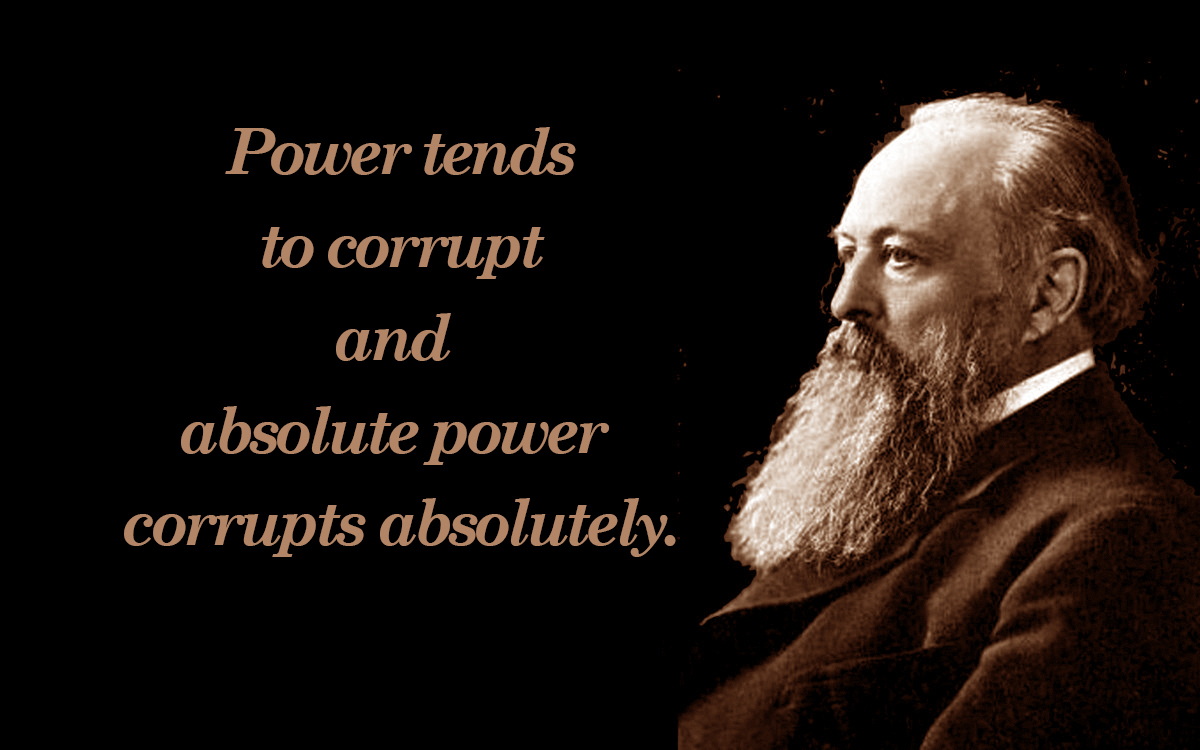
Power tends to corrupt, and absolute power corrupts absolutely.
By Chris CiappaDecember 23, 20256 min read
LinkedInEmail
Why Lord Acton Still Matters: Constraint Is the Price of Stability

“Power tends to corrupt, and absolute power corrupts absolutely.
Great men are almost always bad men, even when they exercise influence and not authority: still more when you superadd the tendency or the certainty of corruption by authority.”

John Emerich Edward Dalberg-Acton, Letter to Bishop Mandell Creighton, 1887

This line is usually quoted halfway and then discarded like a slogan.

But Acton wasn’t making a rhetorical point.
He was stating a structural law of power.

At its core, Acton was not opposing progress, reform, or change.
He was opposing unchecked power masquerading as virtue.

That distinction matters — especially now.


Constraint Kills Utopias — and Preserves Civilization

Acton’s insight is uncomfortable because it does something most movements refuse to tolerate:

It kills revolutions, movements, and utopias before they ever get off the ground.

But that isn’t a flaw.

That’s the trade.

Utopias that require unchecked authority must fail early — because if they don’t, they fail later with far greater human cost.

Constraint does not stop change.
It stops runaway change.


Why Revolutions Fail (Over and Over)

Across history, failed movements share the same foundational assumption:

Virtue can substitute for constraint.

Acton rejected that premise entirely.

His position was blunt:

  • Virtue is irrelevant without structure

  • Good intentions decay without limits

  • Power will drift unless it is bounded

This is not cynicism.
It is systems realism.


What Movements Want vs. What Stability Requires

Movements typically demand:

  • Speed

  • Discretion

  • Moral exception

  • Immunity from constraint “just this once”

Stable systems require the opposite:

  • Friction

  • Process

  • Limits

  • Enforcement — even when inconvenient

That tension is not accidental.
It is the filter that separates reform from risk.


Why Constraint Is the Mark of Durable Systems

Look at what actually lasts:

  • Constitutions → changeable, but slow

  • Markets → innovative, but regulated

  • Science → creative, but falsifiable

  • Aviation → advanced, but certified

  • Medicine → evolving, but constrained

None of these are utopias.
All of them are stable.

They advance because constraints force rigor, accountability, and correction before catastrophe.


The Seduction of “Constraint-Free Virtue”

Every failed ideology eventually says some version of:

  • “We are different”

  • “The old rules don’t apply”

  • “Trust us”

  • “The ends justify the means”

That’s not courage.

That’s early-stage corruption.

Acton recognized this pattern before blood was spilled, which is why his warning remains so inconvenient.


The Governing Principle (Stated Plainly)

You can state Acton’s insight as a law:

Any movement that cannot survive constraints is not a reform — it is a risk.

Stability is not the enemy of justice.
Stability is what allows justice to persist after the slogans fade.


Why This Matters Right Now

Today, we are watching:

  • AI systems

  • Political movements

  • Cultural revolutions

  • Institutional rewrites

…all demand speed, discretion, and exemption from constraint.

Acton’s response would be blunt:

“Then slow down — or you’re already drifting.”


Acton Was Naming a Design Problem

Acton didn’t just warn about power.
He exposed a design failure.

The systems that drift are not evil — they are unconstrained.

They rely on intention where structure is required.
They assume virtue where verification is necessary.
They trust discretion where enforceable limits should exist.

That is not a moral failure.
It is an architectural one.


Constraint Is Not an Idea — It’s a System

The durable systems Acton implicitly endorsed all share something modern debates often ignore:

  • Explicit boundaries

  • Clear authority models

  • Removal mechanisms

  • Fast escalation paths

  • Enforced accountability

In other words, constraint is designed, not hoped for.

This is why safety-critical domains — aviation, medicine, nuclear systems — do not rely on trust, slogans, or good intentions.

They rely on certification, auditability, and revocation.


The Drift Problem Is Solvable

Drift is not mysterious.
It is predictable.
And it is preventable.

But only if constraint is treated as a first-class requirement, not an afterthought bolted on after harm occurs.

That applies equally to:

  • AI systems

  • Corporate governance

  • Public institutions

  • Large-scale platforms

  • Any system entrusted with real authority


Final Synthesis

Yes — Acton kills utopias.

Because utopias that require unchecked power must die early,
or they will kill far more later.

What survives that filter is not stagnation.

It is civilization.

And that is the difference most people miss.


**📉 Something in your system wobbling?

AI hallucinating? Governance slipping? Architecture feeling fragile?**

If something in your world is wobbling—strategy, teams, tech foundations, organizational sanity, product direction, institutional integrity, early-tech bets, or entire market models — this is the work I specialize in.

Over the past year or more I’ve mapped the failure pattern across domains, formalized the Drift Stack, and built the diagnostic that identifies which layer is failing — and why systems lose coherence.

👉 Book the Drift Architecture Diagnostic Call — $250

This is not a casual chat.
It’s a precision 30-minute diagnostic revealing which layer is failing.
It’s a quick pattern-level diagnostic to identify which layer your issue sits in:

  • A1 — Identity

  • A2 — Frame

  • A3 — Boundary

  • A4 — Drift

  • A5 — External Correction

If there’s a deeper architectural problem, you’ll see it fast.
If not, you walk away with clarity.

Chris Ciappa
Founder & Chief Architect — Samirac Partners LLC
Ciappa Drift Stack™ • SAQ™ Unified Trust Stack™ • dAIsy™ AI Companion • Mind-Mesch™ Memory Architecture


📌 Updated: Domains Where the Drift Stack Has Now Been Observed

Systemic Domains

Artificial Intelligence
(hallucination → misalignment → boundary failure → drift → external correction)

Manufacturing & Industrial Systems (NEW)
(tolerance drift → process-frame collapse → boundary violations → runaway variation → SPC/external audit correction)

Economics
(market identity loss → frame breakdown → boundary erosion → contagion drift → intervention)

Epidemiology
(pattern breakdown → containment failure → uncontrolled drift → correction)

Institutional Decay
(identity erosion → mission drift → policy collapse → drift → intervention)

Cognitive Systems
(identity fragmentation → frame distortion → boundary loss → behavioral drift → correction)

Estimation & Measurement Theory
(state instability → frame decoherence → boundary collapse → noise drift → reset)

Organizational Behavior
(identity drift → strategy fracture → role blur → entropy drift → restructuring)


🧠 Human Development & Maturation Systems

Adolescent Development Drift
(identity drift → worldview drift → boundary erosion → undetected psychological drift → external-anchor collapse)

This domain now stands shoulder-to-shoulder with the others because:

  • domain experts already describe the drift symptoms

  • the data fits

  • it spans family, education, platforms, and culture

  • it cleanly traces all 5 Drift layers

  • it resolves contradictions other theories can’t


🌌 Physical & Natural Systems

Stellar formation & collapse
Phase transitions
Ecosystem feedback breakdowns


🏎 Everyday Systems

Skateboard speed wobble
Car hydroplaning
Airplane stalls
Chess blunders under fatigue
Social group coherence loss

LinkedInEmail
← Return to the Reading SpineOriginal publication