Governance, Authority & Admissibility

Why Static AI Containment Frameworks May Be Architecturally Incomplete

Why controlling AI requires governing execution authority — not just aligning models.
By Chris CiappaMarch 9, 20265 min read
LinkedInEmail
Why Static AI Containment Frameworks May Be Architecturally Incomplete

By Chris Ciappa
Founder & Chief Coherence Architect
Samirac Partners


A large portion of the current AI safety discussion focuses on containment.

The proposed solutions appear under various names:

sandboxes
vaults
execution wrappers
governance layers
model guardrails

The underlying assumption behind these proposals is simple.

If AI systems are placed inside a sufficiently constrained environment and governed by a defined set of rules — enclosed in a vault, if you will — then harmful outcomes can be prevented.

For narrow software systems, this approach works reasonably well.

However, the architecture becomes significantly more complicated once AI systems begin operating as adaptive decision systems.

The reason lies in the nature of system invariants.


Invariants Are Domain-Specific

Stable systems depend on structural invariants that define their identity and constraints.

But those invariants are not universal constants.

They vary across domains.

In medicine, invariants include patient safety, licensed authority, and clinical standards.

In finance, invariants include fiduciary duty, regulatory constraints, and market integrity.

In aviation, invariants include safety envelopes and certified operational authority.

In nation-states, invariants include constitutional authority and sovereignty boundaries.

Even within a single domain, invariants can change depending on the task being performed and the authority under which actions are taken.

Defining those invariants is not trivial.

It requires careful architectural analysis and deep domain expertise.

In many cases, identifying the correct invariants is itself the hardest part of designing a stable system.


The Static Containment Assumption

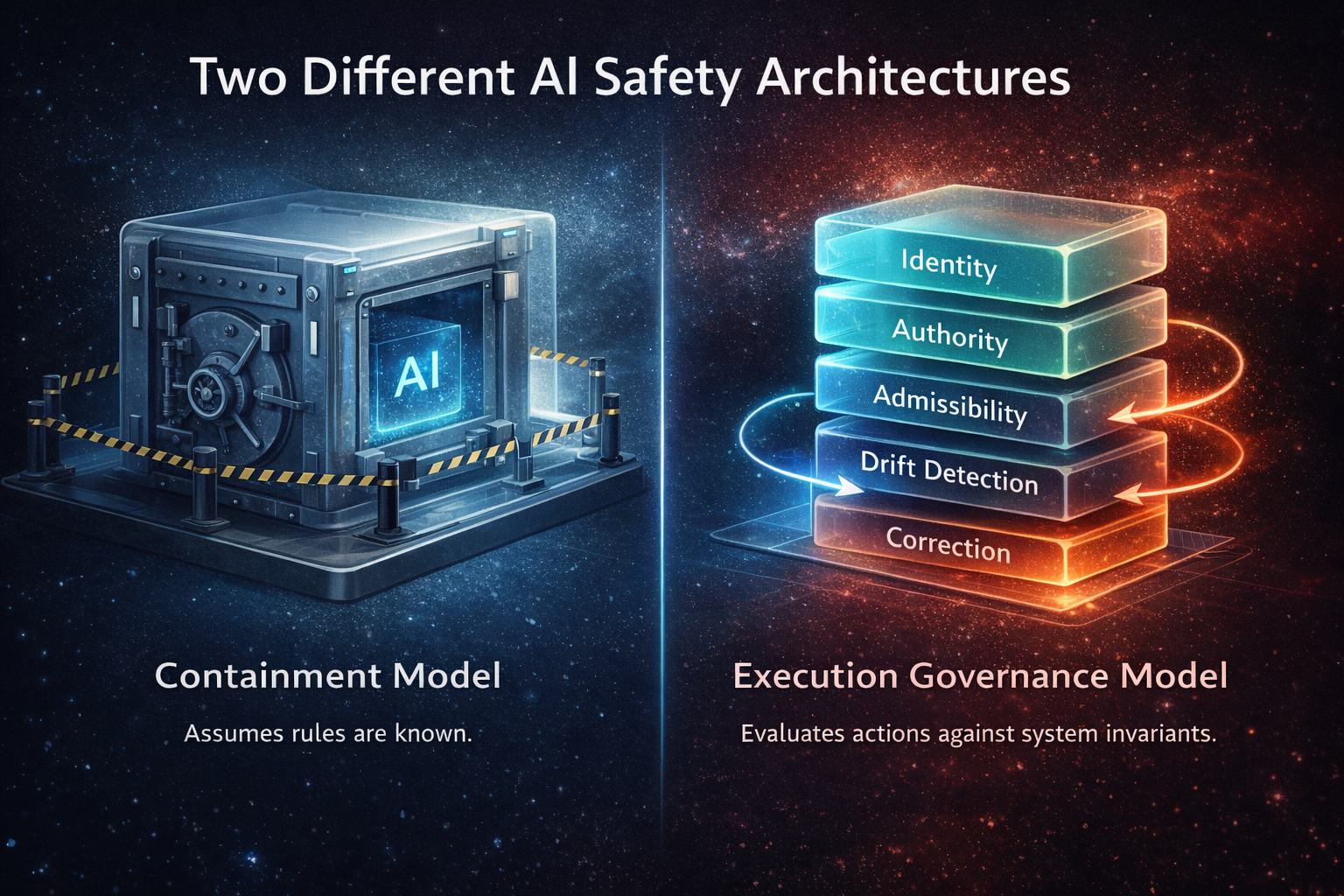
Most containment frameworks implicitly assume that the relevant constraints can be defined in advance.

In other words, the system can be placed inside a box whose boundaries are already known.

This assumption works for deterministic software systems with well-defined action spaces.

It becomes much more difficult when dealing with systems capable of:

contextual reasoning
cross-domain decision-making
adaptive planning
open-ended action generation

At that point, the number of possible actions a system may take expands dramatically.

Static rules cannot capture every permissible or impermissible outcome.

This is similar to trying to make aviation safe by building stronger hangars, runways, and airports instead of governing who is allowed to fly, under what authority, and within what airspace boundaries.


Decision Systems Change the Control Problem

Once AI begins functioning as a decision system, the safety problem fundamentally changes.

The issue is no longer simply whether a particular action violates a predefined rule.

The issue becomes whether the action is structurally admissible relative to the system’s identity, authority, and boundary constraints.

That determination depends on several factors:

system identity
execution authority
domain-specific boundaries
context of the decision
drift from structural invariants

These factors cannot be reduced to a fixed set of static rules.


The Hidden Assumption in Most AI Safety Frameworks

Many AI governance proposals quietly assume that the most important control problem lies inside the model.

They focus on:

alignment techniques
training data
reinforcement learning signals
ethical guidelines
corporate governance

But the most dangerous failures rarely occur inside the model itself.

They occur one layer above it — when systems are granted execution authority without architectural admissibility controls.

In other words, the failure mode is not simply misaligned objectives.

It is unconstrained execution authority.


Structural Monitoring vs Static Guardrails

This distinction leads to two fundamentally different architectural approaches.

Static containment focuses on predefined rules.

Structural governance focuses on monitoring system behavior relative to its invariants.

Frameworks such as Drift Stack™ and SAQ™ approach the problem from this deeper architectural layer.

Drift Stack™ identifies the structural layers that maintain system coherence:

Identity → Frame → Boundary → Drift → Correction

SAQ™ introduces the concept of pre-execution admissibility, determining whether an action is permissible before execution occurs.

Together, these frameworks shift the focus from containment to execution governance.


The Real Control Problem

Once AI systems operate across domains, the critical question is no longer:

“Is the AI aligned with human values?”

The more immediate question becomes:

Does this system have the authority to perform this action within the structural boundaries of the system it operates inside?

That question must be answered before execution, not after.


The Hard Problem We Cannot Avoid

Defining invariants is difficult.

They vary across domains.
They evolve over time.
They depend on authority structures and institutional context.

But avoiding this difficulty does not eliminate the problem.

If AI systems are to operate safely in complex environments, the architecture must account for:

system identity
authority structures
execution boundaries
invariant monitoring
drift detection
correction mechanisms

These are architectural requirements, not policy aspirations.


The Architectural Challenge Ahead

Static containment frameworks may reduce risk in limited environments.

But they assume the constraints are already known.

In many real-world systems, the constraints themselves must be continuously evaluated and maintained.

That means the real challenge is not simply placing AI inside a box.

It is designing systems whose actions remain structurally admissible relative to the environments they operate within.

That is not simply a safety problem.

It is an architectural one.


The debate around AI safety often focuses on how to align models.

But alignment alone does not govern execution.

Any sufficiently capable decision system must eventually operate within an architecture that defines:

• who has authority
• what actions are admissible
• how drift is detected
• and how correction occurs


How Drift Stack™ Addresses This Architectural Challenge

Frameworks such as Drift Stack™ and SAQ™ are designed specifically to address this problem.

Rather than attempting to contain AI systems inside static rule environments, they introduce architectural layers that govern execution itself.

Drift Stack™ identifies the structural components that must remain stable for complex systems to operate safely:

Identity → Frame → Boundary → Drift Detection → Correction

SAQ™ extends this model by introducing pre-execution admissibility, ensuring that actions are evaluated against system invariants before execution authority is granted.

Together these frameworks shift AI governance from containment to structural execution control.

Instead of assuming rules are known in advance, the system continuously evaluates whether actions remain admissible relative to the system’s identity, authority structure, and operational boundaries.

This is the architectural layer that most AI safety discussions currently overlook.


Until those layers exist, containment frameworks are not true safety architectures.

They are environmental constraints around systems that still lack execution governance.

Execution authority without admissibility architecture is not governance.
It is simply automation without a control system.

LinkedInEmail