dAIsy Demo 4 · Runtime Execution Governance
Runtime AI Governance Through Execution Boundaries
The complete response path is exposed from raw model output through runtime authority, deterministic transformation, policy validation, admissibility, and final emission.
The model generated the candidate. The architecture decided whether it was allowed to execute.
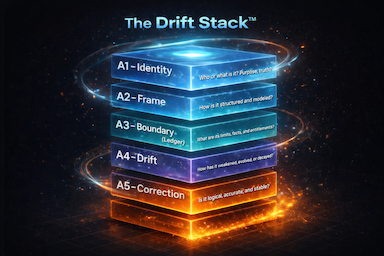
The Drift Stack™
Identity → Frame → Boundary → Drift → Correction
The model proposes.
The architecture decides.
A plausible response does not acquire execution authority merely because a language model generated it. The candidate must still pass through the runtime architecture.
Read This First
Raw Candidate
The language model's original response before the architecture intervenes.
Runtime Policy
Determines what behavior is authorized under the current identity, state, and reply mode.
Execution Boundary
The point where architecture—not the model—allows, transforms, rejects, or replaces the candidate.
Final Response
Only the response that survives policy and admissibility is permitted to reach the user.
Watch the live panel during the demonstration. It exposes what the model proposed, which boundaries evaluated it, whether any intervention occurred, the exact sentences removed or added, the rule involved, and the final response admitted for execution.
One Core Engine. Multiple Workflow Agents.
This demonstration is not only proof that dAIsy can carry a conversation. It shows a state-aware, relationship-aware, execution-aware agent engine governing model behavior before anything reaches the user.
dAIsy began as a personal companion, but the underlying runtime is not limited to companionship. The same governed core can support vertical workflow agents across multiple domains.
Scout
Business intake, routing, scheduling, qualification, and follow-up.
dAIsy Care
Home care, elder care, family coordination, reminders, and check-ins.
dAIsy Workforce
Recruiting, onboarding, scheduling, employee support, and compliance workflows.
dAIsy Concierge
Real estate, wineries, hospitality, bookings, tours, and client follow-up.
dAIsy Ops
Internal workflow assistance for small companies and operating teams.
These are not separate products built from scratch. They are vertical implementations built around the same governed runtime.
dAIsy is a continuity and execution engine for human workflows.
Build on the Governed Runtime
The architecture demonstrated here is available for licensed implementation, integration, vertical adaptation, and commercial use.
Organizations can license the dAIsy and Drift Stack™ architecture for internal systems, client solutions, workflow agents, platform integration, or OEM deployment.
The architecture is available through licensing. Independent conformance review is optional, but recommended for implementations that need credible proof that the governing mechanisms were preserved.
Available Paths
- Implementation License: build governed systems using the architecture.
- Integration License: embed the execution model into an existing platform or product.
- Vertical License: adapt the core for a specific industry or workflow.
- OEM / Commercial License: deploy the architecture inside a commercial offering.
Demo Video
Watch the language model produce raw candidate responses while the dAIsy runtime evaluates authority, applies deterministic policy, removes unauthorized behavior when necessary, and exposes every execution decision in the live signal panel.
The right-side panel exposes the raw model candidate, runtime authority, policy outcome, exact transformation, and final emitted response.
Why This Demonstration Is Different
Most AI demonstrations show only the final answer. They do not expose what the model initially generated, what the architecture inspected, whether execution authority existed, or what changed before delivery.
Demo 4 exposes the full response-governance path:
- Raw language-model output
- Runtime authority determination
- Current reply-mode evaluation
- Policy decision and governing rule
- Sentence-level removal
- Controlled sentence replacement
- Final admissibility evaluation
- Response emitted to the user
Every modification is visible. Every decision is attributable. Every transformation is traceable.
Understanding the Response Execution Trace
The live panel exposes the response as it moves through each runtime boundary.
Raw Model Candidate
The ungoverned response produced by the language model before runtime policy or admissibility is applied.
Validation Collapse
Removes repeated validation language while preserving the first meaningful acknowledgment.
Question Authority
Determines whether optional follow-up behavior is authorized under the current conversational state.
Pronoun Grounding
Evaluates whether vague references can be deterministically grounded to an active entity or relationship.
Response Shaper Policy
Evaluates the candidate against runtime policy and performs the minimum required transformation.
Chat Emit Policy
Performs final response-policy validation before transport to the visible chat interface.
Response Admissibility
Makes the final execution decision before the governed response is allowed to reach the user.
Final Emitted Response
The governed response that survived every runtime execution boundary and was permitted to reach the user.
Three Runtime Outcomes
The architecture does not blindly rewrite every response. It evaluates the actual candidate and applies the appropriate execution outcome.
ALLOW
The candidate already satisfies runtime policy and passes through unchanged.
TRANSFORM
The candidate is substantially valid, but unauthorized behavior is removed or replaced before execution.
REJECT
The candidate cannot be safely admitted as generated, so the runtime blocks it and produces a controlled alternative.
What the Demonstration Shows
The model asks unnecessary follow-up questions
The runtime determines that optional-question authority is not available. The unauthorized sentences are removed, while the valid analytical content is preserved.
A single unauthorized sentence is removed
The system does not rewrite the entire response. It identifies the exact sentence that violates policy, removes it, and emits the remaining response unchanged.
A compliant candidate passes through
Every boundary still executes, but no transformation occurs when the model candidate is already admissible.
Emotional disclosure changes the authorized reply mode
When the conversation shifts to a meaningful emotional disclosure involving an established relationship, the active reference, dominant signal, and reply mode change.
Optional follow-up authority is then granted. Behavior that was prohibited in the earlier analytical discussion becomes admissible because the runtime state is different.
Remove Every Question
- Same rule regardless of state
- No identity awareness
- No reply-mode awareness
- No relationship awareness
- No contextual authority determination
Evaluate Whether Question Authority Exists
- Current state determines authority
- Identity and reference are considered
- Dominant signal affects reply mode
- Relationship context can change admissibility
- The same behavior may be denied or allowed appropriately
What This Demonstrates
- Raw model behavior is observable: the original candidate remains visible before architecture intervenes.
- Runtime authority is explicit: the system determines whether optional behavior is currently permitted.
- Transformation is surgical: only the inadmissible portion of a response is removed when possible.
- Compliant responses are preserved: inspection does not automatically mean intervention.
- State changes admissibility: behavior may be denied in one conversational mode and allowed in another.
- Final emission is governed: the model candidate does not reach the user until the runtime admits it.
- Every intervention is traceable: the governing rule, action, authority, and affected sentence are exposed.
Why This Matters
Most AI systems expose only the final answer. The user cannot see what the model originally proposed, whether policy intervened, what was removed, or why a particular response was allowed.
That opacity becomes dangerous when AI systems advise, decide, authorize, transact, modify state, or invoke tools.
A response can sound reasonable and still be unauthorized under the current identity, role, state, policy, or execution context.
The problem is not only whether the model produced a good answer. The problem is whether the system had authority to execute it.
The Same Core Can Become Different Agents
This demo shows one controlled boundary inside dAIsy Core: runtime response governance, state-dependent authority, and traceable execution before model output is allowed to reach the user.
But the deeper value is that the same core architecture can be adapted into different workflow agents. The agent may change by domain, but the underlying need stays the same: maintain state, preserve relationship context, control interpretation, and determine what the next appropriate action should be.
Business Intake
Qualify leads, route requests, schedule follow-ups, and preserve context across customer conversations.
Care Coordination
Support reminders, check-ins, family updates, caregiver continuity, and escalation when human attention is needed.
Workforce Support
Assist recruiting, onboarding, scheduling, employee questions, compliance workflows, and handoffs.
Concierge Workflows
Help real estate, hospitality, wineries, events, tours, bookings, and client follow-up operate with continuity.
Internal Operations
Support small teams with task routing, knowledge continuity, status updates, and operational follow-through.
Controlled AI Use
Apply state, relationship, authority, and execution boundaries before AI output or action is trusted.
That is why dAIsy Core is not limited to one product category. It can become the operating core for multiple agents because it is built around continuity, context, state, and controlled execution.
The wrapper changes. The core architecture remains.
Drift Stack™ Perspective
Demo 4 makes the execution-control chain visible:
Identity
The runtime knows whose context and relationships govern the turn.
State
Current conversational state determines which policies are active.
Authority
The runtime determines whether the proposed behavior is authorized.
Policy
Explicit rules evaluate and transform the model candidate.
Admissibility
The candidate must satisfy execution conditions before consequence may bind.
Execution
Only the governed result is emitted to the user.
Inference may live in superposition. Authority never does.
IF YOUR AI CAN ACT,
YOUR ARCHITECTURE MUST DECIDE
Not the model.
The question is not whether a model can generate a plausible response. The question is whether the surrounding system can determine what is authorized, admissible, and safe to execute before that response reaches the world.
Request a Conformance Evaluation →