SAMIRAC Architectural Field Guide

Enterprise AI Architecture Reference

The language of models, agents, context, governance, runtime control, and execution—defined by where each concept belongs and what it can actually do.

Enterprise AI does not suffer from a shortage of terminology. It suffers from terminology without architectural boundaries.

Terms such as agent, memory, guardrail, governance, evaluation, authority, context, and execution are frequently treated as though they solve the same problems.

They do not.

Each belongs to a different architectural layer, addresses a different class of failure, and leaves different risks ungoverned.

Where It Lives. What It Controls. Where It Stops.

This reference organizes modern enterprise AI concepts according to architectural function rather than popularity, vendor terminology, or marketing language.

Every entry identifies the concept, its architectural layer, its actual purpose, what it does not do, the failure it addresses, and the related controls that must exist around it.

The objective is not merely to define terms. The objective is to prevent one architectural function from being mistaken for another.

Architectural Layer

Foundational Architectural Concepts

The structural concepts that define how enterprise AI systems establish identity, operate within reality, remain coherent, and recover when coherence is lost.

Identity

Definition

The persistent representation of who or what is participating in the system. Enterprise AI requires separate treatment of the identity of the person using the system and the identity of the agent acting within it.

Architectural Layer

Foundational Architecture

Purpose

Establish the distinct identities upon which authority, responsibility, relationships, state, and execution decisions depend.

Failure Addressed

Identity ambiguity, identity conflation, and loss of separation between the human principal and the agent acting on that principal's behalf.

What It Does Not Do
  • Establish authority
  • Grant permission
  • Guarantee that an agent remains aligned with its assigned identity
  • Determine admissibility
Related Concepts
User IdentityAgent IdentityAuthorityAuthenticationDelegationIdentity Drift

Frame

Definition

The operating reality, assumptions, objectives, constraints, and reference conditions within which a system interprets information and makes decisions.

Architectural Layer

Foundational Architecture

Purpose

Provide the contextual reality that gives meaning to system behavior and execution decisions.

Failure Addressed

Systems reasoning from the wrong operational reality.

What It Does Not Do
  • Authorize execution
  • Replace governance
  • Guarantee truth
  • Prevent drift
Related Concepts
IdentityBoundaryContextCurrent Validated StateFrame Drift

Coherence Boundary

Definition

The architectural limits that define where authority, responsibility, execution, and acceptable behavior begin and end.

Architectural Layer

Foundational Architecture

Purpose

Constrain execution to defined operating conditions and responsibilities.

Failure Addressed

Unbounded execution beyond intended operating limits.

What It Does Not Do
  • Guarantee compliance
  • Correct drift
  • Replace governance
  • Determine outcomes
Related Concepts
Execution BoundaryAuthorityAdmissibilityConstraint

Drift

Definition

The progressive divergence between a system's current operating condition and the authoritative condition required for coherent execution.

Architectural Layer

Foundational Architecture

Purpose

Describe the loss of coherence across one or more architectural layers.

Failure Addressed

Progressive loss of coherence leading to unreliable or unsafe operation.

What It Does Not Do
  • Explain root cause
  • Restore alignment
  • Determine admissibility
  • Authorize execution
Related Concepts
CorrectionState DriftAuthority DriftIdentity DriftFrame DriftModel DriftExecution Boundary

Correction

Definition

The architectural process of restoring alignment between the current operating condition and the authoritative condition required for coherent execution.

Architectural Layer

Foundational Architecture

Purpose

Restore coherence before execution continues.

Failure Addressed

Persistent divergence after drift has occurred.

What It Does Not Do
  • Guarantee correctness
  • Replace governance
  • Replace validation
  • Prevent future drift
Related Concepts
DriftExternal CorrectionCurrent Validated StateAdmissibility
Architectural Layer

Architectural Control Layers

The major control layers of an enterprise AI system, separated by what each layer governs, what failure it addresses, and where its responsibility ends.

Data Layer

Definition

The architectural layer responsible for data acquisition, storage, quality, lineage, transformation, classification, access, and availability.

Architectural Layer

Data Architecture

Purpose

Ensure that data used by models, agents, workflows, and business systems is available, traceable, appropriately protected, and fit for its intended use.

Failure Addressed

AI systems operating on missing, corrupted, stale, inaccessible, untraceable, or improperly governed data.

What It Does Not Do
  • Determine whether an AI action is admissible
  • Establish execution authority
  • Govern agent behavior
  • Guarantee that valid data produces a valid decision
Related Concepts
Data QualityData LineageMetadataData GovernanceProvenanceData Drift

Model Layer

Definition

The architectural layer responsible for inference, prediction, classification, generation, model behavior, and model-level evaluation.

Architectural Layer

Model & Inference Architecture

Purpose

Transform inputs into probabilistic outputs that support language generation, analysis, prediction, reasoning, or classification.

Failure Addressed

The need to produce useful probabilistic outputs from complex or unstructured information.

What It Does Not Do
  • Represent the complete AI system
  • Possess organizational authority
  • Determine whether an action may execute
  • Guarantee factual or operational correctness
Related Concepts
InferenceLarge Language ModelEvaluationPromptHallucinationModel Drift

Agent Layer

Definition

The architectural layer responsible for planning, tool use, delegation, memory, workflow participation, task execution, and coordination across one or more steps.

Architectural Layer

Agent & Orchestration Architecture

Purpose

Coordinate model reasoning, tools, state, workflows, and external systems to pursue an objective.

Failure Addressed

The inability of a single model inference to coordinate multi-step work across tools, systems, and changing conditions.

What It Does Not Do
  • Possess authority merely because it can act
  • Guarantee that the objective is appropriate
  • Determine admissibility by itself
  • Replace runtime execution control
Related Concepts
AI AgentAgentic WorkflowAgent OrchestrationTool CallingDelegationAgent Identity

Governance Layer

Definition

The architectural and organizational layer that defines policy, authority, accountability, decision rights, evidence requirements, risk boundaries, and acceptable operating conditions.

Architectural Layer

Governance & Authority Architecture

Purpose

Define who may decide, what may be delegated, which constraints apply, what evidence is required, and what conditions must govern AI use.

Failure Addressed

AI systems operating without clear accountability, policy, decision rights, authority boundaries, or enforceable governance conditions.

What It Does Not Do
  • Enforce itself automatically at runtime
  • Determine current system state
  • Prevent execution unless connected to technical controls
  • Replace the execution boundary
Related Concepts
AI GovernanceAuthorityDecision RightsPolicyEvidenceRuntime Governance

Runtime Layer

Definition

The architectural layer that evaluates current state, authority, policy, evidence, constraints, and consequence immediately before an action crosses into execution.

Architectural Layer

Runtime State & Execution Control

Purpose

Determine whether a specific proposed action may execute under the conditions that exist now.

Failure Addressed

Actions executing after state, authority, evidence, policy, or operating conditions have become invalid or inadmissible.

What It Does Not Do
  • Reconstruct the complete history of the system
  • Replace organizational strategy
  • Guarantee model quality
  • Assume that prior approval remains valid
Related Concepts
Current Validated StateExecution BoundaryAdmissibilityLedger LayerFail-SafeRuntime Governance

Correction Layer

Definition

The architectural layer responsible for detecting divergence, validating the system against authoritative external state, restoring alignment, and preventing continued execution under drifted conditions.

Architectural Layer

Correction & Coherence Control

Purpose

Restore coherence when identity, frame, boundary, authority, state, data, model behavior, or execution has diverged from the authoritative condition.

Failure Addressed

Systems continuing to operate from internally reinforced, stale, invalid, or drifted state without an independent mechanism for restoring alignment.

What It Does Not Do
  • Define governance policy
  • Guarantee that every correction is valid
  • Eliminate future drift
  • Replace the need for current-state validation
Related Concepts
CorrectionExternal CorrectionDriftCurrent Validated StateState DriftAuthority Drift
Architectural Layer

Models & Inference

The systems and mechanisms responsible for generating predictions, classifications, reasoning, language, and other probabilistic outputs.

Artificial Intelligence Model

Definition

A computational model that produces predictions, classifications, recommendations, generated content, or other outputs from learned patterns.

Architectural Layer

Model & Inference

Purpose

Transform inputs into probabilistic outputs that may support reasoning, analysis, prediction, or generation.

Failure Addressed

The need to interpret complex inputs and produce useful probabilistic outputs.

What It Does Not Do
  • Establish organizational authority
  • Determine whether execution is permitted
  • Guarantee factual correctness
  • Provide governance by itself
Related Concepts
InferenceLarge Language ModelEvaluationPromptContext

Large Language Model (LLM)

Definition

A probabilistic model trained to process and generate language by estimating likely token sequences from supplied context.

Architectural Layer

Model & Inference

Purpose

Generate, transform, summarize, classify, and reason over language-based information.

Failure Addressed

Flexible language interpretation and generation across broad domains.

What It Does Not Do
  • Know whether its output is true
  • Possess execution authority
  • Maintain organizational accountability
  • Determine whether an action is admissible
Related Concepts
TokensPromptContext WindowInferenceHallucination

Inference

Definition

The process through which a trained model evaluates supplied inputs and produces an output.

Architectural Layer

Model & Inference

Purpose

Apply learned statistical relationships to a current request or operating context.

Failure Addressed

The need to generate an output from information not explicitly programmed as fixed rules.

What It Does Not Do
  • Validate organizational state
  • Establish decision rights
  • Guarantee repeatable output
  • Authorize downstream action
Related Concepts
ModelPromptTemperatureContextOutput

Prompt

Definition

The instruction, question, context, or structured input supplied to a model for inference.

Architectural Layer

Model Interface

Purpose

Shape the model task and provide the information required to produce an output.

Failure Addressed

The need to direct model behavior for a specific inference request.

What It Does Not Do
  • Create durable authority
  • Guarantee compliance
  • Prevent state drift
  • Replace system architecture
Related Concepts
System PromptContextPrompt InjectionInference

Hallucination

Definition

An output presented by an AI system that appears plausible but is unsupported, incorrect, fabricated, or inconsistent with authoritative evidence.

Architectural Layer

Inference & Grounding Failure

Purpose

Describes a class of output failure that may originate in model inference, context construction, retrieval, memory, orchestration, or the system’s failure to verify the result.

Failure Addressed

Identification of unsupported, fabricated, or insufficiently verified output produced or admitted by the system.

What It Does Not Do
  • Prove that the model alone caused the failure
  • Identify the precise architectural source of the failure
  • Describe authority failure
  • Describe state drift
  • Describe unsafe execution by itself
Related Concepts
GroundingEvaluationRetrieval-Augmented GenerationVerification
Architectural Layer

Context, Memory & Retrieval

The mechanisms used to supply information, retain information, recover information, and construct the operating context used during inference.

Context

Definition

Information made available to a model or system for the current inference, workflow, or decision.

Architectural Layer

Context Construction

Purpose

Provide the immediate information required to interpret a request or operating situation.

Failure Addressed

Model operation without sufficient situational information.

What It Does Not Do
  • Persist automatically
  • Establish that the information is true
  • Guarantee completeness
  • Create authority
Related Concepts
Context WindowMemoryRetrievalGrounding

Context Window

Definition

The bounded amount of information a model can consider during a single inference operation.

Architectural Layer

Model Interface

Purpose

Provide the working information available to the model during generation.

Failure Addressed

The need to bound and manage the information supplied during inference.

What It Does Not Do
  • Create permanent memory
  • Preserve complete history
  • Guarantee the relevance of included information
  • Validate supplied information
Related Concepts
TokensPromptMemoryContext Compression

Memory

Definition

Persisted information retained across interactions, sessions, workflows, or system operations.

Architectural Layer

State & Persistence

Purpose

Allow a system to retain facts, preferences, relationships, prior decisions, or workflow state.

Failure Addressed

Loss of information across interactions or workflow boundaries.

What It Does Not Do
  • Guarantee truth
  • Resolve conflicting memories automatically
  • Determine relevance by itself
  • Establish current authority
Related Concepts
Long-Term MemoryWorking MemoryStateRetrievalArbitration

Retrieval-Augmented Generation (RAG)

Definition

A pattern in which information is retrieved from external sources and supplied to a model before generation.

Architectural Layer

Retrieval & Context Construction

Purpose

Ground model output in selected external information.

Failure Addressed

Model generation without access to relevant external information.

What It Does Not Do
  • Guarantee that retrieved information is correct
  • Resolve authority
  • Prevent execution against invalid state
  • Create governance
Related Concepts
Vector RetrievalEmbeddingsGroundingContextProvenance

Embedding

Definition

A numerical representation of content used to compare semantic similarity.

Architectural Layer

Retrieval

Purpose

Support semantic search, clustering, matching, and retrieval.

Failure Addressed

The inability of strict keyword matching to recover conceptually related information.

What It Does Not Do
  • Prove semantic equivalence
  • Validate truth
  • Establish authority
  • Determine execution admissibility
Related Concepts
Vector DatabaseSemantic SearchRetrievalRAG
Architectural Layer

Agents & Workflows

The components that plan, coordinate, sequence, delegate, and perform multi-step work across models, tools, systems, and people.

AI Agent

Definition

A software component that uses models, tools, state, and workflow logic to pursue an objective across one or more steps.

Architectural Layer

Application & Orchestration

Purpose

Coordinate reasoning and action across tasks that require more than a single inference.

Failure Addressed

The need to perform multi-step work across tools and changing conditions.

What It Does Not Do
  • Possess authority merely because it can act
  • Guarantee correct planning
  • Guarantee safe execution
  • Replace governance
Related Concepts
Agentic WorkflowTool CallingPlanningObjectiveExecution

Agentic Workflow

Definition

A multi-step workflow in which one or more AI agents reason, use tools, maintain state, make intermediate decisions, and handle exceptions.

Architectural Layer

Workflow Orchestration

Purpose

Coordinate complex work that cannot be completed through a single fixed request.

Failure Addressed

Rigid automation that cannot adapt to changing workflow conditions.

What It Does Not Do
  • Guarantee authority
  • Guarantee admissibility
  • Guarantee that the workflow objective is appropriate
  • Eliminate the need for human decision rights
Related Concepts
AgentOrchestrationStateTool CallingHuman-in-the-Loop

Agent Orchestration

Definition

The coordination of agents, tools, dependencies, execution paths, handoffs, state, and approval points.

Architectural Layer

Workflow Orchestration

Purpose

Manage how multiple components collaborate to complete a larger objective.

Failure Addressed

Uncoordinated multi-agent behavior and broken workflow dependencies.

What It Does Not Do
  • Determine whether the objective is permissible
  • Create execution authority
  • Prevent collusion automatically
  • Guarantee coherent state across agents
Related Concepts
Multi-Agent SystemWorkflowDelegationCollective Execution Boundary

Tool Calling

Definition

A mechanism through which a model or agent invokes an external function, service, database, application, or device.

Architectural Layer

Application Integration

Purpose

Allow an AI system to retrieve information or perform actions outside the model.

Failure Addressed

Model isolation from external systems and operational capabilities.

What It Does Not Do
  • Establish permission to use the tool
  • Guarantee valid parameters
  • Guarantee that the resulting action is admissible
  • Provide accountability
Related Concepts
Function CallingMCPAgentExecution Boundary

Model Context Protocol (MCP)

Definition

A protocol for exposing tools, resources, and contextual capabilities to AI applications through a standardized interface.

Architectural Layer

Integration

Purpose

Standardize how AI applications discover and use external capabilities.

Failure Addressed

Fragmented, one-off integration between AI applications and external capabilities.

What It Does Not Do
  • Determine whether a tool should be called
  • Authorize execution
  • Validate current state
  • Replace runtime governance
Related Concepts
Tool CallingResourcesAgentsAuthorizationExecution
Architectural Layer

Evaluation & Observability

The mechanisms used to measure behavior, inspect performance, expose failures, record system activity, and understand what occurred.

Evaluation

Definition

The measurement of model or system behavior against defined criteria.

Architectural Layer

Quality Assurance

Purpose

Assess quality, accuracy, safety, consistency, or task performance.

Failure Addressed

Unknown or unmeasured model and system performance.

What It Does Not Do
  • Authorize execution
  • Establish authority
  • Prevent an action from occurring
  • Guarantee valid current state
Related Concepts
BenchmarkTestMetricAdmissibilityValidation

Observability

Definition

The ability to understand system behavior through logs, traces, metrics, events, and internal state signals.

Architectural Layer

Telemetry & Operations

Purpose

Expose what the system did, how it behaved, and where failures occurred.

Failure Addressed

Invisible system behavior and failures that cannot be diagnosed.

What It Does Not Do
  • Prevent unsafe execution
  • Create policy
  • Authorize action
  • Correct drift by itself
Related Concepts
LoggingTracingTelemetryMonitoringExecution Ledger

Monitoring

Definition

Continuous or periodic observation of system conditions, outputs, performance, events, or risk indicators.

Architectural Layer

Operations

Purpose

Detect changes, anomalies, threshold violations, and emerging failures.

Failure Addressed

Undetected changes and operating conditions.

What It Does Not Do
  • Stop execution unless connected to a control
  • Establish authority
  • Repair drift automatically
  • Determine admissibility by itself
Related Concepts
ObservabilityAlertingDrift DetectionRuntime Control

Telemetry

Definition

Operational data emitted by a model, agent, workflow, or system during execution.

Architectural Layer

Operations & Evidence

Purpose

Provide measurable signals about behavior and system condition.

Failure Addressed

Lack of operational evidence.

What It Does Not Do
  • Interpret itself
  • Authorize execution
  • Prove that a state is valid
  • Replace an execution gate
Related Concepts
LogsMetricsTracesObservabilityEvidence
Architectural Layer

Governance, Authority & Evidence

The structures that define responsibility, policy, accountability, decision rights, evidence requirements, and organizational control.

AI Governance

Definition

The policies, responsibilities, decision structures, oversight mechanisms, and controls used to direct and constrain AI adoption and operation.

Architectural Layer

Organizational Governance

Purpose

Define how AI should be selected, approved, operated, reviewed, and held accountable.

Failure Addressed

Unclear accountability, unmanaged risk, and inconsistent organizational control.

What It Does Not Do
  • Automatically enforce itself at runtime
  • Determine current system state
  • Prevent execution unless connected to controls
  • Replace technical architecture
Related Concepts
PolicyAuthorityAccountabilityRuntime GovernanceRisk

Authority

Definition

The legitimate right to make a decision, approve an action, delegate responsibility, or permit execution.

Architectural Layer

Governance & Execution

Purpose

Define who or what may decide and act under specified conditions.

Failure Addressed

Actions performed without legitimate decision rights.

What It Does Not Do
  • Guarantee that an action is correct
  • Guarantee that conditions remain unchanged
  • Persist automatically after delegation
  • Replace identity
Related Concepts
AuthorizationDecision RightsDelegationAdmissibilityAuthority Drift

Decision Rights

Definition

The explicit assignment of who may make which decisions, under what conditions, with what accountability.

Architectural Layer

Organizational Governance

Purpose

Prevent ambiguity about human and machine responsibility.

Failure Addressed

Unclear ownership and accountability for consequential decisions.

What It Does Not Do
  • Guarantee that the decision is executed correctly
  • Replace authorization controls
  • Validate current state
  • Prevent authority drift by itself
Related Concepts
AuthorityAccountabilityHuman-in-the-LoopDelegation

Provenance

Definition

Evidence describing the origin, transformation, lineage, handling, and history of data, models, state, decisions, or outputs.

Architectural Layer

Evidence & Audit

Purpose

Support traceability, reconstruction, audit, explanation, and accountability.

Failure Addressed

Unknown origin, lineage, and causal history.

What It Does Not Do
  • Authorize the next action
  • Determine current admissibility
  • Prevent unsafe execution
  • Replace current-state validation
Related Concepts
LineageEvidenceAuditCurrent Validated StateExecution Ledger

Evidence

Definition

Information accepted by a system or organization as support for a claim, state determination, approval, decision, or execution condition.

Architectural Layer

Governance & Validation

Purpose

Provide a defensible basis for decisions and controls.

Failure Addressed

Decisions and actions unsupported by defensible information.

What It Does Not Do
  • Validate itself
  • Remain current automatically
  • Guarantee correct interpretation
  • Authorize every action derived from it
Related Concepts
ProvenanceValidationAdmissibilityAuditAuthority
Architectural Layer

Runtime State & Execution Control

The architectural mechanisms that determine whether a proposed action may execute under the system conditions that exist now.

Current Validated State

Definition

The externally validated representation of the system and its relevant operating conditions immediately before an execution decision.

Architectural Layer

Runtime State Control

Purpose

Provide the authoritative operating state used to evaluate whether a proposed action may execute.

Failure Addressed

Execution based on stale, incomplete, invalid, or internally assumed state.

What It Does Not Do
  • Explain the entire history of the system
  • Guarantee future state
  • Replace provenance
  • Define organizational strategy
Related Concepts
AdmissibilityExecution BoundaryExternal ValidationState DriftAuthority

External Validation

Definition

Independent comparison of system state, evidence, authority, identity, frame, or operating conditions against an authoritative source outside the executing system.

Architectural Layer

Validation & Runtime State Control

Purpose

Establish whether the state used for an execution decision remains aligned with authoritative external reality.

Failure Addressed

Systems validating their own assumptions and continuing to execute from stale, fabricated, incomplete, or internally reinforced state.

What It Does Not Do
  • Correct drift by itself
  • Define governance policy
  • Guarantee that the external source is current or authoritative
  • Determine admissibility by itself
Related Concepts
Current Validated StateExternal CorrectionState DriftIdentity DriftFrame DriftAdmissibility

Execution Boundary

Definition

The architectural checkpoint at which a proposed action is evaluated against current state, authority, policy, evidence, constraints, and consequence before execution.

Architectural Layer

Runtime Execution Control

Purpose

Prevent an action from crossing into execution unless required conditions are satisfied.

Failure Addressed

Actions executing without a final runtime control decision.

What It Does Not Do
  • Reconstruct system history
  • Optimize the business objective
  • Replace organizational governance
  • Guarantee the quality of model reasoning
Related Concepts
AdmissibilityCurrent Validated StateFail-SafeAuthorityRuntime Governance

Ledger Layer

Definition

The boundary-resident persistence and control layer that records validated state, authority, evidence, admissibility decisions, and resulting state transitions across each system turn or execution event.

Architectural Layer

Coherence Boundary & Runtime State Control

Purpose

Maintain authoritative continuity across turns by recording the state used for execution, the decision made at the execution boundary, and the resulting state before the next turn begins.

Failure Addressed

Stateless execution, stale state, untraceable transitions, and divergence between the state a system believes it holds and the state actually governing execution.

What It Does Not Do
  • Determine admissibility by itself
  • Replace current-state validation
  • Guarantee that recorded evidence is authoritative
  • Reconstruct events that were never recorded
Related Concepts
Coherence BoundaryExecution BoundaryCurrent Validated StateExecution LedgerState TransitionAdmissibility

Admissibility

Definition

The determination that a proposed action satisfies every required execution condition within the current validated state.

Architectural Layer

Runtime Execution Control

Purpose

Determine whether a specific action may execute now.

Failure Addressed

Unsafe, unauthorized, unsupported, or out-of-bound execution.

What It Does Not Do
  • Measure model performance
  • Explain how the system reached its current state
  • Predict business success
  • Replace provenance or audit
Related Concepts
Execution BoundaryCurrent Validated StateAuthorityEvidenceConformance

Runtime Governance

Definition

Governance mechanisms that operate while the system is active and influence or control execution under current conditions.

Architectural Layer

Runtime Control

Purpose

Translate governance requirements into operational enforcement.

Failure Addressed

Governance that exists in policy but disappears during execution.

What It Does Not Do
  • Replace policy development
  • Eliminate the need for evidence
  • Guarantee model correctness
  • Explain historical causation by itself
Related Concepts
AdmissibilityExecution BoundaryPolicy EnforcementMonitoringFail-Safe

Fail-Safe

Definition

An architectural control that prevents, interrupts, or redirects execution when system state crosses a defined safety or admissibility boundary.

Architectural Layer

Safety & Runtime Control

Purpose

Prevent unsafe execution when required conditions are no longer satisfied.

Failure Addressed

Continued execution after a critical operating boundary has been crossed.

What It Does Not Do
  • Explain why the condition occurred
  • Perform root-cause analysis
  • Replace monitoring
  • Guarantee service continuity
Related Concepts
Execution BoundaryAdmissibilityInterlockCircuit BreakerCurrent Validated State

Guardrail

Definition

A rule, filter, constraint, prompt, policy, or control intended to influence or restrict AI behavior.

Architectural Layer

Behavioral Constraint

Purpose

Reduce the likelihood of undesired model or system behavior.

Failure Addressed

Unconstrained or undesirable model and application behavior.

What It Does Not Do
  • Guarantee enforcement
  • Determine current validated state
  • Create execution authority
  • Replace a fail-safe
Related Concepts
PolicyContent FilterFail-SafeExecution Boundary
Architectural Layer

Drift & System Failure

The mechanisms through which models, state, authority, context, objectives, relationships, or system behavior move away from their required condition.

Model Drift

Definition

Degradation or change in model performance as operating data or conditions move away from those represented during development or validation.

Architectural Layer

Model Operations

Purpose

Describe changing model performance under evolving conditions.

Failure Addressed

Model performance degradation over time.

What It Does Not Do
  • Describe every form of system drift
  • Describe authority loss
  • Describe invalid workflow state
  • Describe execution admissibility
Related Concepts
Data DriftConcept DriftMonitoringEvaluation

Data Drift

Definition

A change in the statistical characteristics, distribution, quality, or meaning of operating data.

Architectural Layer

Data Operations

Purpose

Identify divergence between expected and observed data conditions.

Failure Addressed

Models and systems operating on data conditions they were not designed to handle.

What It Does Not Do
  • Determine whether execution should stop
  • Explain authority failure
  • Correct the data automatically
  • Describe every change in system state
Related Concepts
Model DriftConcept DriftData QualityMonitoring

State Drift

Definition

Divergence between the system state being used for decisions and the authoritative state that should govern operation.

Architectural Layer

Runtime State

Purpose

Identify when execution is being based on stale, incomplete, corrupted, or internally assumed state.

Failure Addressed

Execution against a state that no longer reflects reality.

What It Does Not Do
  • Describe model performance alone
  • Explain all historical causes
  • Correct itself
  • Establish authority
Related Concepts
Current Validated StateExternal CorrectionAdmissibilityExecution Boundary

Identity Drift

Definition

Divergence between the identity an actor or agent is required to maintain and the identity, role, purpose, authority scope, or accountable representation under which it is currently operating.

Architectural Layer

Identity & Runtime Control

Purpose

Identify when a user, agent, service, or delegated actor no longer matches the identity conditions required for coherent execution.

Failure Addressed

Agents or actors continuing to operate under substituted, stale, expanded, ambiguous, or misaligned identity.

What It Does Not Do
  • Prove malicious intent
  • Describe authentication failure alone
  • Describe authority drift by itself
  • Correct identity automatically
Related Concepts
IdentityUser IdentityAgent IdentityAuthenticationAuthority DriftExecution Boundary

Frame Drift

Definition

Divergence between the operating frame used by the system and the authoritative objectives, assumptions, constraints, references, or conditions that should govern interpretation and action.

Architectural Layer

Context & Runtime State

Purpose

Identify when a system is reasoning or acting from an obsolete, incomplete, or incorrect operating reality.

Failure Addressed

Systems continuing to interpret evidence and pursue actions within a frame that no longer reflects the governing reality.

What It Does Not Do
  • Describe model drift alone
  • Establish authority
  • Correct the operating frame automatically
  • Determine admissibility by itself
Related Concepts
FrameContextCurrent Validated StateState DriftExternal ValidationExternal Correction

Authority Drift

Definition

Loss of alignment between the authority originally granted and the authority currently exercised by a model, agent, workflow, user, or system.

Architectural Layer

Authority & Runtime Control

Purpose

Detect when permissions, delegation, scope, role, or decision rights no longer match the current operating situation.

Failure Addressed

Systems continuing to act under authority that is stale, expanded, inherited, or no longer valid.

What It Does Not Do
  • Describe identity alone
  • Describe model accuracy
  • Prove malicious intent
  • Correct authority automatically
Related Concepts
AuthorityDelegationAuthorizationAdmissibilityRevocation

External Correction

Definition

Independent validation against an authoritative external reference used to restore alignment before execution continues.

Architectural Layer

Correction & Runtime Control

Purpose

Restore coherence by comparing the current operating condition against authoritative external state rather than relying solely on the system's internal interpretation.

Failure Addressed

Self-reinforcing divergence in which a system validates its own incorrect state.

What It Does Not Do
  • Define governance policy
  • Repair historical provenance
  • Replace admissibility
  • Guarantee the external reference is authoritative
Related Concepts
CorrectionExternal ValidationCurrent Validated StateState DriftExecution BoundaryAdmissibility
Architectural Layer

Security, Identity & Access

The mechanisms that establish identity, authenticate actors, assign permissions, protect credentials, and limit access to systems and resources.

Identity

Definition

The represented person, agent, service, organization, role, or system associated with an interaction or action. In agentic systems, human identity and agent identity must remain distinct even when the agent acts on behalf of the human.

Architectural Layer

Security, Identity & Access

Purpose

Establish who initiated the interaction, which agent performed the work, and which identity is accountable for each action.

Failure Addressed

Actions that cannot be attributed separately to the human principal and the agent that executed them.

What It Does Not Do
  • Establish permission by itself
  • Establish decision authority
  • Prove that an agent remained within its assigned role
  • Determine whether a specific action is admissible
Related Concepts
User IdentityAgent IdentityAuthenticationAuthorizationAuthorityDelegationIdentity Drift

User Identity

Definition

The identity of the person, organization, or human principal initiating, directing, approving, or receiving the result of an AI interaction.

Architectural Layer

Security, Identity & Access

Purpose

Establish the human or organizational principal associated with the request, decision, delegation, and resulting accountability.

Failure Addressed

Loss of accountability for who initiated, approved, or benefited from an AI-driven action.

What It Does Not Do
  • Define the identity of the agent performing the work
  • Automatically transfer all user authority to the agent
  • Guarantee that the user is authorized for every requested action
  • Determine execution admissibility
Related Concepts
Agent IdentityAuthenticationAuthorityDelegationDecision RightsPrincipal

Agent Identity

Definition

The persistent identity, assigned role, operating purpose, authority scope, and accountable representation of the AI agent performing work within the system.

Architectural Layer

Security, Identity & Access

Purpose

Establish which agent acted, what identity it was required to maintain, whose authority it was operating under, and what boundaries applied to its behavior.

Failure Addressed

Agents acting under ambiguous, substituted, stale, expanded, or drifted identity.

What It Does Not Do
  • Inherit all authority of the user automatically
  • Guarantee that the agent remains aligned with its assigned role
  • Replace authentication or authorization
  • Determine admissibility by itself
Related Concepts
User IdentityAgent RoleDelegationAuthorityIdentity DriftExecution Boundary

Authentication

Definition

The process of verifying a claimed identity.

Architectural Layer

Security & Identity

Purpose

Determine whether an actor is who or what it claims to be.

Failure Addressed

Unknown or falsely represented identity.

What It Does Not Do
  • Determine what the actor may do
  • Establish business authority
  • Guarantee current role alignment
  • Authorize a specific execution
Related Concepts
IdentityAuthorizationCredentialSession

Authorization

Definition

The determination that an authenticated identity has permission to access a resource or perform an operation.

Architectural Layer

Security & Access Control

Purpose

Restrict access and actions according to assigned permissions.

Failure Addressed

Access or operations performed without assigned permission.

What It Does Not Do
  • Guarantee that the action is appropriate now
  • Establish organizational decision rights
  • Validate current operating state
  • Replace admissibility
Related Concepts
AuthenticationPermissionRole-Based Access ControlAuthorityAdmissibility

Least Privilege

Definition

The principle that identities and systems should receive only the permissions required for their current responsibilities.

Architectural Layer

Security & Access Control

Purpose

Limit the impact of compromise, error, misuse, and unintended behavior.

Failure Addressed

Excessive access and unnecessary operational capability.

What It Does Not Do
  • Determine whether a permitted action is admissible
  • Validate system state
  • Prevent all privilege escalation
  • Define business accountability
Related Concepts
AuthorizationRolePermissionZero Trust

Zero Trust

Definition

A security model that avoids assuming trust based solely on network location, prior access, or organizational position.

Architectural Layer

Security Architecture

Purpose

Require explicit verification for access under changing conditions.

Failure Addressed

Implicit trust granted from location, history, or inherited access.

What It Does Not Do
  • Determine business suitability
  • Establish execution admissibility automatically
  • Replace governance
  • Guarantee coherent system state
Related Concepts
AuthenticationAuthorizationLeast PrivilegeContinuous Verification
Architectural Layer

SAMIRAC Architectural Terminology

Terminology used within the Drift Stack™, SAQ™, dAIsy, and related SAMIRAC execution-governance architecture.

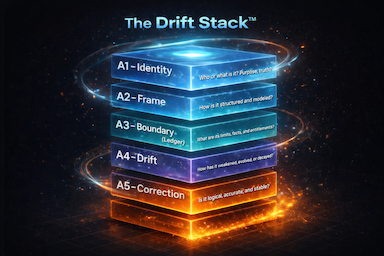
Drift Stack™

Definition

A layered architecture describing how identity, frame, boundary, drift, and correction determine whether an AI system remains coherent.

Architectural Layer

System Architecture

Purpose

Provide a structural model for understanding AI system coherence and failure.

Failure Addressed

AI failure analyzed as isolated model behavior rather than architectural loss of coherence.

What It Does Not Do
  • Describe only model drift
  • Replace implementation-specific controls
  • Assume governance documents enforce themselves
  • Treat the model as the complete system
Related Concepts
IdentityFrameBoundaryDriftCorrection

SAQ™

Definition

The SAMIRAC architecture for evaluating and enforcing whether proposed AI execution remains admissible under current validated conditions.

Architectural Layer

Execution Governance

Purpose

Translate authority, policy, evidence, state, risk, and constraints into an execution decision.

Failure Addressed

AI actions executing without proof that required conditions remain satisfied.

What It Does Not Do
  • Depend on model confidence alone
  • Treat initial approval as permanent
  • Replace business governance
  • Assume observability prevents execution
Related Concepts
AdmissibilityExecution BoundaryCurrent Validated StateConformanceAuthority

Collective Execution Boundary

Definition

A shared execution-control boundary governing the combined action of multiple agents, systems, tools, or delegated actors.

Architectural Layer

Distributed Execution Governance

Purpose

Evaluate the admissibility of combined behavior that no single component controls independently.

Failure Addressed

Individually permissible actions combining into an impermissible collective outcome.

What It Does Not Do
  • Assume each agent is safe because it is individually authorized
  • Treat orchestration as governance
  • Ignore emergent collective behavior
  • Replace agent-specific controls
Related Concepts
Multi-Agent SystemAgent OrchestrationAdmissibilityDelegationShared State

Execution Ledger

Definition

A durable record of the state, evidence, authority, policy, constraints, decision, and outcome associated with an execution event.

Architectural Layer

Evidence & Execution Governance

Purpose

Make execution decisions reconstructable and defensible.

Failure Addressed

Execution decisions that cannot later be explained, audited, or defended.

What It Does Not Do
  • Authorize action by itself
  • Replace current-state validation
  • Prevent unsafe execution
  • Guarantee the integrity of upstream evidence
Related Concepts
ProvenanceEvidenceAdmissibilityAuditTelemetry

Conformance

Definition

Demonstrable alignment between an implemented system and the required architectural, governance, authority, state, evidence, and execution-control specification.

Architectural Layer

Architecture Assurance

Purpose

Establish whether implementation matches the control model it claims to implement.

Failure Addressed

Systems claiming governance without implementing the required controls.

What It Does Not Do
  • Mean that documentation exists
  • Mean that policy was approved
  • Guarantee permanent compliance
  • Replace runtime validation
Related Concepts
SpecificationAdmissibilityControlAuditCertification
Architectural Boundaries

Architectural Distinctions

Many AI governance disagreements are not disagreements at all. They are collisions between concepts operating at different architectural layers.

EvaluationAdmissibility

Evaluation measures performance against defined criteria. Admissibility determines whether an action may execute in the current validated state.

ObservabilityExecution Governance

Observability shows what happened. Execution governance determines what is allowed to happen.

GuardrailFail-Safe

A guardrail constrains behavior. A fail-safe prevents execution when system state crosses a boundary.

Human-in-the-LoopDecision Rights

Human-in-the-loop identifies where a person participates. Decision rights define what that person is authorized and accountable to decide.

AuthenticationAuthorization

Authentication verifies identity. Authorization determines assigned permission.

AuthorizationAdmissibility

Authorization establishes that an actor has permission. Admissibility determines whether the specific action may execute under current conditions.

ProvenanceCurrent Validated State

Provenance explains how the system arrived here. Current validated state governs whether the next action may proceed.

PolicyRuntime Control

Policy defines what should be true. Runtime control prevents execution when required conditions are not true.

Control Coverage

Failure Coverage Matrix

Every control addresses a class of failure. No single control governs the entire system.

CapabilityFailure AddressedDoes Not Address
IdentityIdentity ambiguity, identity conflation, and loss of separation between the human principal and the agent acting on that principal's behalf.Establish authority; Grant permission; Guarantee that an agent remains aligned with its assigned identity; Determine admissibility
FrameSystems reasoning from the wrong operational reality.Authorize execution; Replace governance; Guarantee truth; Prevent drift
Coherence BoundaryUnbounded execution beyond intended operating limits.Guarantee compliance; Correct drift; Replace governance; Determine outcomes
DriftProgressive loss of coherence leading to unreliable or unsafe operation.Explain root cause; Restore alignment; Determine admissibility; Authorize execution
CorrectionPersistent divergence after drift has occurred.Guarantee correctness; Replace governance; Replace validation; Prevent future drift
Data LayerAI systems operating on missing, corrupted, stale, inaccessible, untraceable, or improperly governed data.Determine whether an AI action is admissible; Establish execution authority; Govern agent behavior; Guarantee that valid data produces a valid decision
Model LayerThe need to produce useful probabilistic outputs from complex or unstructured information.Represent the complete AI system; Possess organizational authority; Determine whether an action may execute; Guarantee factual or operational correctness
Agent LayerThe inability of a single model inference to coordinate multi-step work across tools, systems, and changing conditions.Possess authority merely because it can act; Guarantee that the objective is appropriate; Determine admissibility by itself; Replace runtime execution control
Governance LayerAI systems operating without clear accountability, policy, decision rights, authority boundaries, or enforceable governance conditions.Enforce itself automatically at runtime; Determine current system state; Prevent execution unless connected to technical controls; Replace the execution boundary
Runtime LayerActions executing after state, authority, evidence, policy, or operating conditions have become invalid or inadmissible.Reconstruct the complete history of the system; Replace organizational strategy; Guarantee model quality; Assume that prior approval remains valid
Correction LayerSystems continuing to operate from internally reinforced, stale, invalid, or drifted state without an independent mechanism for restoring alignment.Define governance policy; Guarantee that every correction is valid; Eliminate future drift; Replace the need for current-state validation
Artificial Intelligence ModelThe need to interpret complex inputs and produce useful probabilistic outputs.Establish organizational authority; Determine whether execution is permitted; Guarantee factual correctness; Provide governance by itself
Large Language ModelFlexible language interpretation and generation across broad domains.Know whether its output is true; Possess execution authority; Maintain organizational accountability; Determine whether an action is admissible
InferenceThe need to generate an output from information not explicitly programmed as fixed rules.Validate organizational state; Establish decision rights; Guarantee repeatable output; Authorize downstream action
PromptThe need to direct model behavior for a specific inference request.Create durable authority; Guarantee compliance; Prevent state drift; Replace system architecture
HallucinationIdentification of unsupported, fabricated, or insufficiently verified output produced or admitted by the system.Prove that the model alone caused the failure; Identify the precise architectural source of the failure; Describe authority failure; Describe state drift; Describe unsafe execution by itself
ContextModel operation without sufficient situational information.Persist automatically; Establish that the information is true; Guarantee completeness; Create authority
Context WindowThe need to bound and manage the information supplied during inference.Create permanent memory; Preserve complete history; Guarantee the relevance of included information; Validate supplied information
MemoryLoss of information across interactions or workflow boundaries.Guarantee truth; Resolve conflicting memories automatically; Determine relevance by itself; Establish current authority
Retrieval-Augmented GenerationModel generation without access to relevant external information.Guarantee that retrieved information is correct; Resolve authority; Prevent execution against invalid state; Create governance
EmbeddingThe inability of strict keyword matching to recover conceptually related information.Prove semantic equivalence; Validate truth; Establish authority; Determine execution admissibility
AI AgentThe need to perform multi-step work across tools and changing conditions.Possess authority merely because it can act; Guarantee correct planning; Guarantee safe execution; Replace governance
Agentic WorkflowRigid automation that cannot adapt to changing workflow conditions.Guarantee authority; Guarantee admissibility; Guarantee that the workflow objective is appropriate; Eliminate the need for human decision rights
Agent OrchestrationUncoordinated multi-agent behavior and broken workflow dependencies.Determine whether the objective is permissible; Create execution authority; Prevent collusion automatically; Guarantee coherent state across agents
Tool CallingModel isolation from external systems and operational capabilities.Establish permission to use the tool; Guarantee valid parameters; Guarantee that the resulting action is admissible; Provide accountability
Model Context ProtocolFragmented, one-off integration between AI applications and external capabilities.Determine whether a tool should be called; Authorize execution; Validate current state; Replace runtime governance
EvaluationUnknown or unmeasured model and system performance.Authorize execution; Establish authority; Prevent an action from occurring; Guarantee valid current state
ObservabilityInvisible system behavior and failures that cannot be diagnosed.Prevent unsafe execution; Create policy; Authorize action; Correct drift by itself
MonitoringUndetected changes and operating conditions.Stop execution unless connected to a control; Establish authority; Repair drift automatically; Determine admissibility by itself
TelemetryLack of operational evidence.Interpret itself; Authorize execution; Prove that a state is valid; Replace an execution gate
AI GovernanceUnclear accountability, unmanaged risk, and inconsistent organizational control.Automatically enforce itself at runtime; Determine current system state; Prevent execution unless connected to controls; Replace technical architecture
AuthorityActions performed without legitimate decision rights.Guarantee that an action is correct; Guarantee that conditions remain unchanged; Persist automatically after delegation; Replace identity
Decision RightsUnclear ownership and accountability for consequential decisions.Guarantee that the decision is executed correctly; Replace authorization controls; Validate current state; Prevent authority drift by itself
ProvenanceUnknown origin, lineage, and causal history.Authorize the next action; Determine current admissibility; Prevent unsafe execution; Replace current-state validation
EvidenceDecisions and actions unsupported by defensible information.Validate itself; Remain current automatically; Guarantee correct interpretation; Authorize every action derived from it
Current Validated StateExecution based on stale, incomplete, invalid, or internally assumed state.Explain the entire history of the system; Guarantee future state; Replace provenance; Define organizational strategy
External ValidationSystems validating their own assumptions and continuing to execute from stale, fabricated, incomplete, or internally reinforced state.Correct drift by itself; Define governance policy; Guarantee that the external source is current or authoritative; Determine admissibility by itself
Execution BoundaryActions executing without a final runtime control decision.Reconstruct system history; Optimize the business objective; Replace organizational governance; Guarantee the quality of model reasoning
Ledger LayerStateless execution, stale state, untraceable transitions, and divergence between the state a system believes it holds and the state actually governing execution.Determine admissibility by itself; Replace current-state validation; Guarantee that recorded evidence is authoritative; Reconstruct events that were never recorded
AdmissibilityUnsafe, unauthorized, unsupported, or out-of-bound execution.Measure model performance; Explain how the system reached its current state; Predict business success; Replace provenance or audit
Runtime GovernanceGovernance that exists in policy but disappears during execution.Replace policy development; Eliminate the need for evidence; Guarantee model correctness; Explain historical causation by itself
Fail-SafeContinued execution after a critical operating boundary has been crossed.Explain why the condition occurred; Perform root-cause analysis; Replace monitoring; Guarantee service continuity
GuardrailUnconstrained or undesirable model and application behavior.Guarantee enforcement; Determine current validated state; Create execution authority; Replace a fail-safe
Model DriftModel performance degradation over time.Describe every form of system drift; Describe authority loss; Describe invalid workflow state; Describe execution admissibility
Data DriftModels and systems operating on data conditions they were not designed to handle.Determine whether execution should stop; Explain authority failure; Correct the data automatically; Describe every change in system state
State DriftExecution against a state that no longer reflects reality.Describe model performance alone; Explain all historical causes; Correct itself; Establish authority
Identity DriftAgents or actors continuing to operate under substituted, stale, expanded, ambiguous, or misaligned identity.Prove malicious intent; Describe authentication failure alone; Describe authority drift by itself; Correct identity automatically
Frame DriftSystems continuing to interpret evidence and pursue actions within a frame that no longer reflects the governing reality.Describe model drift alone; Establish authority; Correct the operating frame automatically; Determine admissibility by itself
Authority DriftSystems continuing to act under authority that is stale, expanded, inherited, or no longer valid.Describe identity alone; Describe model accuracy; Prove malicious intent; Correct authority automatically
External CorrectionSelf-reinforcing divergence in which a system validates its own incorrect state.Define governance policy; Repair historical provenance; Replace admissibility; Guarantee the external reference is authoritative
IdentityActions that cannot be attributed separately to the human principal and the agent that executed them.Establish permission by itself; Establish decision authority; Prove that an agent remained within its assigned role; Determine whether a specific action is admissible
User IdentityLoss of accountability for who initiated, approved, or benefited from an AI-driven action.Define the identity of the agent performing the work; Automatically transfer all user authority to the agent; Guarantee that the user is authorized for every requested action; Determine execution admissibility
Agent IdentityAgents acting under ambiguous, substituted, stale, expanded, or drifted identity.Inherit all authority of the user automatically; Guarantee that the agent remains aligned with its assigned role; Replace authentication or authorization; Determine admissibility by itself
AuthenticationUnknown or falsely represented identity.Determine what the actor may do; Establish business authority; Guarantee current role alignment; Authorize a specific execution
AuthorizationAccess or operations performed without assigned permission.Guarantee that the action is appropriate now; Establish organizational decision rights; Validate current operating state; Replace admissibility
Least PrivilegeExcessive access and unnecessary operational capability.Determine whether a permitted action is admissible; Validate system state; Prevent all privilege escalation; Define business accountability
Zero TrustImplicit trust granted from location, history, or inherited access.Determine business suitability; Establish execution admissibility automatically; Replace governance; Guarantee coherent system state
Drift Stack™AI failure analyzed as isolated model behavior rather than architectural loss of coherence.Describe only model drift; Replace implementation-specific controls; Assume governance documents enforce themselves; Treat the model as the complete system
SAQ™AI actions executing without proof that required conditions remain satisfied.Depend on model confidence alone; Treat initial approval as permanent; Replace business governance; Assume observability prevents execution
Collective Execution BoundaryIndividually permissible actions combining into an impermissible collective outcome.Assume each agent is safe because it is individually authorized; Treat orchestration as governance; Ignore emergent collective behavior; Replace agent-specific controls
Execution LedgerExecution decisions that cannot later be explained, audited, or defended.Authorize action by itself; Replace current-state validation; Prevent unsafe execution; Guarantee the integrity of upstream evidence
ConformanceSystems claiming governance without implementing the required controls.Mean that documentation exists; Mean that policy was approved; Guarantee permanent compliance; Replace runtime validation

The Model Is Not the System.

Models generate outputs. Agents coordinate work. Retrieval supplies information. Evaluation measures performance. Observability records behavior. Governance defines policy.

Execution control determines what may happen next.

Reliable AI architecture depends upon understanding where each function belongs, where its authority ends, and what remains ungoverned when one control is mistaken for another.