dAIsy Demo 2 · Interpretation Under Ambiguity
Controlled Interpretation Under Real-World Input
The system resolves people, relationships, context, and emotional signals before deciding what is allowed to govern the response.
The model does not react freely to the last input. The architecture controls interpretation before response execution.
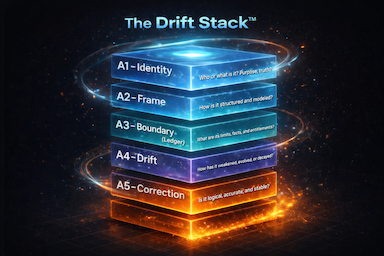
The Drift Stack™
Identity → Frame → Boundary → Drift → Correction
Read This First
Interpretation Control
Does not mean prompt engineering or better instructions.
State
Does not mean memory recall, context stuffing, or prompt history.
Admissibility
Does not mean guardrails, filters, or output cleanup.
This demo shows the system evaluating competing signals before allowing any one signal to govern the response. The model is not reacting freely to the last input. The system decides what is admissible at the conversational boundary.
One Core Engine. Multiple Workflow Agents.
These demonstrations are not only proof that dAIsy can hold a conversation. They are early proof points for a broader architecture: a state-aware, relationship-aware, execution-aware agent engine that can maintain continuity across people, conversations, decisions, roles, tasks, and next actions.
dAIsy began as a personal companion, but the deeper architecture is not limited to companionship. The same core engine can support vertical workflow agents across multiple domains.
Scout
Business intake, routing, scheduling, qualification, and follow-up.
dAIsy Care
Home care, elder care, family coordination, reminders, and check-ins.
dAIsy Workforce
Recruiting, onboarding, scheduling, employee support, and compliance workflows.
dAIsy Concierge
Real estate, wineries, hospitality, bookings, tours, and client follow-up.
dAIsy Ops
Internal workflow assistance for small companies and operating teams.
These are not separate products built from scratch. They are vertical wrappers around the same core architecture.
dAIsy is not just a personal companion. dAIsy is a continuity engine for human workflows.
Demo Video
Watch the system resolve a natural, real-world sentence involving a person, a relationship, a situation, and emotional weight — without drifting, overreacting, or forcing the conversation into an inadmissible path.
Embedded from YouTube for reliable playback, device compatibility, and clean sharing.
What This Demonstrates
- Real-world input handling: the system processes a natural sentence with multiple signals, not a clean command.
- Entity anchoring under ambiguity: Miranda remains the active reference without drift.
- Signal arbitration: person-reference dominates while emotional signal remains secondary.
- Emotional discipline: the system acknowledges tone without escalating or flattening the response.
- Non-forced conversational control: the system does not impose a follow-up when it is not warranted.
- Context preservation: the response remains attached to the correct person and situation.
Why This Matters
Most AI systems react to surface input. When a sentence contains multiple signals — people, situations, and emotion — they either overreact or flatten the meaning.
That is where drift begins.
This system resolves the full conversational state first, determines what matters most, and only then allows a response. It does not guess. It does not overcommit. It governs interpretation before execution.
The Same Core Can Become Different Agents
This demo shows one controlled boundary inside dAIsy Core: controlled interpretation under real-world ambiguity.
But the deeper value is that the same core architecture can be adapted into different workflow agents. The agent may change by domain, but the underlying need stays the same: maintain state, preserve relationship context, control interpretation, and determine what the next appropriate action should be.
Business Intake
Qualify leads, route requests, schedule follow-ups, and preserve context across customer conversations.
Care Coordination
Support reminders, check-ins, family updates, caregiver continuity, and escalation when human attention is needed.
Workforce Support
Assist recruiting, onboarding, scheduling, employee questions, compliance workflows, and handoffs.
Concierge Workflows
Help real estate, hospitality, wineries, events, tours, bookings, and client follow-up operate with continuity.
Internal Operations
Support small teams with task routing, knowledge continuity, status updates, and operational follow-through.
Controlled AI Use
Apply state, relationship, authority, and execution boundaries before AI output or action is trusted.
That is why dAIsy Core is not limited to one product category. It can become the operating core for multiple agents because it is built around continuity, context, state, and controlled execution.
The wrapper changes. The core architecture remains.
Drift Stack™ Perspective
From a Drift Stack™ perspective, this demonstrates controlled interpretation at the conversational boundary under ambiguity.
- Identity remained anchored.
- Reference was preserved under contextual load.
- Signals were correctly weighted and arbitrated.
- Emotion was acknowledged without dominating the turn.
- The system avoided forcing an inadmissible next move.
Control is not just what the system allows — it is what it refuses to force.
IF YOUR SYSTEM CAN TAKE ACTION,
IT MUST CONTROL DRIFT BEFORE EXECUTION
If your system can approve, deny, trigger, flag, recommend, or decide, the real question is not whether it sounds smart. The question is whether its architecture controls what is allowed to become a response before authority is trusted.
Request a Conformance Evaluation →