dAIsy Demo 3 · Governed State Mutation
Controlled Persistence at the Execution Boundary
Writes, corrections, and removals are admitted, confirmed, and only then committed to structured state.
This is not passive memory storage. It is enforced state mutation under explicit authority.
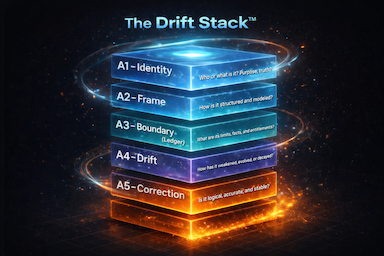
The Drift Stack™
Identity → Frame → Boundary → Drift → Correction
Read This First
Boundary
Not validation rules or formatting checks — this is where execution is allowed or denied.
State
Not passive memory — this is structured, governed system state.
Control
Not the model deciding — the system determines what is admissible.
Watch the panel during the demo. When a relationship is introduced, the system moves to CONFIRM. Nothing has changed yet. Only after explicit authority does it move to COMPLETED.
One Core Engine. Multiple Workflow Agents.
These demonstrations are not only proof that dAIsy can hold a conversation. They are early proof points for a broader architecture: a state-aware, relationship-aware, execution-aware agent engine that can maintain continuity across people, conversations, decisions, roles, tasks, and next actions.
dAIsy began as a personal companion, but the deeper architecture is not limited to companionship. The same core engine can support vertical workflow agents across multiple domains.
Scout
Business intake, routing, scheduling, qualification, and follow-up.
dAIsy Care
Home care, elder care, family coordination, reminders, and check-ins.
dAIsy Workforce
Recruiting, onboarding, scheduling, employee support, and compliance workflows.
dAIsy Concierge
Real estate, wineries, hospitality, bookings, tours, and client follow-up.
dAIsy Ops
Internal workflow assistance for small companies and operating teams.
These are not separate products built from scratch. They are vertical wrappers around the same core architecture.
dAIsy is not just a personal companion. dAIsy is a continuity engine for human workflows.
Demo Video
Watch the execution boundary in action. The system detects a structured write, holds it at CONFIRM, waits for explicit authority, then executes and transitions to COMPLETED.
The panel shows real-time enforcement of admissibility before execution.
What This Demonstrates
- Detection without execution: writes are identified but not committed.
- Explicit authority required: only “yes” admits execution.
- No silent mutation: the system refuses to assume correctness.
- Controlled correction flow: removals are gated the same way as writes.
- Ambiguity is rejected: “maybe” does not carry authority.
- Visible enforcement: CONFIRM → COMPLETED is shown in real time.
Why This Matters
Most systems treat memory as passive storage. They write too easily, overwrite too quickly, and cannot govern correction properly.
That is where drift begins.
This system does not react to input. It enforces admissibility based on system state before any mutation is allowed to occur.
The Same Core Can Become Different Agents
This demo shows one controlled boundary inside dAIsy Core: controlled state mutation before memory is allowed to change.
But the deeper value is that the same core architecture can be adapted into different workflow agents. The agent may change by domain, but the underlying need stays the same: maintain state, preserve relationship context, control interpretation, and determine what the next appropriate action should be.
Business Intake
Qualify leads, route requests, schedule follow-ups, and preserve context across customer conversations.
Care Coordination
Support reminders, check-ins, family updates, caregiver continuity, and escalation when human attention is needed.
Workforce Support
Assist recruiting, onboarding, scheduling, employee questions, compliance workflows, and handoffs.
Concierge Workflows
Help real estate, hospitality, wineries, events, tours, bookings, and client follow-up operate with continuity.
Internal Operations
Support small teams with task routing, knowledge continuity, status updates, and operational follow-through.
Controlled AI Use
Apply state, relationship, authority, and execution boundaries before AI output or action is trusted.
That is why dAIsy Core is not limited to one product category. It can become the operating core for multiple agents because it is built around continuity, context, state, and controlled execution.
The wrapper changes. The core architecture remains.
Drift Stack™ Perspective
- Identity remains stable during mutation.
- State is admitted before execution.
- No silent writes or deletions occur.
- Correction requires explicit authority.
- Execution is governed at the boundary.
If a system can change state without discipline, it can drift itself into corruption.
IF YOUR SYSTEM CAN STORE STATE,
IT MUST CONTROL HOW THAT STATE CHANGES
Memory without governance leads to drift. The question is not whether your system remembers — it is whether it controls what is allowed to become state.
Request a Conformance Evaluation →