DSS-1.0 · Pre-Execution Stability
Drift Substrate Standard
Invariant structure before adaptive execution
DSS-1 defines the structural conditions that must exist before an adaptive system may form authoritative state, propagate consequential change, or receive meaningful execution authority.
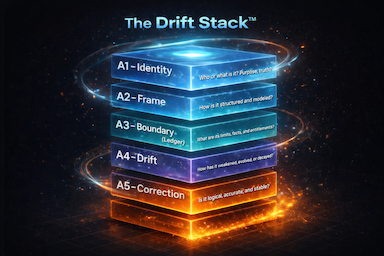
DSS-1 · Structural Substrate
Identity → Frame → Boundary → Drift → Correction
Recommended Architecture Path
DSS-1 — Drift Substrate
This page defines the core failure mode and the invariant substrate required before adaptive execution can be trusted.
This sequence is cumulative. Each layer builds on the one before it.
What DSS-1 Is
DSS-1 defines the architectural substrate that must exist before an adaptive system is trusted with execution authority. It governs the conditions under which state may form, adapt, and propagate into real outcomes. The purpose is not to improve outputs after the fact. The purpose is to prevent invalid trajectories from instantiating in the first place.
Drift is not treated here as a rare anomaly or a cosmetic model issue. It is treated as a foreseeable systems condition. Any system with memory, adaptation, optimization pressure, environmental change, or scaled influence can drift away from its intended function unless its invariants are constrained before execution.
DSS-1 therefore establishes the public doctrine for pre-execution stability: identity must be anchored, decision frame must be declared, boundaries must be explicit, deviation must be detectable, and correction must exist before irreversible authority is permitted to act.
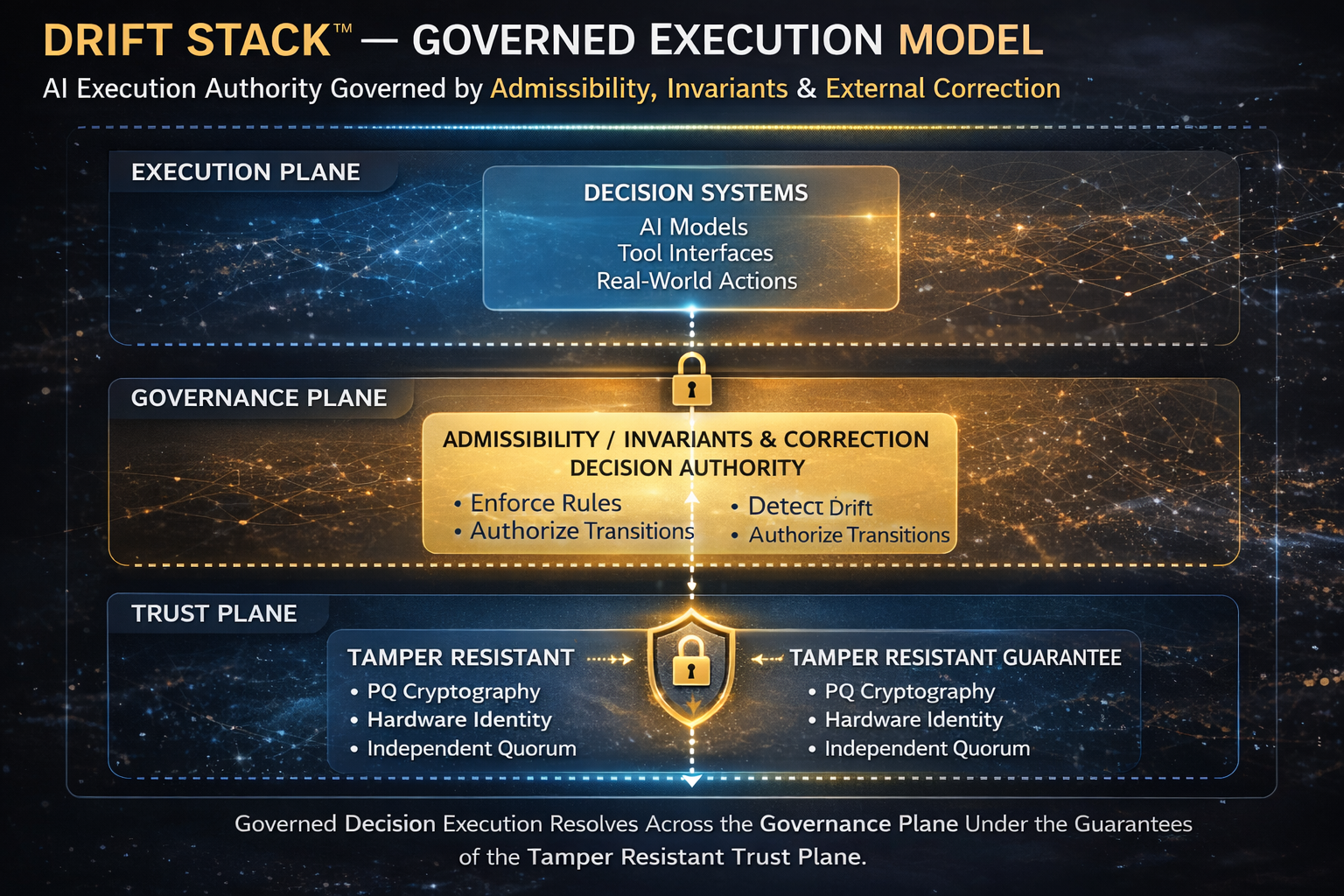
This model shows DSS-1 at the conceptual level: execution authority is governed across a distinct governance plane, under the guarantees of a trust plane, before irreversible action occurs.
What DSS-1 Is Not
DSS-1 is not a policy slogan, a branding layer, or a post-hoc governance narrative. It does not certify outputs, reward self-attestation, or substitute for runtime enforcement. It is a structural standard describing what must be true before execution authority can be considered governable.
- Not a downloadable certification.
- Not post-hoc patching after drift has already propagated.
- Not alignment language without enforceable constraint.
- Not self-awarded compliance or documentation theater.
- Not a vendor-specific implementation recipe.
If a system can proceed without passing its architectural constraints, then those constraints do not meaningfully exist.
Core Invariant Structure
DSS-1 defines the minimum invariant structure required for governed adaptive execution. These layers are not implementation details. They are architectural requirements that must hold continuously under optimization pressure, scale, and environmental change.
- A1 — Identity: the system’s authorized role, scope, and authority must be explicit, persistent, and auditable.
- A2 — Frame: the operating context, declared assumptions, and decision reference model must be stable enough to prevent silent reinterpretation.
- A3 — Boundary: admissible scope, memory limits, and execution permissions must be enforceable rather than implied.
- A4 — Drift Detection: deviation from defined anchors must be measurable before visible harm occurs.
- A5 — Pre-Execution Correction: threshold breach must trigger correction, degradation, escalation, or refusal before irreversible execution continues.
These invariants are interdependent. Weakening any one layer creates a failure vector the others eventually inherit.
Practical Use
DSS-1 is used to evaluate whether a system is architecturally capable of governed execution before stronger runtime conformance claims are made. It asks a simple question: can the system detect, constrain, and refuse invalid authority states before they become operational facts?
- Can identity, scope, and authority be explicitly defined and preserved over time?
- Can the system detect deviation relative to named anchors rather than outcome vibes?
- Are tolerance limits executable, or are they just written down somewhere?
- Can the system degrade, escalate, or halt before irreversible execution continues?
- Does human intervention re-anchor authority, or merely rubber-stamp continuation?
If a system relies on retries, optimism, or recursive correction after state mutation, it is not demonstrating governed execution. It is demonstrating drift tolerance.
Architecture · Evidence · Enforcement · Correction
Conformance must be demonstrated in the operating system.
Review the architecture, evidence, execution controls, and correction behavior required before a consequential AI system can claim conformance.