DSS-2.1 · Runtime Enforcement
Sealed Governance Telemetry
External enforcement before irreversible action
DSS-2.1 defines how runtime governance telemetry is captured, independently checked, and used to constrain execution authority before state mutation becomes irreversible.
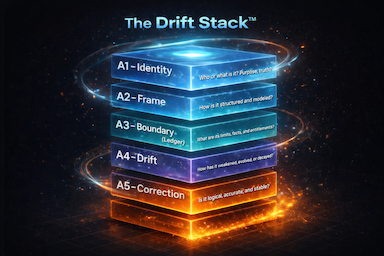
DSS-2.1 · Runtime Enforcement
Identity → Frame → Boundary → Drift → Correction
Recommended Architecture Path
DSS-2 — Governance & Telemetry
This page makes drift visible, measurable, and externally reviewable. Observation is established here, not enforcement.
This sequence is cumulative. Each layer builds on the one before it.
What DSS-2.1 Is
DSS-2.1 is the runtime enforcement standard within the Drift Stack™ family. Where DSS-1 defines the structural conditions required before governed execution becomes possible, DSS-2.1 addresses what must happen when a system is active, making decisions, evaluating scope, and approaching real execution.
The standard is concerned with runtime authority integrity. It asks whether governance signals remain meaningful under pressure, whether execution can be blocked when conditions become inadmissible, and whether compliance claims can be checked from outside the system's own narrative.
- Runtime governance enforcement, not policy description.
- Authority posture that remains checkable during execution.
- Governance signals that are more than advisory noise.
- Structural gating of execution authority before irreversible action.
Layered Governance Model (A0–A4)
DSS-2.1 treats runtime governance as layered rather than generic. The purpose of the layer model is simple: authority, frame, boundary, deviation, and correction must remain distinct enough to be evaluated and enforced before they collapse into vague monitoring.
- A0 — Identity Continuity
- A1 — Declared Frame
- A2 — Boundary Enforcement
- A3 — Drift Detection
- A4 — External Correction Authority
Publicly, that is the important part: governance remains layered so the system cannot blur identity, reinterpret scope, soften boundary conditions, or normalize drift without those shifts becoming visible and actionable.
Why Sealed Telemetry Matters
Governance evidence must survive pressure, incident, and review. If the executing system can revise, normalize, or selectively omit the signals used to justify its own behavior, then governance has collapsed into narration after the fact.
Sealed telemetry matters because governance claims must remain attributable to runtime conditions rather than to post-hoc interpretation. The point is not more logging for its own sake. The point is evidentiary posture that can support real enforcement.
- Runtime signals must be attributable to actual execution conditions.
- Boundary violations must support real blocking, not advisory warnings.
- Observe-only posture is not conformance.
- Governance evidence must remain meaningful under review and dispute.
External Enforcement
DSS-2.1 requires governance to remain more than self-description. That means execution authority cannot be treated as valid merely because the runtime says it is. At a minimum, governance posture must remain capable of independent validation when scope, contradiction, or boundary pressure becomes material.
The public principle is straightforward: a system should not be trusted simply because it can produce a story about its own controls. Governance becomes real only when inadmissible execution can be restricted by something more than the system's own preference.
- Execution authority must remain subject to independent checking.
- Boundary enforcement must matter before state mutation, not after.
- Governance cannot rely on runtime self-attestation alone.
- Conformance requires enforceable posture, not monitoring theater.
Architecture · Evidence · Enforcement · Correction
Conformance must be demonstrated in the operating system.
Review the architecture, evidence, execution controls, and correction behavior required before a consequential AI system can claim conformance.