DSS-3 · Interpretation and Admissibility
Interpretation & Admissibility Control Standard
Signal → Interpretation → Validation → Admissibility → Execution
DSS-3 preserves the required ordering between signal detection, candidate meaning, structural validation, admissibility, and action so inference never acquires authority by default.
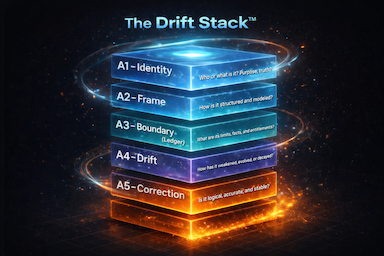
DSS-3 · Meaning Before Action
Identity → Frame → Boundary → Drift → Correction
Recommended Architecture Path
DSS-3 — Admissibility Control
This page defines the control boundary where admissibility is evaluated before execution is allowed to proceed.
This sequence is cumulative. Each layer builds on the one before it.
0. Purpose
DSS-3 governs the ordering by which adaptive systems transform raw signals into executable meaning. It exists to prevent a familiar failure mode: interpretation acquiring authority before it has been structurally challenged.
In many systems, meaning formation and action collapse into the same step. Signals are detected, a likely interpretation is inferred, and the system responds as though that inference were already valid. DSS-3 rejects that collapse.
The standard requires that inferred meaning remain non-authoritative until it has passed through validation and admissibility ordering. Interpretation may inform the system. It may not govern it.
1. Required Ordering
All conforming systems must preserve the following structural sequence:
Signal → Interpretation → Validation → Admissibility → Execution
Each layer has a distinct role.
- Signal: raw observations such as text, emotional cues, references, entities, and contextual indicators.
- Interpretation: candidate meanings produced from those signals.
- Validation: structural challenge against contradiction, ambiguity, current state, and invariant expectations.
- Admissibility: authority resolution determining whether a candidate meaning may influence execution.
- Execution: response, state update, memory write, or tool use.
2. Boundary as Meaning Selection Authority
DSS-3 operationalizes the Boundary layer as more than a list of constraints. Boundary becomes the authority layer that determines which inferred meanings are even allowed to survive into execution.
This is the missing bridge between Frame and action. Frame produces possible interpretations. Boundary decides which of those interpretations may become operative reality.
In conforming systems, boundary is not advisory. It is the structural surface on which meaning selection is enforced.
3. Memory, Contradiction, and Candidate Survival
DSS-3 makes a strict distinction between memory presence and governing truth. A memory artifact, recalled statement, or contextual signal may influence interpretation, but it does not automatically acquire authority.
Memory must pass through the same structure as any other candidate meaning: validation, contradiction handling, and admissibility resolution. This prevents unvalidated recall from silently mutating state or contaminating execution.
Contradiction detection alone is insufficient. Conforming systems must resolve competing meanings, prevent dual truths from propagating simultaneously, and block unresolved contradictions from entering execution.
4. Drift Prevention Function
Without DSS-3 ordering, systems collapse into:
Signal → Interpretation → Execution
That shortcut allows emotion to be treated as truth, ambiguity to become action, and weak inference to propagate into state. Drift accelerates because meaning is never structurally challenged before it acts.
DSS-3 constrains drift earlier. It does not wait for bad outcomes, post-hoc review, or monitoring artifacts. It prevents inadmissible meaning from becoming executable in the first place.
5. Non-Conforming Patterns
- Interpretation treated as authority without structural challenge
- Emotion allowed to override state or invariants
- Memory recall treated as truth without admissibility
- Ambiguity allowed to pass into execution without clarification or deferment
- Confidence or probability substituted for authority resolution
- Monitoring, review, or approval used as a replacement for pre-execution ordering
6. Conformance Condition
A system is conformant under DSS-3 only if interpretation remains explicitly non-authoritative, validation occurs before admissibility, admissibility can block execution when meaning is unresolved, and execution cannot proceed on inferred meaning alone.
In plain terms: the system may interpret first, but it may not act until interpretation has been structurally challenged and admitted.
Implementation Substrate Notice
DSS-3 defines ordering, constraint, and admissibility principles.
Candidate generation mechanics, scoring models, arbitration logic, contradiction weighting, and execution gating algorithms are part of the licensed implementation substrate.
For implementation or integration assistance, request a conformance review.
Architecture · Evidence · Enforcement · Correction
Conformance must be demonstrated in the operating system.
Review the architecture, evidence, execution controls, and correction behavior required before a consequential AI system can claim conformance.