Guided Reading Track · Database-Driven
Governance Track
A guided reading path through AI governance, execution authority, admissibility, liability, runtime control, drift, and state-based correction.
Follow the sections in order for the guided path, or move to the full Reading Spine to browse the complete 137-article corpus by subject.
Structure first. Authority before execution.
What This Track Is
A guided reading path through AI governance, execution authority, admissibility, liability, runtime control, drift, and state-based correction.
5 ordered sections · 24 article placements. The page structure and article order are loaded from the Samirac database.
From Observational Governance to Runtime Control
This sequence moves from policy, review, and audit into the architectural question most governance discussions still avoid: what determines whether execution is allowed before an action occurs?
- Most AI Governance Is Still ObservationalSets the frame: observing, auditing, and explaining after execution is not the same thing as controlling execution.4 min read
- AI Governance Fails Because It Starts One Layer Too LateIf your AI governance strategy starts at accountability, you’re already too late.Explains why governance fails when it begins at policy, accountability, or review instead of architecture.4 min read
- Governance Does Not Control Runtime ExecutionArchitecture and Code are the enforcementClarifies the difference between governance as direction and architecture as enforceable runtime control.5 min read
- Governance That Actually BindsSealed telemetry and external enforcement — because policy without runtime control isn’t governance.Shows why policy without runtime enforcement is documentation, not governance.3 min read
- AI Trust TheaterWhen the Language of Safety Replaces the Architecture of SafetySeparates the language of safety from the architecture required to make safety real.5 min read
Model ≠ System, Liability & Institutional Accountability
This section focuses on the shift from model-centered governance to system-level responsibility. The model may generate output, but the system determines what becomes authoritative, actionable, or consequential.
- The LLM Is Not the SystemWhy Real AI Requires Architecture Above and Around the ModelEstablishes the core distinction between model capability and system architecture.7 min read
- Liability Will Land on the Systemnot the model, not the operatory, the system.Uses recent legal developments to show why responsibility attaches to the operator and architecture, not the model alone.4 min read
- The Real Risk of AI Agents Isn’t Hallucination — It’s Massive Institutional LiabilityThe moment AI agents gain execution authority inside real systems, the problem stops being hallucination and becomes institutional liability.Explains why the risk changes once AI agents are connected to operational systems and delegated authority.11 min read
- When Safety Meets State Power: The Real Governance Problem Behind the Anthropic DisputeAI Safety Is Not the Conflict. Authority Is.Shows why AI safety disputes eventually become authority disputes when state power meets execution constraints.3 min read
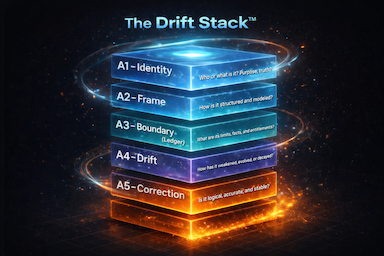
- Where Drift Stack™ Applies — And Where It Doesn’tSeparating learning systems from authority-bearing systems before drift becomes damageSeparates ordinary learning systems from authority-bearing systems where drift can become damage.5 min read
Drift, State Validity & Correction Over Time
This section follows the governance problem after deployment. Once systems act in changing environments, safety depends on valid state, external correction, continuation validity, and drift control.
- The Moment AI Acts, Drift BeginsHow to solve agentic use cases without delegating execution authorityAdds the dynamic systems argument: once authority is granted, action itself introduces drift risk.5 min read
- You Cannot Claim a Safe System Without ThisControl at the boundary. Correction over time. Without both, “safe” is just a story.Completes the control argument: safety requires boundary control and correction over time.5 min read
- You Cannot Correct Drift From Inside Your Own DriftWhy stable systems require external correction, measurable state, and coherent reference boundaries over time.Explains why stable systems require external correction, measurable state, and coherent reference boundaries.7 min read
- The Problem With ChainsAnd the hidden assumption that accompany themShows why sequence integrity is not enough when state can change between approval, commitment, and execution.5 min read
- If You Can’t Measure Identity, You Can’t Govern AuthorityIdentity Is Not a Story — It’s a Stability Condition and it's MeasurableConnects identity stability to authority governance and shows why identity is a measurable stability condition.3 min read