Guided Reading Track · Database-Driven
Structural Thinking Track
Structural cognition, systems architecture, organizational coherence, architectural thinking, divergent cognition, and the kinds of minds that remain valuable in the age of AI.
Follow the sections in order for the guided path, or move to the full Reading Spine to browse the complete 137-article corpus by subject.
Structure first. Authority before execution.
What This Track Is
Structural cognition, systems architecture, organizational coherence, architectural thinking, divergent cognition, and the kinds of minds that remain valuable in the age of AI.
6 ordered sections · 18 article placements. The page structure and article order are loaded from the Samirac database.
Structural Architecture
This section establishes the central claim: real architecture is structural. It is not merely technology selection, documentation, process coordination, or implementation detail.
- Modern IT Architecture: A Structural Organization ModelBuilt for systems that must survive realityExplores why real architecture is fundamentally structural rather than purely procedural or technological.5 min read
- Structure Builds RealityPolicy Defines itExplains why organizations consistently underestimate structural architects and why runtime systems ultimately obey architecture rather than narrative.5 min read
- The Question Nobody Wants To Ask About AIWhy the future may belong to structural thinkers rather than narrative thinkers and larger teamsCenters the architectural question beneath governance, accountability, and policy: how does the system determine what happens next?6 min read
Leadership Without Architecture
This section focuses on what happens when organizations are led through narrative, process, title, or authority without enough structural systems cognition.
- When Leadership Lacks Architectural Competency, Systems FailWhen people who don’t understand the system are the ones deciding how it’s builtExamines what happens when organizational leadership operates without structural systems cognition.5 min read
- Who Remains In The Wake of AI ?Reading the Signal Beneath the NoiseLooks at which forms of cognition and operational capability become more valuable as AI reshapes labor and knowledge work.10 min read
- The Category Mistake at the Top of the AI StackThe stack didn’t change. The responsibility layer is just being ignored.Shows how responsibility gets misplaced when leaders confuse the model layer with the system layer.4 min read
AI Compression & Future Work
AI is compressing procedural labor, repetitive synthesis, informational coordination, and many forms of narrative production. This section asks what remains valuable when those layers become cheap.
- Velocity Is Not a Measure of Competence"Speed has quietly become the stand-in for intelligence."Separates speed from competence and explains why fast output is not the same thing as structural judgment.4 min read
- The Fallacy of Tool-Driven ArchitectureArchitecture doesn’t disappear when tools get easier—it gets ignored.Shows why easier tooling does not eliminate architecture; it often hides the need for it.3 min read
- The Most Expensive Computation Is the One That Should Never Have HappenedThe overlooked relationship between drift, recomputation, and AI energy demandConnects architecture, recomputation, energy demand, and the cost of systems that act before they should.5 min read
Divergent Cognition & Structural Minds
Not everyone sees the same structure at the same depth. These articles explore why some minds detect system-level pattern, drift, and incoherence earlier than others.
- The Ciappa Drift Stack™ — How My “Divergent Thinker” Article Accidentally Proved a Universal Coherence LawConnects divergent cognition, architecture, drift theory, and the emergence of the Drift Stack framework.6 min read
- Welcome to The Synth — Where Cross-Domain Minds Finally Make SenseFrames the publication as a home for cross-domain structural thinkers who see recurring patterns across systems.1 min read
Drift Stack Origin & Coherence Architecture
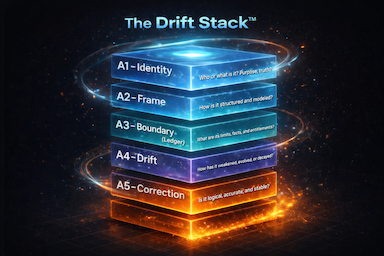
This section connects structural thinking to the emergence of Drift Stack™, coherence architecture, invariants, boundaries, and correction.
- The Drift Stack™ — Why Every Coherent System in Reality Follows the Same 5-Layer ArchitectureSets out the five-layer architecture behind identity, frame, boundary, drift, and correction.4 min read
- What an “Invariant” Really Is(And Why You Can’t Engineer Your Way Around the Wrong One)Explains the structural role of invariants in maintaining coherence across changing systems.4 min read
- The Tiny Mistake That Revealed the Entire Architecture of CoherenceUses a small recognition error to expose the deeper architecture of identity, frame, boundary, drift, and correction.7 min read
- ENGINEERED DRIFTThe human face of educational drift, institutional drift, and ideological drift colliding.Introduces drift as something that can be reinforced, exploited, or structurally produced rather than merely observed.2 min read
Systems Obey Structure
This section brings the track back to its central premise: systems do not ultimately obey narratives, intentions, titles, slogans, or documentation. They obey structure.
- Why Some People Literally Cannot See Permission LayersArchitecture Is Where Authority Actually LivesExplains why some people cannot see permission layers even when the authority problem is directly in front of them.5 min read
- The LLM Is Not the SystemWhy Real AI Requires Architecture Above and Around the ModelApplies the structural distinction to AI: the model generates output, but the surrounding system determines authority and action.7 min read
- Why Ontology, Explainability, and Governance Keep Missing the Same LayerShows why ontology, explainability, and governance keep missing the same structural control layer.4 min read