Vehicle State
A forward camera may be available while parking and unavailable at road speed. The request and user remain the same; operating state changes whether the action is admissible.
Drift · Coherence · Admissibility · External Correction
Systems can remain operational long after they have begun to separate from valid state.
Drift is accumulated deviation without sufficient correction. This reading path explains how it develops, why failure often appears sudden only at the end, and how Drift Stack™ makes the underlying structure visible.
Healthy systems are not systems without drift. They are systems with sufficient correction.
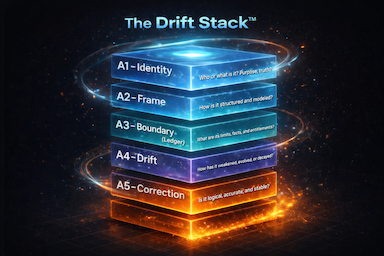
The Drift Stack™
Identity → Frame → Boundary → Drift → Correction
Start with the visible pattern
A system rarely fails all at once.
An engine is not failing only at the moment it seizes. The seizure is the visible end-state of accumulated, uncorrected deviation that has been building underneath the surface for a long time.
The moment an engine turns over, wear begins. Friction exists. Heat exists. Oil degrades. Tiny particles shave off surfaces. Tolerances shift at microscopic levels. None of that means the engine is broken.
In fact, it may run beautifully for years while all of that is happening.
That is drift.
Correction is what keeps the system alive. You change the oil, replace filters, maintain lubrication, monitor temperature, and correct timing before misfires become destructive.
Every maintenance action is an external correction layer acting against inevitable drift.
AI systems behave much the same way structurally. Instead of metal shavings, worn bearings, weakening springs, and degraded oil, drift accumulates inside the informational state of the system itself.
Assumptions become distorted. Context becomes stale. Relationships become misweighted. Memory becomes inconsistent. Internal representations slowly separate from external reality.
Nothing appears broken at first. The system still runs, and the outputs may still sound coherent. Beneath the surface, though, small deviations can continue accumulating until the system is no longer operating from valid state.
Healthy systems are not systems without drift. Healthy systems are systems with continuous correction.
Different substrate, same geometry
The easiest way to understand drift is not to begin with AI. It is to look at systems people already trust.
A forward camera may be available while parking and unavailable at road speed. The request and user remain the same; operating state changes whether the action is admissible.
Landing gear, flaps, thrust, and control surfaces are governed by phase of flight, configuration, and safety envelopes—not merely by whether the component can move.
A web break may look sudden even though tension, moisture, speed, alignment, and material behavior were drifting out of tolerance long before the visible failure.
Pressure, flow, temperature, valve position, and sensor agreement must be compared continuously against acceptable state before drift becomes rupture, leak, or shutdown.
Measurement alone creates little value. The system must compare current conditions against safe operating ranges and escalate when evidence crosses a meaningful threshold.
The same request may become inadmissible as identity, authority, context, evidence, policy, or external reality changes during execution.
State changes. Validity changes. Correction determines whether drift remains manageable or becomes collapse.
The Drift Explained reading path
This is the entry point for readers trying to understand the core pattern: systems drift when current state slowly separates from the assumptions, references, boundaries, and correction mechanisms that once made them coherent.
The dangerous part is that advanced drift can remain internally coherent while instability accumulates beneath the surface. Collapse frequently appears sudden. The drift was not.
For the complete organized library, continue to the Organized Corpus.
Browse the drift corpus
Jump directly to any section. Each section includes a return link because this page is intentionally comprehensive.
Start with the plain-English frame. Drift is not sudden failure. It is accumulated deviation without sufficient correction.
The simplest introduction to drift and why it matters.
Explains why every closed system drifts unless something detects and corrects it.
Shows the same pattern appearing across bodies, markets, AI, and institutions.
A plain story showing why collapse appears sudden only at the end.
Frames the difference between visible symptoms and root structure.
The architectural foundation: coherence, identity, frame, boundary, ledger, drift, correction, invariants, and falsifiability.
A clean orientation point for Drift Stack™ and Coherence Architecture.
Explains why coherent systems follow the same layered architecture across domains.
The fuller architectural version of Drift Stack™ and its stability logic.
Frames Drift Stack™ as a testable architecture, not a slogan.
Defines invariants as conditions that must hold for a system to remain coherent.
Connects drift, collapse, and correction into the broader reality-stack frame.
This is where drift becomes operational: when state changes, what determines whether a previously valid action remains admissible?
Explains why stable systems require external correction and measurable reference state.
Separates preventing an invalid action from correcting drift over time.
Separates ordinary learning systems from authority-bearing systems where drift can become damage.
Places Drift Stack™ in context for readers who need the broader control architecture.
Explains why drift is not uniform and why architecture must reflect different drift classes.
Uses compression and optimization to show why zero drift is not the right target.
These articles connect drift to AI memory, hallucination, self-verification, recomputation, runtime instability, and execution risk.
Frames hallucination as a symptom of deeper drift rather than the disease itself.
Uses dAIsy as a concrete example of memory drift and correction.
Explains why a model attempting to verify itself from inside itself remains structurally exposed.
Shows why drift cannot simply be trained away and must be architected around.
Explores why correction determines whether systems recover or keep drifting.
Shows why execution authority introduces drift risk the moment action becomes possible.
Connects agentic systems to institutional liability once execution authority exists.
Connects architecture, avoided recomputation, and lower AI energy demand.
Frames the most expensive computation as the one a better architecture would never have allowed.
Different substrate, same geometry. These articles show drift, boundary, correction, and collapse across industry, economics, epidemiology, culture, and institutions.
Shows how manufacturing has been describing drift without naming the architecture.
Extends manufacturing drift into industrial control and firewall logic.
Uses disease spread as a structural proof of drift, boundary, and correction.
Shows collapse geometry appearing even inside economics.
Uses power and constraint to show why stability requires limits.
Shows cultural drift through the replacement of meaning and anchors.
These pieces show drift at larger scale: nations, education, media, civic anchors, institutional authority, and social formation.
Shows collapse as a recurring sequence rather than a random event.
Explains American institutional decline through drift instead of personalities or outrage.
Reframes American fracture as drift against shared anchors rather than simple separation.
Maps how educational, institutional, corporate, and AI drift compound over time.
Tracks one upstream channel where institutional drift took hold.
Shows how journalism can drift when upstream formation rewires interpretation.
Applies Drift Stack™ to adolescent mental health and developmental formation.
Shows drift reinforced by incentives, structures, and institutional design choices.
These pieces extend drift into boundary collapse, ledger state, possibility, commitment, consciousness, and reality formation.
Explains why judgment collapses when boundaries collapse.
Explains the ledger layer as the place where possibility becomes committed reality.
Extends the ledger concept into consciousness, decoherence, and reality formation.
Explores the boundary between possibility and committed reality.
Extends the same architectural principle into spacetime as a thought model.
Connects consciousness, AI, and physics through the same drift architecture.
These pieces connect drift to human cognition, identity, language, judgment, ideology, and cross-domain pattern recognition.
Defines how to evaluate whether a framework is structurally sound.
Shows how a small recognition error exposed the deeper mechanics of coherence.
Explores the worldview that protects and propagates drift rather than correcting it.
A human-scale example of drift, memory, and cultural correction.
Shows how cross-domain thinking exposed the recurring structure of drift.
Connects cross-disciplinary thinking to the next wave of AI architecture.
The recurring structure
Drift rarely begins as visible collapse. It begins as small deviations, proxy optimizations, inherited assumptions, authority leakage, frame instability, and systems validating against already-drifting internal state.
Most systems appear operationally coherent long after instability has begun propagating internally.
The central question is whether a system remains coherently admissible as state changes—and whether sufficiently stable external correction exists to detect drift before collapse becomes normalized internally.
Drift → Correction → Readiness → Governed Execution
The articles in this path explain drift, correction, coherence, runtime instability, and collapse. AI RADAR™ helps determine where an organization is ready, where execution authority remains unclear, and what should happen before deployment accelerates.