
Structural Thinking Track
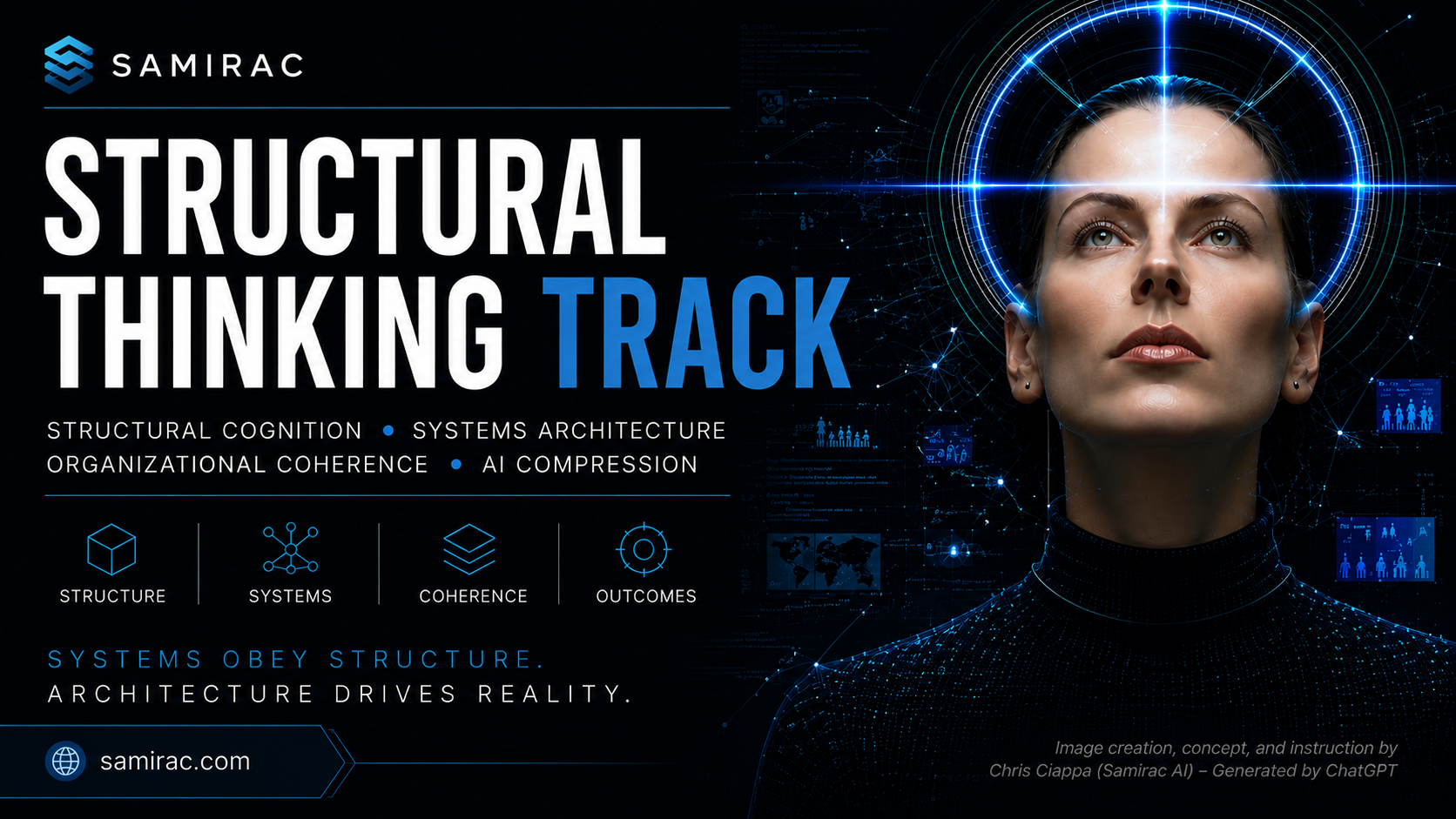
Structural cognition, systems architecture, organizational coherence, architectural thinking, divergent cognition, and the kinds of minds that remain valuable in the age of AI.
What This Track Is
This track explores a recurring pattern appearing across technology, leadership, AI, enterprise architecture, and organizational behavior: systems eventually obey structure, not narrative.
The articles in this sequence focus on structural thinking, architectural cognition, organizational coherence, systems-level reasoning, and the growing divide between procedural labor and the kinds of minds capable of reconciling complex systems under changing conditions.
As AI increasingly compresses repetitive synthesis work, procedural coordination, informational abstraction, and narrative production, structural thinking becomes more important — not less.
This track is intended for:
- architects
- systems thinkers
- technical leaders
- operators
- organizational designers
- AI strategists
- leaders trying to understand why execution keeps drifting away from intent
- and people attempting to understand what kinds of cognition remain durable as AI evolves
If you want the broader structured corpus, begin with the Reading Spine.
If you want the governance and execution-authority path, use the Governance Track.
Structural Architecture
This section establishes the central claim: real architecture is structural. It is not merely technology selection, documentation, process coordination, or implementation detail.
- Modern IT Architecture: A Structural Organization ModelExplores why real architecture is fundamentally structural rather than purely procedural or technological.
- Structure Builds RealityExplains why organizations consistently underestimate structural architects and why runtime systems ultimately obey architecture rather than narrative.
- The Question Nobody Wants To Ask About AICenters the architectural question beneath governance, accountability, and policy: how does the system determine what happens next?
Leadership Without Architecture
This section focuses on what happens when organizations are led through narrative, process, title, or authority without enough structural systems cognition.
- When Leadership Lacks Architectural Competency, Systems FailExamines what happens when organizational leadership operates without structural systems cognition.
- Who Remains In The Wake of AI ?Looks at which forms of cognition and operational capability become more valuable as AI reshapes labor and knowledge work.
- The Category Mistake at the Top of the AI StackShows how responsibility gets misplaced when leaders confuse the model layer with the system layer.
AI Compression & Future Work
AI is compressing procedural labor, repetitive synthesis, informational coordination, and many forms of narrative production. This section asks what remains valuable when those layers become cheap.
- Velocity Is Not a Measure of CompetenceSeparates speed from competence and explains why fast output is not the same thing as structural judgment.
- The Fallacy of Tool-Driven ArchitectureShows why easier tooling does not eliminate architecture; it often hides the need for it.
- The Most Expensive Computation Is the One That Should Never Have HappenedConnects architecture, recomputation, energy demand, and the cost of systems that act before they should.
Divergent Cognition & Structural Minds
Not everyone sees the same structure at the same depth. These articles explore why some minds detect system-level pattern, drift, and incoherence earlier than others.
- The Ciappa Drift Stack™ — How My “Divergent Thinker” Article Accidentally Proved a Universal Coherence LawConnects divergent cognition, architecture, drift theory, and the emergence of the Drift Stack framework.
- Welcome to The Synth — Where Cross-Domain Minds Finally Make SenseFrames the publication as a home for cross-domain structural thinkers who see recurring patterns across systems.
Drift Stack Origin & Coherence Architecture
This section connects structural thinking to the emergence of Drift Stack™, coherence architecture, invariants, boundaries, and correction.
- The Drift Stack™ — Why Every Coherent System in Reality Follows the Same 5-Layer ArchitectureSets out the five-layer architecture behind identity, frame, boundary, drift, and correction.
- What an “Invariant” Really IsExplains the structural role of invariants in maintaining coherence across changing systems.
- The Tiny Mistake That Revealed the Entire Architecture of CoherenceUses a small recognition error to expose the deeper architecture of identity, frame, boundary, drift, and correction.
- ENGINEERED DRIFTIntroduces drift as something that can be reinforced, exploited, or structurally produced rather than merely observed.
Systems Obey Structure
This section brings the track back to its central premise: systems do not ultimately obey narratives, intentions, titles, slogans, or documentation. They obey structure.
- Why Some People Literally Cannot See Permission LayersExplains why some people cannot see permission layers even when the authority problem is directly in front of them.
- The LLM Is Not the SystemApplies the structural distinction to AI: the model generates output, but the surrounding system determines authority and action.
- Why Ontology, Explainability, and Governance Keep Missing the Same LayerShows why ontology, explainability, and governance keep missing the same structural control layer.
The Throughline
Structure is what survives when narrative collapses. Systems do not remain coherent because people mean well, document intentions, or assign impressive titles. They remain coherent when identity, frame, boundary, authority, and correction are designed into the operating architecture. That is why structural thinking becomes more valuable as AI compresses procedural work: someone still has to see the system behind the system.
Ready to Move Beyond Reading?
The articles in this track explain the architecture, failure modes, governance considerations, and operational realities of AI systems.
Organizations evaluating deployment readiness may also find the AI RADAR™ framework useful. It focuses on identifying the lowest-risk, highest-value AI opportunities and determining what should happen next.
Learn More About AI RADAR™ →