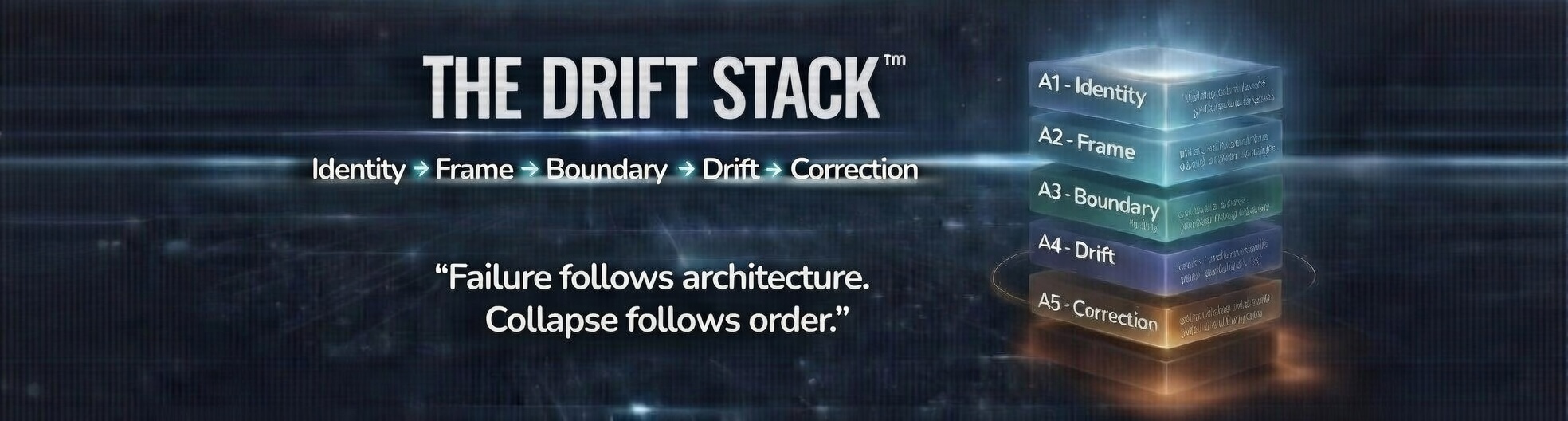
What Is Drift?
A structured reading track explaining Drift Stack™, coherence collapse, admissibility, external correction, operational instability, and the architecture of longitudinal drift across AI systems, institutions, organizations, and civilization-scale systems.
Drift, Plainly Explained
A system rarely fails all at once.
An engine is not failing only at the moment it seizes. The seizure is simply the visible end-state of accumulated, uncorrected deviation that has been building underneath the surface for a long time.
The moment an engine turns over, wear begins. Friction exists. Heat exists. Oil degrades. Tiny particles shave off surfaces. Tolerances shift at microscopic levels. None of that means the engine is broken.
In fact, it may run beautifully for years while all of that is happening.
That is drift.
Correction is what keeps the system alive. You change the oil. You replace filters. You maintain lubrication. You monitor temperature. You correct timing before misfires become destructive.
Every maintenance action is an external correction layer acting against inevitable drift.
AI systems behave much the same way structurally. Instead of metal shavings, worn bearings, weakening springs, and degraded oil, the drift accumulates inside the informational state of the system itself.
Assumptions become slightly distorted. Context becomes stale. Relationships become misweighted. Memory becomes inconsistent. Internal representations slowly separate from external reality.
Nothing appears broken at first. The system still runs. The outputs still sound coherent.
But underneath the surface, tiny deviations continue accumulating until the system is no longer operating from valid state, even though it still appears functional from the outside.
Healthy systems are not systems without drift. Healthy systems are systems with continuous correction.
That is why drift matters in AI architecture. A system can continue producing apparently coherent outputs while its internal state slowly separates from the conditions that originally made it trustworthy.
What This Track Explores
Drift is not merely error.
Drift is the gradual divergence between operational reality and the assumptions, frames, boundaries, authority conditions, or coherence structures under which systems were originally allowed to operate.
The dangerous part is that sufficiently advanced drift often remains internally coherent while instability quietly accumulates beneath the surface.
Collapse frequently appears sudden.
The drift was not.
This track explores:
- Drift Stack™ architecture
- external correction
- identity, frame, boundary, and ledger drift
- coherence collapse
- admissibility at the execution boundary
- operational instability in AI systems
- institutional and organizational drift
- why internally coherent systems can still collapse
These articles are organized by top-level category and are intended to make the larger corpus easier to navigate without repeating the same article inside the page.
If you want the full organized corpus, begin with the Reading Spine.
Start Here — Drift in Plain English
This opening sequence gives readers the basic frame: drift is not sudden failure. It is accumulated deviation without sufficient correction.
- What Is Drift?Introduces drift as the simple mechanism behind instability across systems.
- The Drift Problem (In Plain English)Explains why every closed system drifts unless something detects and corrects it.
- The Drift Problem: The Hidden Pattern Behind System FailureShows the same drift pattern appearing across bodies, markets, AI, and institutions.
Core Drift Stack™ Architecture
These pieces define the underlying architecture: identity, frame, boundary, ledger, drift, correction, invariants, and falsifiability.
- THE REALITY STACK MANIFESTOEstablishes the layered view of coherence, collapse, and restoration.
- The Drift Stack™ — Why Every Coherent System in Reality Follows the Same 5-Layer ArchitectureExplains why coherent systems follow the same layered architecture across domains.
- The Drift Stack™ — Architecture v2.0The fuller architectural version of Drift Stack™ and its stability logic.
- THE DRIFT STACK IS FALSIFIABLEFrames Drift Stack™ as a testable architecture, not a slogan.
- What an “Invariant” Really IsDefines invariants as conditions that must hold for a system to remain coherent.
- The Tiny Mistake That Revealed the Entire Architecture of CoherenceShows how a small recognition error exposed the deeper mechanics of coherence.
- ENGINEERED DRIFTIntroduces drift as something that can be reinforced by incentives, structures, and design choices.
External Correction & Longitudinal Stability
Healthy systems are not systems without drift. Healthy systems have correction strong enough to keep state, identity, frame, and boundary aligned over time.
- You Cannot Correct Drift From Inside Your Own DriftExplains why stable systems require external correction and measurable reference state.
- Where the Drift Stack™ FitsPlaces Drift Stack™ in context for readers who need the broader control architecture.
- Where Drift Stack™ Applies — And Where It Doesn’tSeparates ordinary learning systems from authority-bearing systems where drift can become damage.
- Drift Is Not Uniform — And Now the Architecture Reflects ThatExplains why drift is not uniform and why architecture must reflect different drift classes.
- The ZIP Analogy (“Zero Drift” Is a Myth)Uses compression and optimization to explain why zero drift is not the right target.
- The One System That Can Snap Back - (Part 5)Explores the exception that reveals why correction matters to stability.
AI Drift, Memory & Compute Waste
These articles move from drift as a universal structure into AI-specific failure modes: hallucination, memory instability, recomputation, and correction costs.
- Hallucinations Are a Symptom — Drift Is the DiseaseFrames hallucination as a symptom of deeper drift rather than the disease itself.
- When AI “Remembers” Incorrectly — And Then Fixes ItselfUses dAIsy as a concrete example of memory drift and correction.
- Why AI Remembers Incorrectly And Then Fixes Itself - (Part 2)Explains why a model attempting to verify itself from inside itself remains structurally exposed.
- How to Build an AI That Doesn’t Permanently Drift - (Part 3)Shows why drift cannot simply be trained away and must be architected around.
- Architecture vs. Compute — How the Drift Stack Solves AI’s Energy CrisisConnects architecture to avoided recomputation and lower AI energy demand.
- The Most Expensive Computation Is the One That Should Never Have HappenedFrames the most expensive computation as the one a better architecture would never have allowed.
Ledger, Possibility & Reality
This section focuses on the point where possibility becomes commitment, memory becomes binding, and drift becomes harder to reverse.
- THE LEDGER LAYER: Where Possibility Becomes RealityExplains the ledger layer as the place where possibility becomes reality.
- THE LEDGER LAYER THEORY OF CONSCIOUSNESSExtends the ledger concept into consciousness, decoherence, and reality formation.
- The Drift That Runs the Universe — Why Consciousness, AI, and Warp Bubbles All Obey the Same LawConnects consciousness, AI, and physics through the same drift architecture.
- The Border Between Quantum Possibility and This RealityExplores the boundary between possibility and committed reality.
- The Spacetime Bubble Model - (Part 4)Extends the same architectural principle into spacetime as a thought model.
Institutional & Civilizational Drift
These pieces show drift operating above the individual system: inside nations, education, media, culture, and institutional authority.
- Civilizations Don’t Collapse RandomlyShows collapse as a recurring sequence rather than a random event.
- Collapse Ain’t SuddenMakes the same point in plain story form: collapse looks sudden only at the end.
- Drift, Not Divorce: Measuring America’s Drift Against Its Own AnchorsReframes American fracture as drift against shared anchors rather than simple separation.
- America’s Drift Engine: How 30 Years of Ideological Capture Broke Education, Corporations, and Now AIMaps how educational, institutional, corporate, and AI drift compound over time.
- How America’s Educational Drift Began: The Quiet Capture of the Teacher PipelineTracks one upstream channel where institutional drift took hold.
- Media Drift: How Upstream Ideology Rewired Journalism and Led to Enforcement CultureShows how journalism can drift when upstream formation rewires interpretation.
- The Drift Stack Behind the Adolescent Mental Health CrisisApplies Drift Stack™ to adolescent mental health and developmental formation.
Cross-Domain Proofs
Different substrate, same geometry. These pieces show Drift Stack™ logic appearing across power, culture, manufacturing, epidemiology, and economics.
- Why Lord Acton Still Matters: Constraint Is the Price of StabilityUses Lord Acton to show why constraint is the price of stability.
- The Drift of ChristmasShows cultural drift through the replacement of meaning and anchors.
- Manufacturing Has Been Describing Drift for 60 Years — They Just Didn’t Know ItShows how manufacturing has been describing drift without naming the architecture.
- The Manufacturing Drift Stack (Part 2): From Failure Mechanism to Industrial FirewallExtends manufacturing drift into industrial control and firewall logic.
- Epidemiology and the Drift Stack — Why Disease Spread Follows the Same 5-Stage Collapse LawUses disease spread as a structural proof of drift, boundary, and correction.
- The Five Stages of Collapse Are the Same Everywhere — Even Economics Accidentally Matches the Drift StackShows collapse geometry appearing even inside economics.
Human Identity, Frame & Culture
Drift is not only technical or institutional. It also appears inside identity, judgment, language, relationships, and meaning.
- When Boundaries Collapse, So Does JudgmentExplains why judgment collapses when boundaries collapse.
- When a person’s identity comes almost entirely from their tribe, something begins to break.Shows how identity becomes fragile when it depends almost entirely on tribe.
- Wednesday Morning Coffee — and a Lesson in DriftA human-scale example of drift, memory, and cultural correction.
- Fractals in Markets… and Fractals in LanguageConnects market structure, language, and recurring patterns of drift.
- The Ideology of DriftExplores the worldview that protects and propagates drift rather than correcting it.
The Throughline
Drift rarely begins as visible collapse.
It begins as small deviations, proxy optimizations, inherited assumptions, authority leakage, frame instability, and systems validating against already-drifting internal state over time.
Most systems appear operationally coherent long after instability has already begun propagating internally.
The central question is no longer simply whether systems can act — but whether they remain coherently admissible over time, and whether sufficiently stable external correction exists to detect drift before collapse becomes normalized internally.
Ready to Move Beyond Reading?
The articles in this track explain drift, correction, coherence, system instability, and the architecture behind collapse across AI, institutions, organizations, and human systems.
Organizations evaluating deployment readiness may also find the AI RADAR™ framework useful. While the AI Lifecycle Maturity Model™ helps explain where an organization is, AI RADAR™ focuses on determining what should happen next.
Learn More About AI RADAR™ →